Overview
The interstellar comet 3I/ATLAS (C/2025 N1) has become the focus of a coordinated global effort as it exits the solar system after a brief but data‑rich passage. First reported to the Minor Planet Center on 1 July 2025 by the ATLAS survey telescope in Chile, the object is only the third confirmed visitor from another star system, following ‘Oumuamua (2017) and 2I/Borisov (2019). NASA’s trajectory analysis shows a hyperbolic orbit that carried the comet to perihelion on 30 October 2025 at 1.4 AU, with a closest Earth approach on 19 December 2025 of 1.8 AU—well beyond any impact risk. While the public’s curiosity often veers toward speculation, scientists emphasize that 3I/ATLAS is a natural laboratory, offering a rare chance to compare the composition and physics of icy bodies formed around distant stars with those of our own system.
Technosignature Search with the Green Bank Telescope
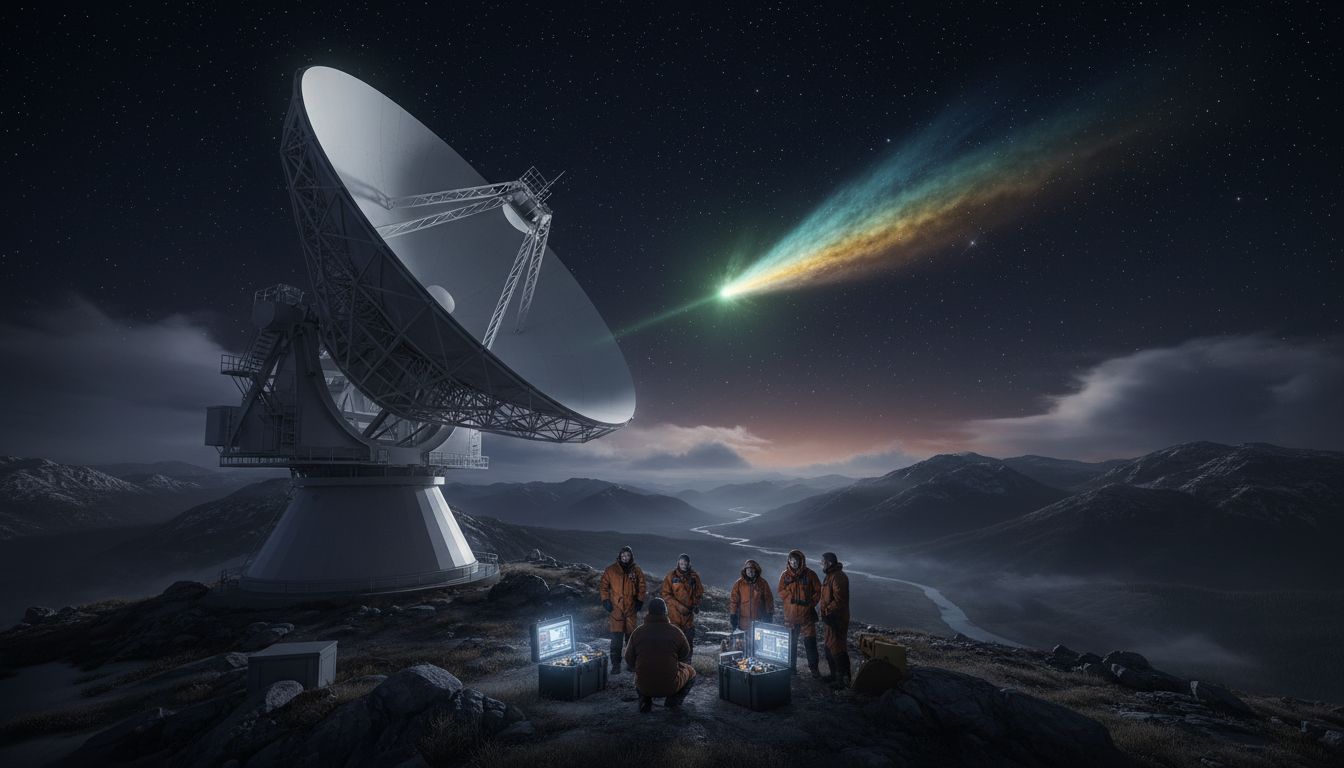
In parallel with traditional cometary studies, the Breakthrough Listen team employed the 100‑meter Green Bank Telescope (GBT) to conduct a comprehensive technosignature survey of 3I/ATLAS across the 1–12 GHz radio band. The campaign, spanning several weeks in late 2025, aimed to detect any narrow‑band or pulsed emissions that could indicate artificial origin, a standard protocol when an interstellar object passes through the inner solar system. Lead researcher Dr. Sara Kumar noted, “We treat every interstellar visitor as a potential carrier of technology, however unlikely, and the GBT provides the sensitivity needed to test that hypothesis.” The analysis, released in a joint NASA‑Breakthrough Listen briefing, found no evidence of artificial radio signals, reinforcing the consensus that the comet is a natural object. The null result also demonstrates the effectiveness of rapid-response SETI observations, setting a benchmark for future interstellar encounters.
Rare Anti‑Tail Phenomenon
Perhaps the most striking feature observed in 3I/ATLAS is its sun‑facing “anti‑tail,” a bright dust structure extending roughly 1 million km toward the Sun—counter to the typical ion tail that points away due to solar wind pressure. Space.com highlighted the anti‑tail’s visibility during December 2025, when Earth’s viewing geometry aligned the comet’s dust sheet edge‑on. Observations from the Two‑meter Twin Telescope at Teide Observatory in Tenerife captured jet‑like filaments within the anti‑tail, wobbling with a precise 7‑hour‑45‑minute cycle. This periodicity indicates a nucleus rotation period of about 15.5 hours, shorter than earlier estimates and suggesting localized active regions on the comet’s surface that release gas and dust as they rotate into sunlight. The Instituto de Astrofísica de Canarias (IAC) remarked, “Seeing such well‑defined jets on an interstellar comet confirms that the basic physics of outgassing is universal, even for material forged around another star.”
Scientific Implications
The anti‑tail and rotating jets provide a unique window into the material properties and structural integrity of an object formed in a different planetary system. By comparing the dust grain size distribution, composition, and outgassing rates of 3I/ATLAS with those of solar‑system comets, researchers can test models of planetary formation across the galaxy. Early spectroscopic data indicate the presence of water‑ice, carbon monoxide, and complex organics, mirroring the volatile inventory of comets like 2I/Borisov but with subtle differences in relative abundances. Such nuances may reflect variations in the natal protoplanetary disk’s temperature and chemistry, offering clues about the diversity of planetary systems. Moreover, the lack of technosignatures, while expected, helps refine the parameters for future SETI searches, emphasizing the importance of rapid, broadband coverage for transient interstellar objects.
Next Steps and Ongoing Monitoring
Although 3I/ATLAS is now on an outbound trajectory, its dust tail and anti‑tail will continue to evolve as solar radiation diminishes, providing a natural experiment in cometary aging. The European Space Agency (ESA) and NASA have scheduled additional observations with the James Webb Space Telescope and ground‑based infrared facilities to track changes in volatile release and dust morphology over the coming months. Meanwhile, the Breakthrough Listen consortium plans to archive the GBT data for re‑analysis with emerging machine‑learning techniques that could uncover faint, broadband signatures missed in the initial sweep. As Dr. Kumar concluded, “Each interstellar visitor expands our baseline of what is possible; 3I/ATLAS has already taught us that ‘normal’ comet physics applies far beyond our own system, and we will continue to learn from its fading wake.”