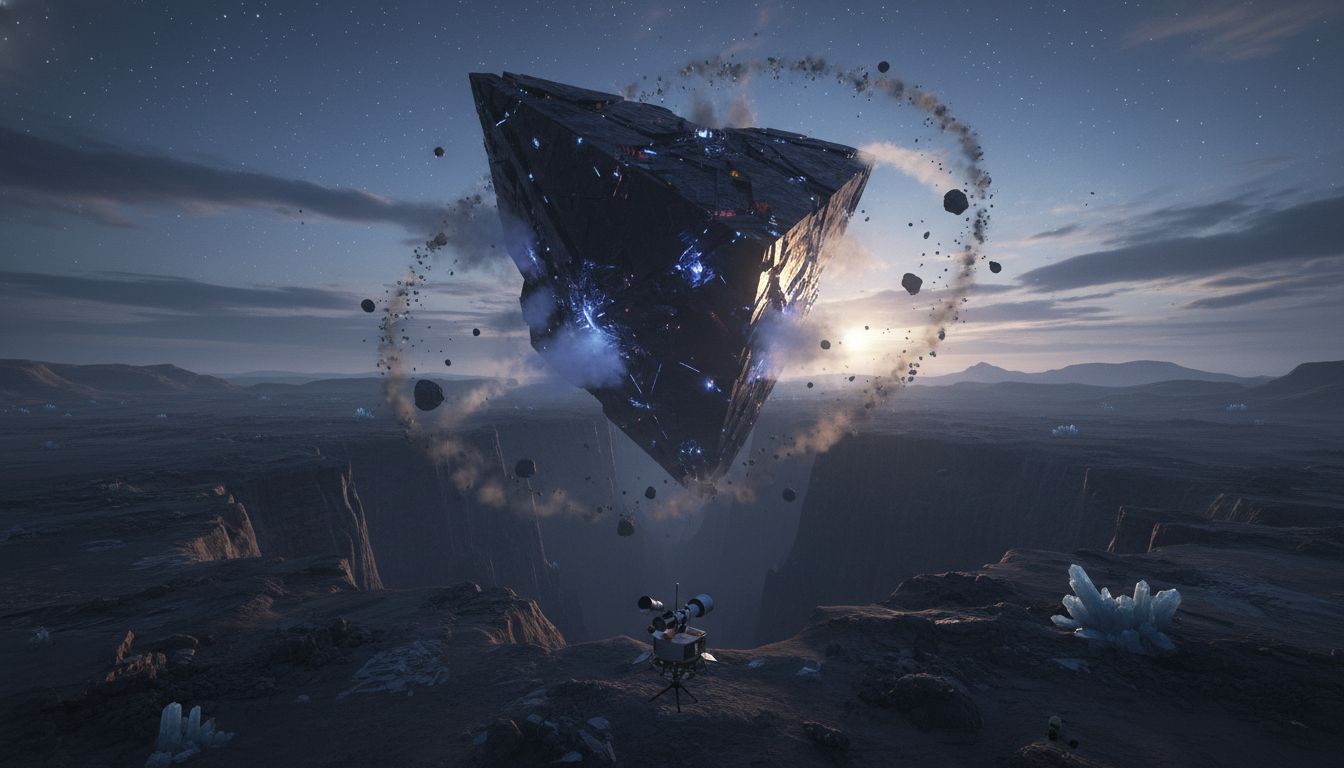
Overview – A Rare Interstellar Visitor Returns to the Spotlight
On 14 November 2025 the interstellar comet 3I/ATLAS re‑emerged in the news cycle after a quiet few weeks following its perihelion passage on 30 October. Discovered by the ATLAS survey in Chile on 1 July, the object is only the third known visitor from beyond the Sun’s gravitational reach. Its hyperbolic trajectory guarantees it will never return, and its current distance of roughly 1.9 AU places it well beyond any impact threat. While the public imagination has been stirred by speculative articles linking the comet to “alien motherships,” the scientific community is focused on new orbital refinements, fresh spectral data, and the practical details of how amateur astronomers can catch a glimpse of this enigmatic wanderer.
ESA Sharpens the Trajectory with Mars‑Based Measurements
The European Space Agency announced a ten‑fold improvement in the predicted orbit of 3I/ATLAS, thanks to astrometric data collected by the ExoMars Trace Gas Orbiter (TGO) between 1 – 7 October. By measuring the comet’s apparent motion against background stars from Mars orbit, ESA reduced the positional uncertainty from several hundred thousand kilometres to under 30 000 km for the period through December. “The TGO’s geometry gives us a unique parallax view that ground‑based telescopes simply cannot match,” explained ESA planetary‑defence scientist Dr. Lina Martínez. The refined ephemeris will aid both professional observatories and hobbyists in planning safe, high‑resolution imaging campaigns as the comet drifts toward a favorable pre‑dawn window for northern‑hemisphere observers.
Fresh Optical and Infrared Spectra Reveal an Unusual Chemistry
A coordinated campaign involving the Very Large Telescope, the NASA Infrared Telescope Facility and the ESA Herschel‑like space observatory produced the first high‑resolution optical/IR portrait of 3I/ATLAS. The spectra show a surprisingly high abundance of nickel and a dominant carbon‑dioxide outgassing component, while typical cometary carbon‑chain molecules such as C₂ and CN are markedly depleted. “The chemistry points to a parent body that formed in a very different protoplanetary environment, possibly around a metal‑rich star,” noted planetary scientist Dr. David Jewitt of the University of Hawaii. Complementary measurements of the dust continuum indicate a deeply reddened, heavily processed surface, consistent with exposure to billions of years of cosmic‑ray bombardment—potentially older than the Solar System itself.
Scientific Community Pushes Back on the “Alien” Narrative
The unusual composition has reignited public speculation, especially after a recent IBTimes article cited Harvard astronomer Avi Loeb’s estimate that there is a 30–40 % chance the object could be artificial. Loeb’s position, while attracting media attention, is not shared by the majority of comet researchers. Jane Luu, co‑discoverer of the Kuiper Belt, emphasized that “the observed coma and nucleus morphology are entirely consistent with a natural cometary body; there is no evidence of engineered structures.” Jewitt added, “Our imaging shows a classic, roughly spherical nucleus surrounded by a diffuse coma—nothing that suggests a propulsion system or a solid hull.” The consensus among peer‑reviewed studies remains that 3I/ATLAS, however odd, is a natural interstellar comet.
How to See 3I/ATLAS and the Ongoing Political Debate
Despite the scientific clarity, political pressure is mounting on NASA to release a set of high‑resolution images captured by the Hubble Space Telescope during perihelion, which remain classified for “mission‑safety” reasons. Advocacy groups argue that transparency would quell misinformation, while NASA officials cite data‑validation protocols. For observers eager to view the comet, the latest ESA ephemeris predicts a pre‑dawn apparition beginning 22 November for latitudes above 30° N. A modest 8‑inch telescope equipped with a broadband filter can capture the faint coma, and longer exposures on a tracking mount may reveal the nucleus’s faint glow. Detailed guides, including exposure settings and star‑chart overlays, have been posted on several astronomy portals, ensuring that both professional and amateur eyes can track this rare interstellar traveler before it fades into the darkness of space.