Overview
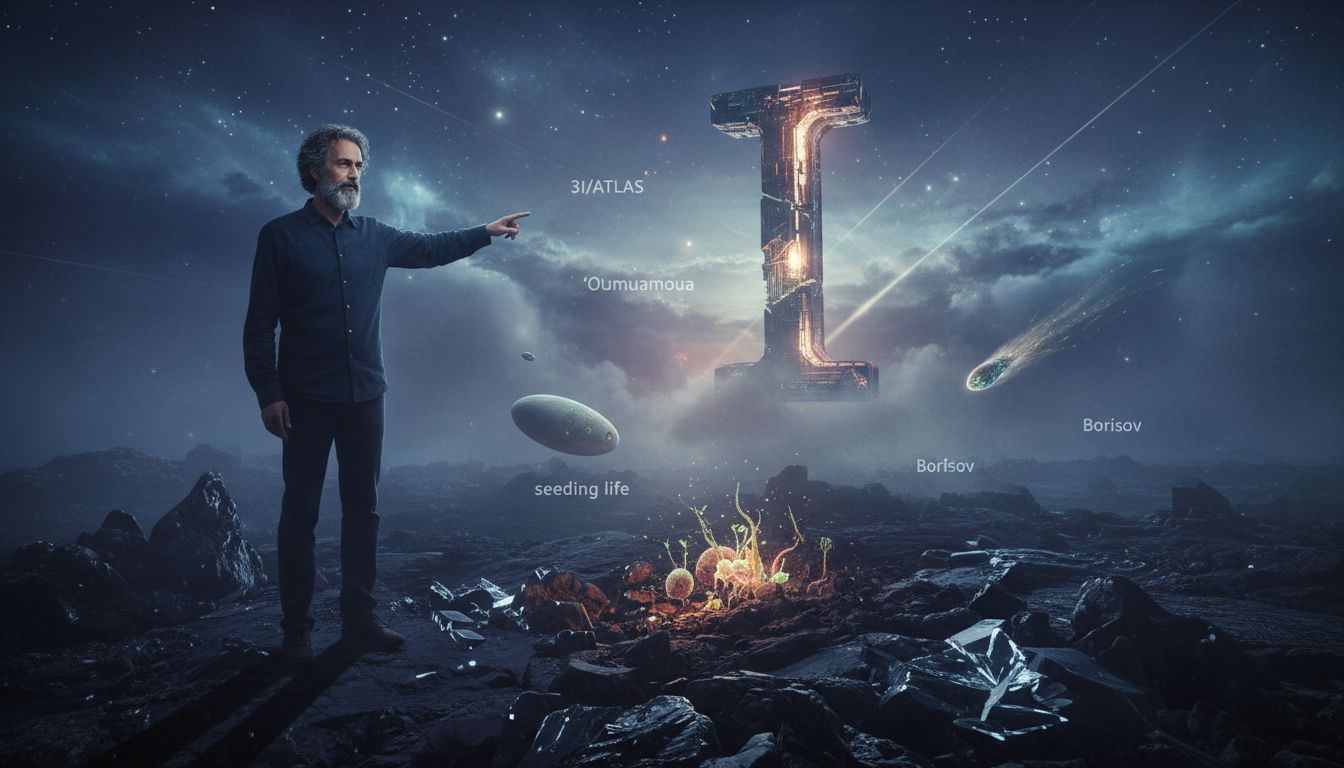
Harvard astrophysicist Avi Loeb has again drawn public attention to the nature of interstellar visitors after the recent detection of 3I/ATLAS. Loeb argues that, like the earlier interstellar objects ʻOumuamua (2017) and 2I/Borisov (2019), ATLAS may be an artificial probe dispatched by an advanced civilization with the purpose of seeding life on Earth. His position stands in contrast to the consensus of NASA and most planetary scientists, who continue to classify ATLAS as a cometary body based on its observed trajectory, composition, and lack of definitive technological signatures.
Background on Interstellar Objects
Since the first confirmed interstellar object, ʻOumuamua, passed through the Solar System in 2017, astronomers have catalogued only a handful of such visitors. ʻOumuamua’s elongated shape and non‑gravitational acceleration sparked debate, while 2I/Borisov displayed a more typical cometary composition. ATLAS, discovered in late 2025, follows a hyperbolic orbit that unmistakably originates outside the Solar System. Spectroscopic measurements from the Hubble Space Telescope and ground‑based observatories indicate a mixture of dust and volatile ices, features that NASA’s Near‑Earth Object Program classifies as “comet‑like.”
Loeb’s Argument
In a recent interview, Loeb outlined a statistical framework suggesting that the probability of a natural interstellar object intersecting Earth’s orbit is exceedingly low compared with the potential for an intentional “seeding” mission. He cited the rarity of such encounters and the apparent timing of ATLAS’s arrival, stating, “If you consider the sheer number of stars capable of launching probes and the narrow window for a successful delivery, an engineered object becomes a plausible explanation.” Loeb also points to what he describes as “anomalous, non‑cometary characteristics” of ATLAS—specifically, an unexpectedly low outgassing rate despite its proximity to the Sun, which he argues could indicate a designed propulsion system rather than sublimation of ices.
Scientific Community Response
The broader astrophysics community remains skeptical. Dr. Sarah M. Klein, a comet researcher at the Southwest Research Institute, emphasized that “the observed properties of ATLAS fit well within the known diversity of cometary nuclei, especially those that have undergone surface processing during interstellar travel.” She added that “without a clear, unambiguous technosignature—such as narrow‑band radio emissions or engineered geometry—we must treat ATLAS as a natural object.” A NASA spokesperson reiterated that “current data do not warrant a re‑classification of ATLAS; its orbital dynamics and spectral signatures are consistent with a long‑period comet.” Critics also note that Loeb’s statistical model relies on assumptions about the prevalence and motivations of extraterrestrial civilizations that are currently untestable.
Implications and Outlook
If, hypothetically, ATLAS were an engineered probe, it would have profound implications for the search for extraterrestrial intelligence (SETI) and for theories of panspermia—the hypothesis that life can be distributed across the galaxy via natural or artificial means. However, the lack of concrete evidence means that the claim remains speculative. Future observations, such as high‑resolution imaging during close approaches or the detection of anomalous electromagnetic signals, would be required to move the discussion from hypothesis to empirical science. For now, ATLAS serves as another reminder of the diversity of objects traversing our cosmic neighborhood and the importance of rigorous, data‑driven analysis in evaluating extraordinary claims.


