Overview
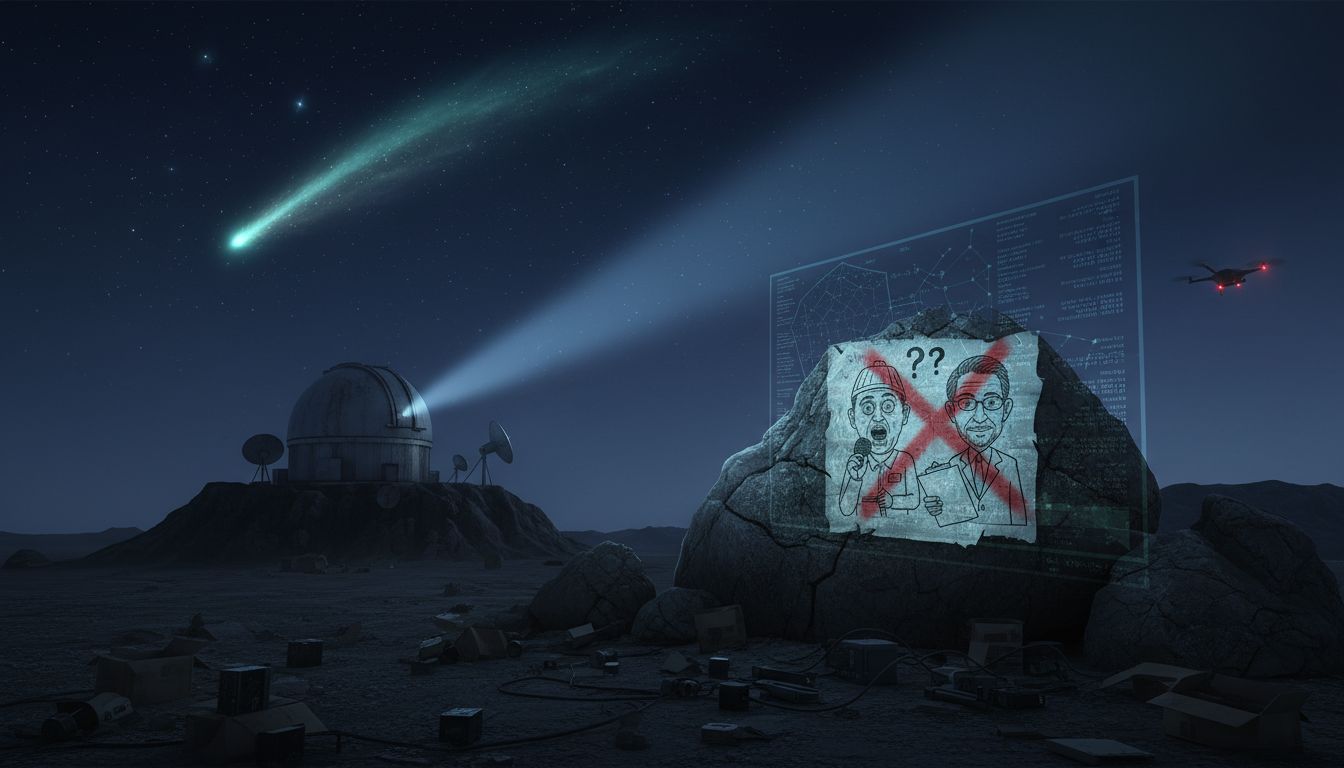
The interstellar visitor 3I/ATLAS, detected earlier this year, has moved from a routine astronomical observation to a focal point of scientific debate and public speculation. While some media personalities—most notably Alex Jones and self‑styled analyst Daniel Liszt—have framed the object as a fabricated “extraterrestrial psyop,” the bulk of the astronomical community is concentrating on genuine anomalies in its trajectory and physical behavior that challenge conventional comet models. The discussion reached a new level on November 5, when conspiracy‑themed articles appeared across fringe outlets, prompting professional astronomers to issue clarifications.
Scientific Findings
Observations from the NASA Infrared Telescope Facility, the European Southern Observatory, and a network of ground‑based telescopes have recorded several puzzling characteristics of 3I/ATLAS. First, its non‑Keplerian acceleration—a small but measurable deviation from the path predicted by solar gravity alone—does not match the outgassing patterns typical of cometary bodies. Second, spectroscopic analysis shows an unusually low abundance of volatile compounds such as water and carbon monoxide, suggesting a composition that is either highly refractory or engineered. Finally, high‑resolution imaging reveals a hyper‑reflective surface with albedo values exceeding those of known icy bodies, hinting at a possible metallic or composite material.
These data points have been compiled in a pre‑print submitted to The Astrophysical Journal Letters and are currently under peer review. The authors, led by Dr. Avi Loeb of Harvard University, describe the observations as “anomalous but not inexplicable,” emphasizing that while the object does not fit neatly into existing comet classifications, the evidence does not require invoking covert intelligence operations.
The Psyop Narrative
The conspiracy narrative gained traction after Jones aired a segment claiming that 3I/ATLAS was a “fabricated extraterrestrial test” orchestrated by undisclosed intelligence agencies to manipulate public perception of UFOs. Liszt’s follow‑up article added that the object’s trajectory was deliberately altered using “hidden thrusters” to create a sensational headline. Neither claim is supported by any verifiable data. No classified documents have been released, and no government agency has acknowledged any involvement. Independent fact‑checking organizations have flagged the statements as unsubstantiated and misleading.
The spread of these theories illustrates a broader pattern where extraordinary astrophysical events become fodder for misinformation, especially when the underlying science is still evolving. The lack of a clear, layperson‑friendly explanation for the anomalies can leave a vacuum that conspiracy narratives readily fill.
Expert Commentary
In an interview with International Business Times UK, Dr. Loeb stressed the importance of transparent, evidence‑based inquiry. “We are dealing with a real physical object that behaves in ways we did not anticipate,” he said. “Our job is to collect data, test hypotheses, and publish results—not to speculate about secret government projects without any proof.”
Other experts echo this sentiment. Dr. Sarah Klein, a comet dynamics specialist at the Max Planck Institute, noted that “the observed acceleration could be explained by radiation pressure on a low‑mass, high‑reflectivity surface, a scenario that, while rare, is within the realm of known physics.” Similarly, NASA’s Planetary Defense Coordination Office has issued a statement confirming that 3I/ATLAS is being monitored under standard protocols and that no threat to Earth has been identified.
Outlook
The scientific community plans to continue monitoring 3I/ATLAS as it exits the inner solar system. Upcoming observations with the James Webb Space Telescope aim to resolve the object's surface composition more precisely, while radar studies from the Goldstone Deep Space Communications Complex will refine its mass and density estimates.
In parallel, outreach efforts are being coordinated to counter misinformation. Harvard’s Center for Astrophysics has launched a public webinar series, and NASA’s social media channels are slated to release simplified explanations of the data as they become available.
Until peer‑reviewed results are published, 3I/ATLAS remains an intriguing anomaly—a reminder that the cosmos can still surprise us, and that rigorous science, not speculation, is the most reliable path to understanding.