Overview
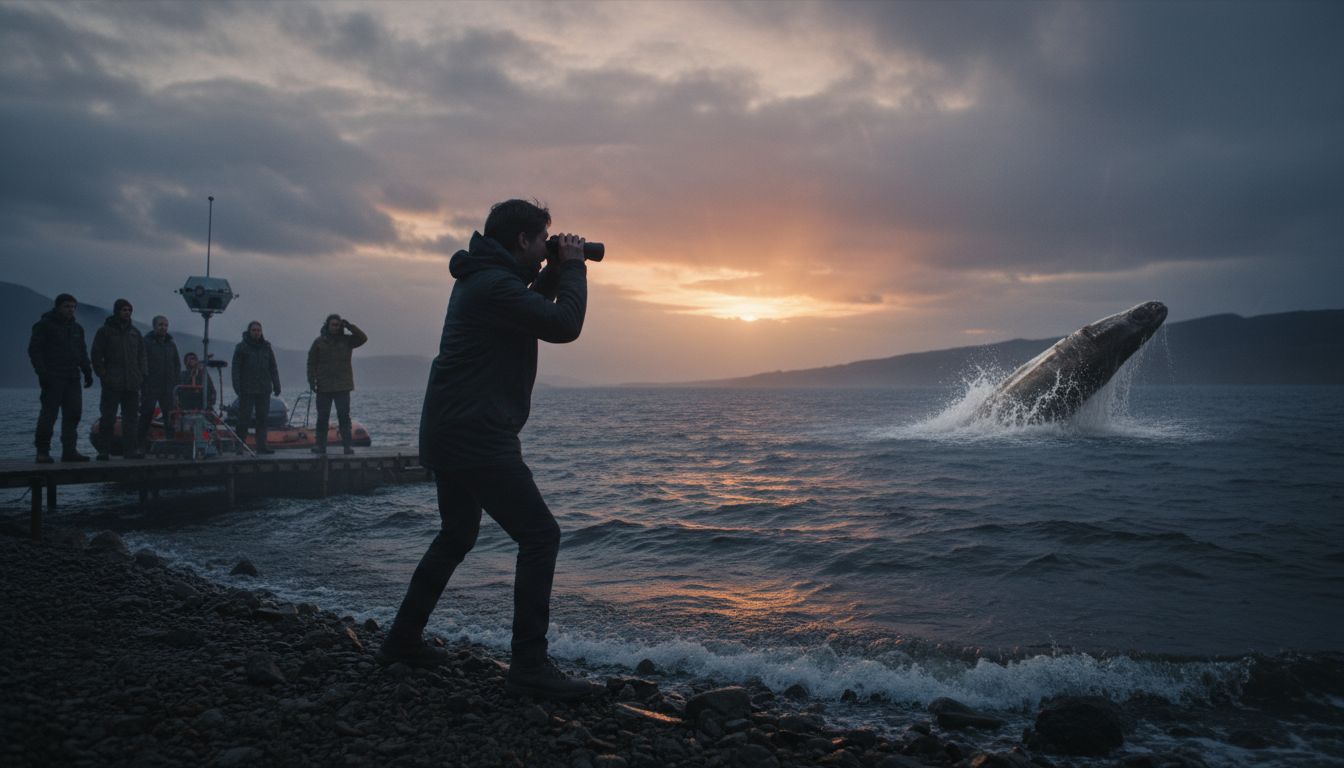
A recent sighting on Loch Ness has reignited debate over the existence of the legendary “Nessie.” On 30 March 2026, a kayaker filming near the loch’s western shore captured a brief, high‑speed movement of an unidentified object that rose sharply out of the water before disappearing beneath the surface. The footage was promptly shared with the Loch Ness Exploration (LNE) team, whose leader, marine biologist Dr. Fiona MacLeod, described the behavior as “unlike any known aquatic animal in this region.” While the video has not yet been independently verified, the incident has drawn attention from both local enthusiasts and the wider scientific community.
Witness Account & Video Evidence
The kayaker, who requested anonymity, reported that the object “shot up like a torpedo, broke the surface in a matter of seconds, then vanished as quickly as it appeared.” The clip, lasting roughly six seconds, shows a dark silhouette accelerating vertically before a rapid plunge. LNE’s field team retrieved the original file and noted that the frame rate appears consistent with the kayaker’s camera settings, reducing the likelihood of digital manipulation. However, Dr. MacLeod cautioned that “without corroborating radar or sonar data, we cannot rule out optical artifacts, wave refraction, or even a man‑made device.” The organization has released the footage to a peer‑reviewed repository, inviting independent analysis.
Expert Analysis
Marine zoologists consulted by the Daily Mail emphasized that the observed speed exceeds that of known loch inhabitants. “A common eel or trout can’t achieve the vertical velocity suggested in the video,” said Prof. Alan Sinclair, a specialist in freshwater biomechanics at the University of Aberdeen. He added that the only native species capable of rapid surface breaches are certain birds, which were not present in the frame. Conversely, Dr. Marta Alvarez, an expert in unmanned underwater vehicles, noted that “compact, battery‑powered drones can mimic such motions, especially if launched from a surface platform.” Both scientists agreed that a thorough forensic review of the footage, coupled with environmental data (water temperature, depth, and acoustic readings), is essential before drawing conclusions.
Context & Next Steps
Loch Ness has a long history of alleged monster sightings, dating back to the 1933 “Surgeon’s Photograph” hoax and subsequent investigations that have produced ambiguous sonar contacts and occasional eyewitness reports. Modern technology—high‑definition cameras, side‑scan sonar, and autonomous submersibles—has reduced the plausibility of simple fabrications, yet it also introduces new avenues for deliberate deception. LNE plans to conduct a targeted survey of the sighting location next month, deploying multi‑beam sonar and acoustic hydrophones to capture any anomalous activity. Until that data is available, the scientific consensus remains cautious: extraordinary claims require extraordinary evidence, and the Loch Ness community will be watching closely for any further developments.


