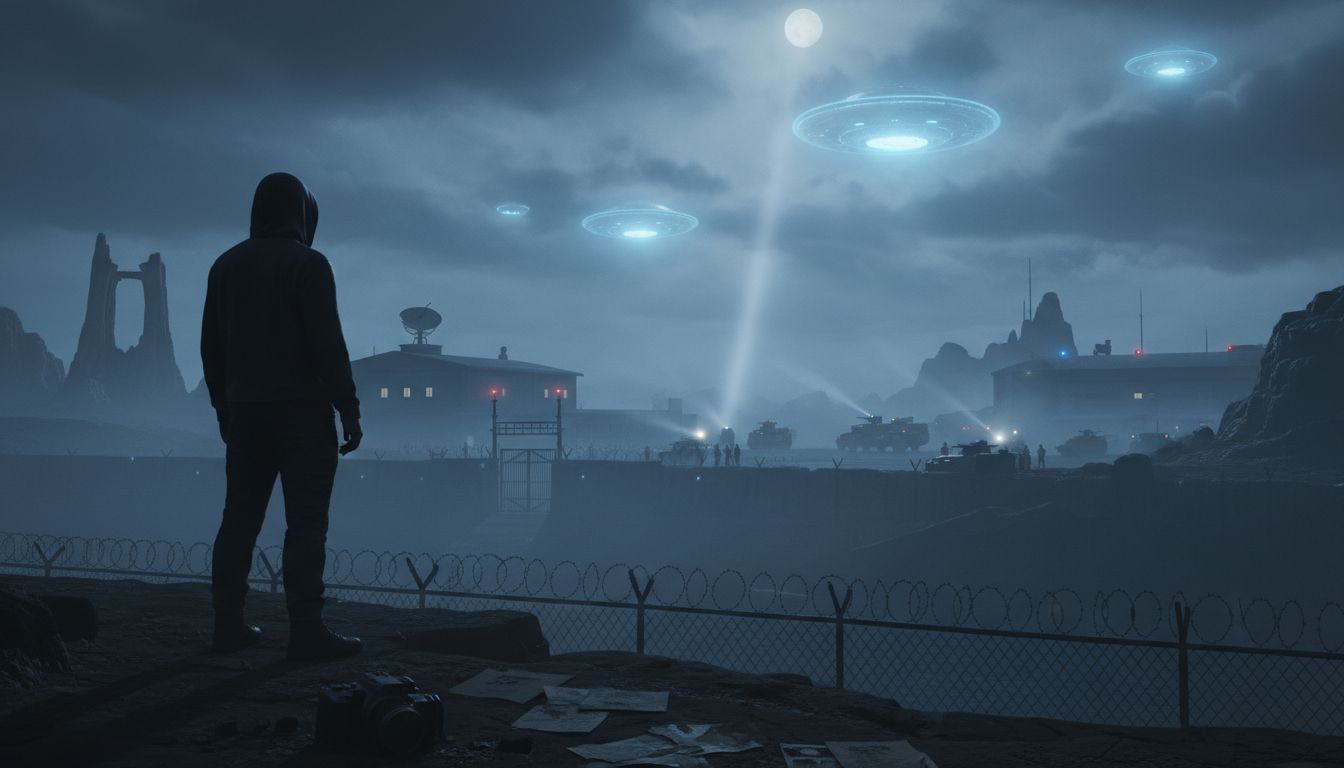
The push for official disclosure of unidentified aerial phenomena (UAP) has intensified in recent months, yet the United States government has shown little movement beyond periodic briefings to congressional committees. Analysts point to a confluence of political, bureaucratic and security considerations that keep the issue firmly under the radar. A recent feature in the International Business Times UK, which draws on the investigative work of documentary filmmaker Jeremy Corbell and veteran journalist George Knapp, argues that the silence is not simply bureaucratic inertia but a calculated strategy to protect national interests.
Corbell, whose 2023 documentary “UFOs: The Untold Truth” examined footage from Navy pilots, says the government’s reluctance stems from “a fear of destabilising public confidence while simultaneously guarding a technology race that we are barely aware of.” In an interview for the IBTimes piece, he noted that the Department of Defense’s UAP Task Force, re‑branded as the Airborne Object Identification and Management Synchronization Group (AOIMSG) last year, has been instructed to “focus on flight safety and potential foreign adversary capabilities, not on the broader existential questions that the public is asking.” Corbell’s claim is echoed by former Pentagon officials who have spoken on condition of anonymity, noting that the classified nature of many UAP encounters makes it difficult to separate genuine security threats from speculative phenomena.
George Knapp, who has reported on the subject since the 1990s, adds a historical dimension to the analysis. “Since the Cold War, every wave of UFO sightings has been filtered through a lens of geopolitical rivalry,” he told the article. “What we are seeing now is a continuation of that pattern, only amplified by the rapid declassification of videos that were once tightly held.” Knapp references the 2021 Office of the Director of National Intelligence (ODNI) report, which catalogued 144 UAP incidents between 2004 and 2021, and the 2023 congressional hearing where senior defense officials declined to answer whether any of the objects could be of non‑human origin. The lack of definitive answers, Knapp argues, fuels speculation and makes it harder for policymakers to justify a full public release.
Political calculations also appear to be at play. The timing of UAP discussions coincides with a volatile election cycle, and senior lawmakers have warned that a sudden admission of “extraterrestrial technology” could become a partisan flashpoint. A senior staffer for the Senate Armed Services Committee, speaking off the record, said, “We are balancing the need for transparency with the risk of providing a rallying point for opposition parties or foreign propaganda.” This caution is mirrored in the Department of Energy’s recent memorandum, which classified certain UAP data as “critical infrastructure” and placed it under the same protection as nuclear secrets.
Security concerns remain the most compelling argument for continued secrecy. The Pentagon’s own statements stress that some UAP sightings involve “advanced flight characteristics that may indicate foreign adversary development,” a claim that aligns with the Department of Defense’s broader focus on near‑peer competitors such as China and Russia. Yet critics argue that this narrative can be used to sideline genuine scientific inquiry. An aerospace researcher at the University of Texas, who requested anonymity, warned, “If we dismiss all anomalous sightings as potential foreign tech without rigorous analysis, we may be overlooking phenomena that could have profound implications for physics and national defense alike.”
The combined investigative efforts of Corbell and Knapp aim to pierce this veil of official reticence. Their latest collaboration, a series of in‑depth interviews and document reviews, seeks to map the “hidden agenda” they believe drives the government’s approach: safeguarding classified programs, maintaining strategic ambiguity, and managing public perception. While their work has reignited debate among enthusiasts and policymakers, the article underscores that without a coordinated inter‑agency framework and clear legislative direction, the prospect of full UFO disclosure remains, for now, a distant goal.


