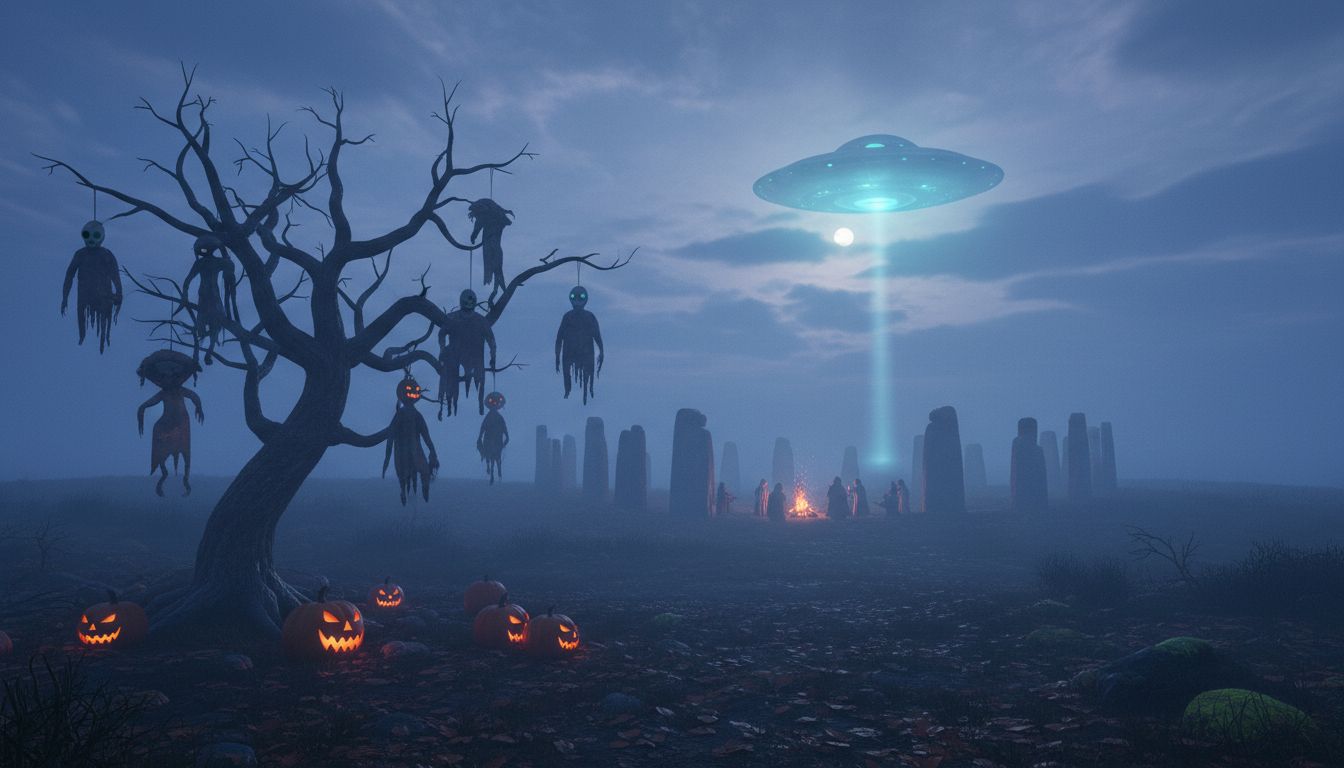
The night of October 31 is filled with costumes, carved pumpkins and the familiar thrill of “goblins and ghouls” prowling the streets, but for some observers the holiday’s eerie atmosphere also revives a more persistent question: are extraterrestrials watching us from the shadows of our own technology? A new study released this week suggests that the answer may be more complex than folklore, pointing to a possible link between the United States’ historic nuclear‑testing program and the surge of unidentified aerial phenomena (UAP) reports that followed.
The research, conducted by a team of aerospace historians and physicists at the University of Utah, examined declassified footage and eyewitness accounts from the 1950s Nevada and Pacific test sites. They identified a statistically significant clustering of bright, transient light flashes—some lasting only a fraction of a second—recorded by ground‑based cameras during atmospheric detonations. Within weeks of those flashes, the team found an uptick in civilian reports of “unusual lights” and “flying objects” in the same regions, many of which were later entered into the U.S. Air Force’s Project Blue Book files. Lead author Dr. Elena Martinez told the Deseret News, “The correlation does not prove intent, but it does raise the question of whether some external observers were monitoring the tests, or whether the tests themselves generated atmospheric conditions that produced anomalous visual phenomena.”
The study arrives at a moment when the U.S. government has formally moved away from the term “UFO” in favor of “unidentified aerial phenomena,” a change intended to reduce stigma and encourage more rigorous reporting. In 2022, the Department of Defense established the All‑Domain Anomaly Resolution Office (AARO) to collect and analyze sightings across air, space and maritime domains. AARO’s annual report released earlier this year noted 1,200 UAP incidents in the United States, with a notable concentration near former nuclear sites such as the Nevada Test and Shot‑Range Complex. While the agency stopped short of attributing any of those sightings to extraterrestrial intelligence, it acknowledged that “some incidents remain unexplained after exhaustive analysis of sensor data, environmental factors, and known aircraft activity.”
Public interest in the subject has been amplified by cultural touchstones—most recently an extra‑large alien statue erected on the outskirts of Roswell, New Mexico, on June 3, 2025. The installation, funded by a private tourism consortium, has become a pilgrimage site for UFO enthusiasts and has sparked renewed debate over the line between entertainment and evidence. “People love a good mystery, especially on Halloween,” said Amy Joi O’Donoghue, the Deseret News reporter who covered the story. “But it’s important to separate the folklore from the data. The study gives us a concrete dataset to examine, rather than relying solely on anecdote.”
Critics caution against over‑interpreting the findings. Former AARO analyst Lt. Col. (Ret.) James Whitaker warned that “the atmospheric disturbances created by large nuclear detonations can produce optical artifacts that mimic what witnesses describe as ‘UFOs.’” He added that without corroborating radar or infrared signatures, visual sightings alone remain inconclusive. Nonetheless, the study’s authors argue that the temporal proximity of the flashes and reports merits further investigation, particularly as modern satellite constellations now provide continuous high‑resolution monitoring of the same regions.
As Halloween night settles across the United States, the blend of mythic monsters and speculative alien watchers serves as a reminder of humanity’s enduring fascination with the unknown. Whether the lights observed over the Nevada desert in the 1950s were the result of secret surveillance, experimental physics, or simple misperception, the new research underscores the need for transparent data collection and scientific scrutiny—an approach that, the authors hope, will keep the conversation grounded in evidence rather than imagination.


