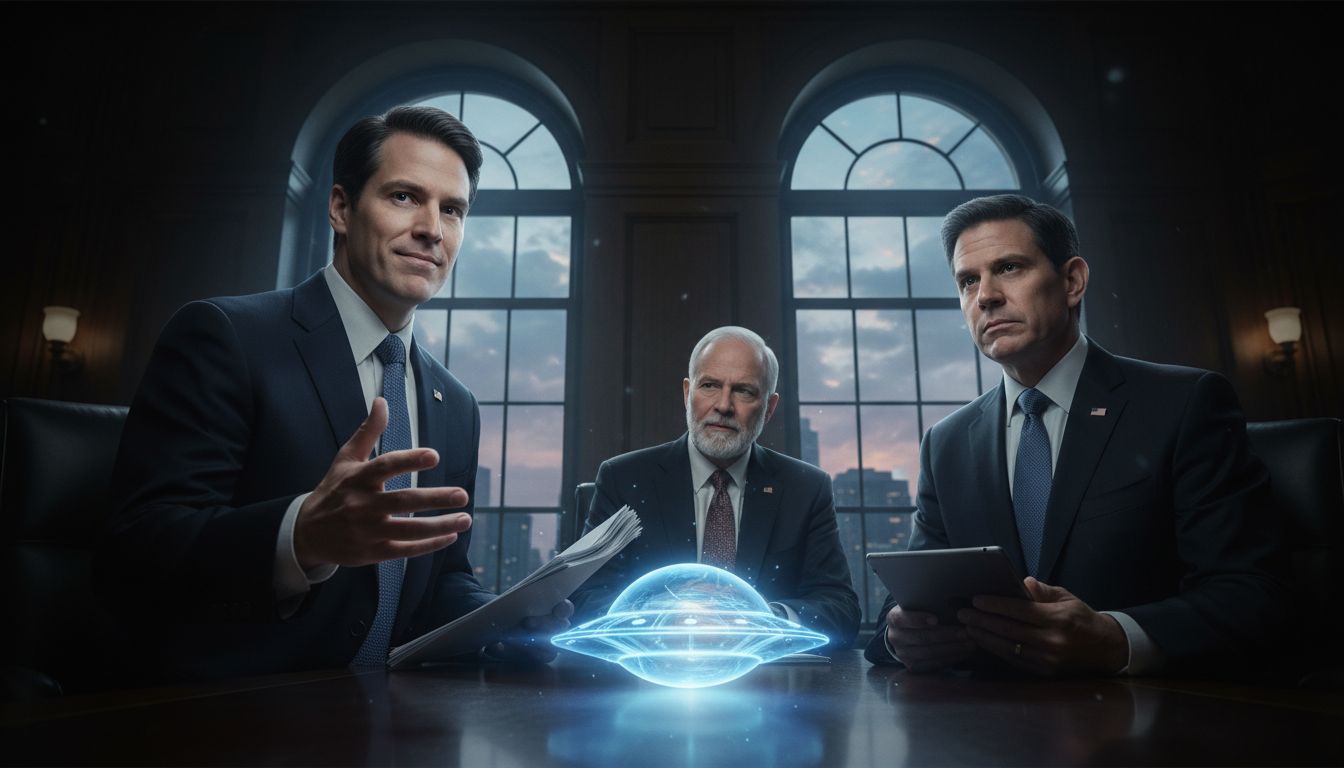
Vice President J.D. Vance, who rose to national prominence as a Senate candidate before being tapped for the administration’s senior leadership team, addressed lingering questions about his earlier remarks on unidentified aerial phenomena (UAP) during a press briefing on Thursday. Vance acknowledged that his “UFO obsession” comment made in a 2023 interview was “partly tongue‑in‑cheek,” but he stressed that the comment was not meant to dismiss the growing bipartisan interest in the subject. “I’m serious about the need for rigorous, transparent investigation,” Vance said, adding that curiosity about UAPs transcends party lines and ideological labels.
In the same briefing, Vance highlighted the involvement of several senators who have publicly supported renewed scrutiny of UAP incidents. He singled out Senator Marco Rubio, describing the Florida Republican as “a close friend” whose curiosity about the phenomenon is “very genuine.” Vance also referenced Senator Kirsten Gillibrand (D‑NY), noting that she has co‑sponsored recent legislation aimed at improving inter‑agency data sharing on UAP sightings. The vice president’s remarks echo a broader congressional push that began in 2022 with the establishment of the All‑Domain Anomaly Resolution Office (AARO) and the release of a declassified report by the Office of the Director of National Intelligence that documented 144 UAP encounters between 2004 and 2021.
The timing of Vance’s comments coincides with heightened public attention to the issue. Earlier this month, former Pentagon officials and senior intelligence officers participated in a series of televised interviews that emphasized the need for a “science‑first” approach to analyzing anomalous aerial observations. Those interviews were followed by the announcement of a documentary, Unidentified: The New Frontier, slated for release on November 1. The film, produced by a consortium of independent journalists and former military analysts, promises to compile declassified footage, witness testimony, and expert commentary, further cementing UAPs as a mainstream policy conversation rather than a fringe curiosity.
While the vice president’s clarification seeks to temper any perception of levity, it also underscores the administration’s commitment to a structured investigative framework. In a written statement, the White House outlined three pillars of its UAP strategy: (1) enhancing data collection across the Department of Defense, the FAA and civilian reporting channels; (2) expanding scientific analysis through partnerships with universities and private research institutions; and (3) ensuring congressional oversight through regular briefings to the Senate Armed Services Committee and the House Intelligence Committee. Vance reiterated that “the American people deserve answers that are based on evidence, not speculation.”
Analysts note that bipartisan cooperation on UAPs may be driven as much by national security concerns as by scientific curiosity. A recent study by the Center for Strategic and International Studies warned that unidentified aerial systems could represent advanced foreign technology, a possibility that warrants rigorous intelligence assessment. At the same time, the growing pool of credible sightings—some corroborated by radar, infrared and visual recordings—has spurred calls for a more open scientific discourse. As the documentary premieres and lawmakers prepare for the next round of hearings, Vance’s remarks suggest that the administration will continue to navigate the delicate balance between transparency, security, and the public’s appetite for answers.


