Overview
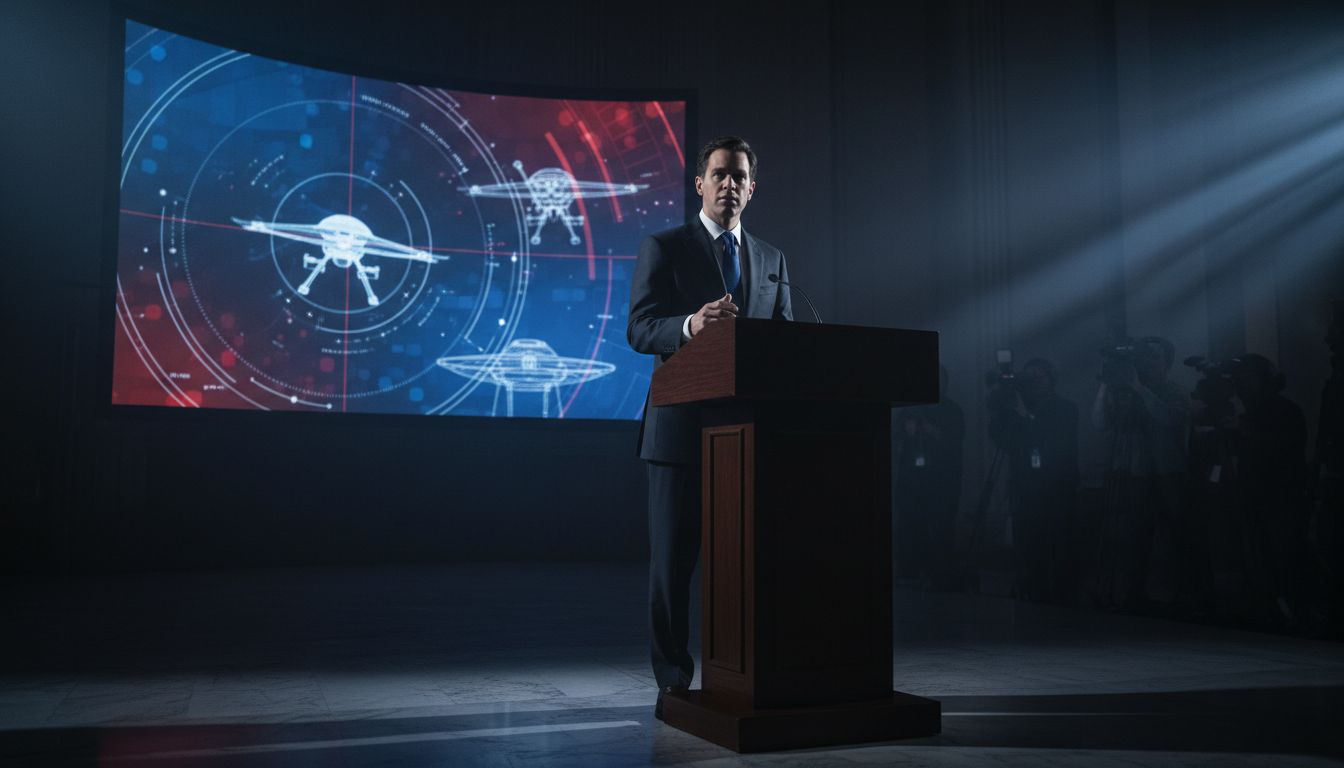
Ohio Senator J.D. Vance took to the Senate floor on Monday to lay out his assessment of the nation’s lingering UFO mystery. While acknowledging the public’s fascination with unidentified aerial phenomena (UAP), Vance argued that the most plausible explanation is advanced technology operated by foreign adversaries, not extraterrestrial craft. He called for a “more rigorous, data‑driven investigation” and urged the intelligence community to provide greater transparency to both lawmakers and the American public.
Vance’s Assessment
In his remarks, Vance referenced the Pentagon’s Airborne Object Identification and Management (AOIM) office, now known as the All‑Domain Anomaly Resolution Office (AARO), which has catalogued dozens of unexplained sightings since 2020. “The pattern we’re seeing points to sophisticated platforms that could be testing our defenses,” Vance said, adding that “the evidence we have so far aligns more closely with foreign‑developed systems than with anything that could be described as alien.” He stopped short of naming any specific nation, but his comments echo concerns raised in recent congressional hearings about potential Chinese or Russian hypersonic drones operating at high altitudes.
Call for Rigorous Investigation
Vance stressed that speculation alone will not satisfy national‑security interests. He urged the Intelligence Community to adopt standardized reporting protocols for UAP encounters and to share de‑classified findings with relevant Senate committees. “We owe it to the American people to move beyond conjecture and establish a clear, accountable framework for investigating these incidents,” he asserted. The senator also suggested that the National Archives could serve as a repository for historical UAP data, allowing independent researchers to examine trends over time.
Political Context
Vance’s statements come amid a broader bipartisan push to demystify UAPs. Earlier this year, the Senate Armed Services Committee held a high‑profile hearing featuring testimony from former Navy pilots and AARO officials. Lawmakers from both parties have introduced legislation to fund a permanent, cross‑agency UAP task force and to mandate annual reporting to Congress. Vance, a member of the Senate Committee on Homeland Security and Governmental Affairs, positioned his viewpoint within this legislative momentum, arguing that clearer intelligence could also inform defense procurement and air‑space safety measures.
Broader Implications
If Vance’s hypothesis holds merit, the implications extend beyond curiosity about alien life to concrete national‑security challenges. Advanced foreign platforms could exploit gaps in radar coverage, potentially compromising air‑defense systems. Conversely, a transparent investigative process could restore public confidence eroded by decades of secrecy surrounding UAPs. As Vance concluded, “Whether these objects are of terrestrial or extraterrestrial origin, the priority must be to protect our skies and our citizens through rigorous, open inquiry.” The Senate’s next steps will likely determine how quickly that priority translates into actionable policy.


