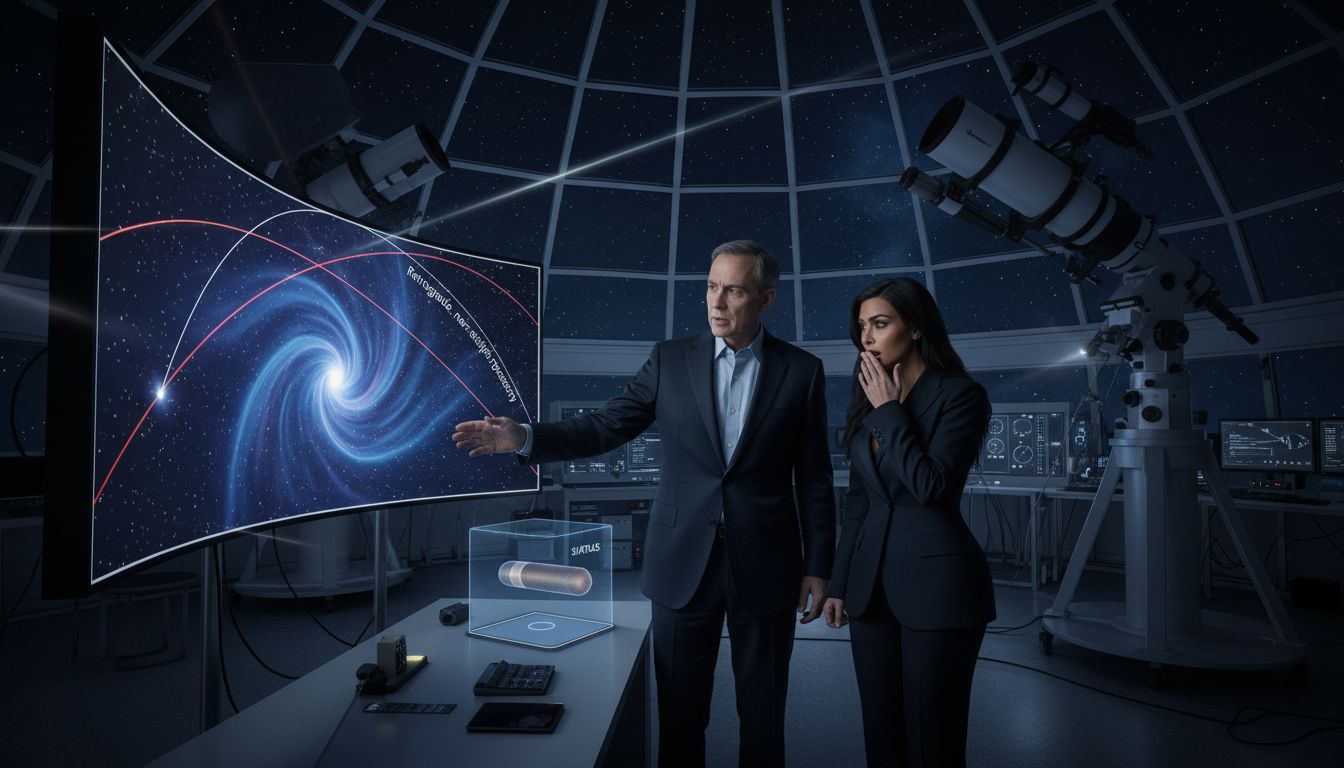
The astronomical community is turning its attention to a newly discovered interstellar comet, designated 3I/ATLAS, after a series of observations revealed a set of unusual dynamical and physical characteristics. 3I/ATLAS is only the third known interstellar object to traverse the Solar System, following the enigmatic 1I/‘Oumuamua in 2017 and the more conventional comet‑like 2I/Borisov in 2019. Its arrival has already sparked scientific debate and, unexpectedly, a flurry of public interest, including a tweet from reality‑TV personality Kim Kardashian that prompted a response from NASA’s acting administrator, Sean Duffy. In a brief exchange, Duffy assured the public that the object poses “no threat to life here on Earth” and emphasized that, to date, there is no evidence of extraterrestrial technology associated with the comet.
Harvard astrophysicist Avi Loeb, a leading voice on interstellar objects, outlined the comet’s most striking anomalies in a Medium post dated 3 November 2025. 3I/ATLAS follows a retrograde orbit that is aligned within five degrees of the ecliptic plane—a configuration Loeb calculates has a probability of roughly 0.2 % for a randomly incoming interstellar body. Such an alignment suggests that the comet’s trajectory is unusually coplanar with the planetary orbits, a feature that could make future gravitational interactions with the inner Solar System more likely than for a typical hyperbolic passerby. In addition, observations in July and August 2025 recorded a persistent sunward jet, or “anti‑tail,” that could not be explained as a mere geometric illusion, distinguishing the comet from the classic dust‑driven tails of familiar Solar System comets.
The physical dimensions of 3I/ATLAS remain tentative, but preliminary analyses of the Hubble Space Telescope imagery indicate a nucleus on the order of tens of meters across—comparable in size to 2I/Borisov but substantially smaller than the kilometer‑scale object that created the Chicxulub crater 66 million years ago. Nonetheless, Loeb raised a speculative but scientifically framed question during a televised interview with NewsNation’s Natasha Zouves: “Was the Chicxulub impactor a predecessor of 3I/ATLAS?” He clarified that, while the masses of the two bodies differ dramatically, the notion of a shared lineage warrants investigation should future orbital dynamics bring 3I/ATLAS into a collision course with Earth. At present, orbital calculations show no imminent impact risk, but the comet’s trajectory will continue to evolve under planetary perturbations, making ongoing monitoring essential.
Access to high‑resolution imagery has become a point of contention. On 2–3 October 2025, NASA’s HiRISE camera aboard the Mars Reconnaissance Orbiter captured the comet at a spatial resolution of 30 km per pixel—a dataset that could refine models of its shape and activity. Congresswoman Anna Paulina Luna formally requested the release of these images, arguing that “the dissemination of scientific information should not be held hostage to the politics of the government shutdown.” Loeb echoed this sentiment in his Medium post, noting that he had reached out to HiRISE principal investigator Professor Alfred McEwen without receiving a reply. The delayed release of the data, he warned, hampers the ability of researchers worldwide to plan timely follow‑up observations before the comet exits the Solar System.
The episode illustrates how an object of purely scientific interest can quickly become a cultural touchstone. While Kardashian’s curiosity about “the tea on 3I/ATLAS” was met with a measured NASA statement, the ensuing media coverage underscores the public’s appetite for space news that bridges rigorous research and popular discourse. As 3I/ATLAS continues its outbound journey, astronomers plan to leverage ground‑based facilities and forthcoming space telescopes to track any subtle changes in its trajectory, composition, and outgassing behavior. Whether the comet will ultimately prove to be a benign interstellar visitor or a clue to deeper astrophysical processes remains to be seen, but the collaborative push for data transparency and interdisciplinary dialogue marks a constructive step forward for the field.


