Overview
In the Köhlholz Forest near Kemoding, Germany, a local haunting legend is tied to a real and violent historical event: the 1831 murder of Anna Schwarzenberger, a pregnant young woman whose death has remained part of the area’s memory for nearly two centuries. According to local accounts, the tragedy gave rise to the story of the White Lady of Köhlholz, a restless spirit said to wander the woods. Today, a large wooden cross stands near the site as a memorial to both the killing and the accidents that have occurred along the nearby B 388 road.
The forest lies in Upper Bavaria, within the municipality of Fraunberg in the Erding district, and is known locally as one of the region’s larger wooded areas. While it is now associated with folklore, the site’s reputation was shaped first by a brutal crime that shocked the community. Over time, the murder became part of a wider tradition of German ghost lore, with the White Lady figure emerging as the supernatural echo of the woman’s violent death.
The 1831 Murder
Historical accounts place the killing on July 31, 1831, when a young unmarried farmer, identified in the source as MG from H., lured Schwarzenberger into the forest. She was said to be eight months pregnant at the time. Believing she was being invited to a fair in Dorfen, she was instead attacked and stabbed 14 times. According to the account, the assailant then drowned her in a small pond while she was still alive.
The murder reportedly went undiscovered for nearly three weeks, until the perpetrator turned himself in. The source notes that the man’s name is often withheld from records because people with the same name still live in the area. That caution reflects the sensitivity that continues to surround the case, which remains one of the most infamous historical crimes connected to the region.
A Cross at the Site
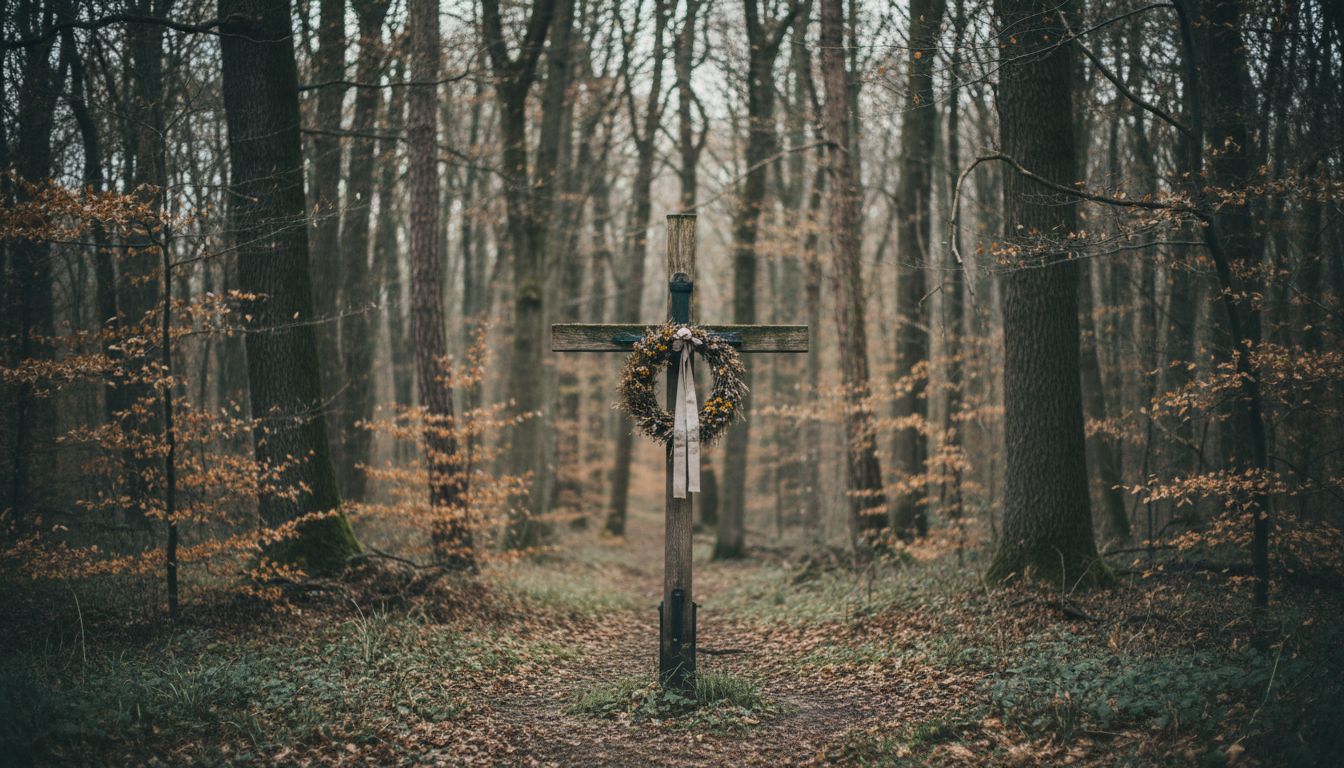
A 2.5-meter-high wooden cross, known as the Fertlbauernkreuz, now marks the location in Köhlholz Forest near the B 388. It was erected through the initiative of Andreas Faltermaier of Kemoding, after an older wayside shrine on the same spot disappeared several years ago. The cross serves not only as a memorial to Schwarzenberger, but also as a reminder of the dangerous conditions along the road, where fatal accidents have also occurred.
The presence of the shrine underscores how local memory in rural Bavaria often blends religious tradition, roadside commemoration, and folklore. In the Kemoding area alone, the source says, several different crosses can be found, each with its own history. In this case, the site has become a physical marker for a story that has lived on long after the facts of the killing were first recorded.
The Legend of the White Lady
As with many rural ghost stories, the legend of the White Lady of Köhlholz appears to have grown from grief, trauma, and the need to explain a violent past. The “white lady” motif is common in European folklore, often describing the spirit of a woman who died tragically and is said to appear in white clothing. In Köhlholz, the legend is linked directly to Schwarzenberger’s murder, giving the haunting a specific human origin rather than a purely imagined one.
Whether viewed as folklore, local history, or both, the story continues to shape how the forest is remembered. The cross standing in the woods is more than a landmark; it is a sign that the event has not been forgotten. In that sense, the White Lady of Köhlholz remains part of a broader pattern seen across Europe, where places of violence become places of memory, and memory, in turn, gives rise to legend.