Overview
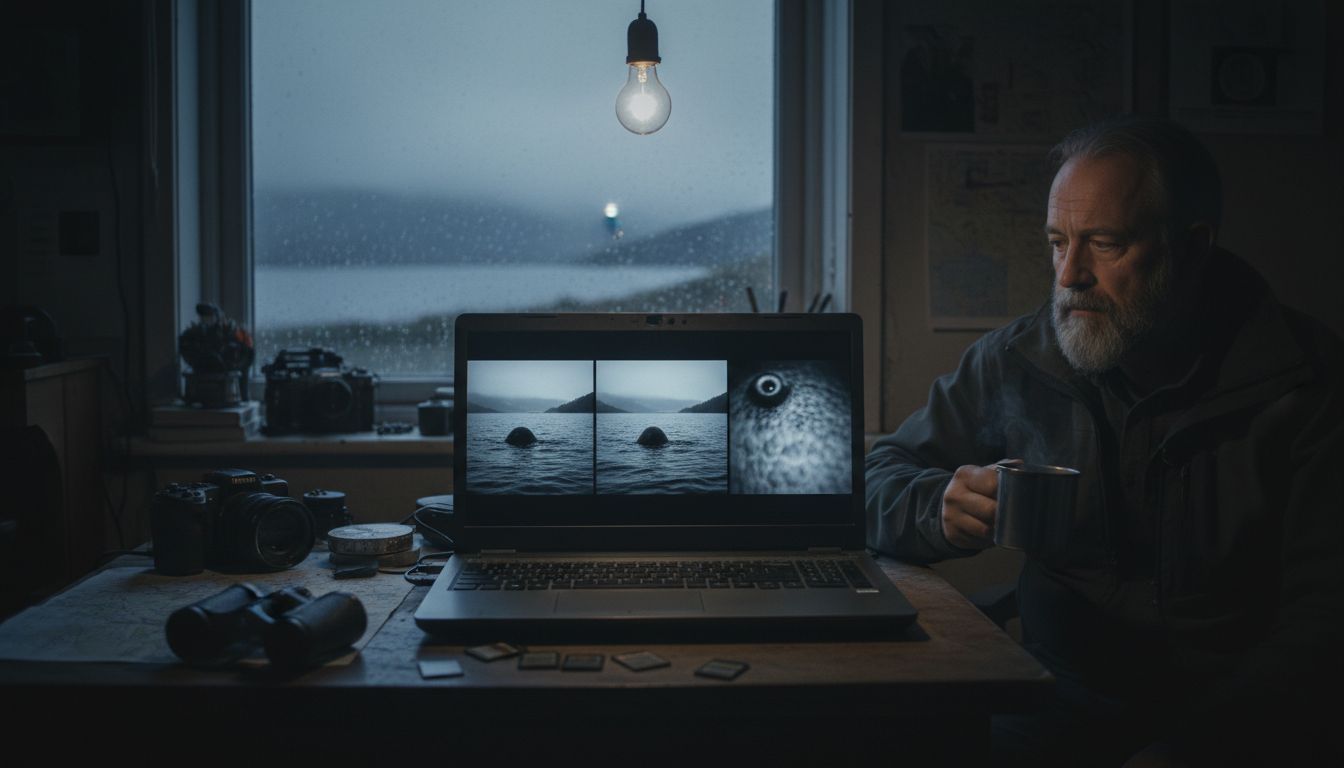
A Glasgow‑based “Nessie” enthusiast has released three trail‑camera photographs that he says capture a distinct hump moving beneath the surface of Loch Ness. The images, taken on the western shore near Inverfarigaig on 26 June 2025 at 06:18 a.m., have been posted alongside the photographer’s annual 2025 Nessie review. While the photographer, 63‑year‑old Roland Watson, believes the hump could be the legendary monster’s body and a nearby white line its head, he also acknowledges that a large fish cannot be ruled out.
The Images and Method
Watson, a software engineer from Edinburgh, mounted a motion‑activated trail camera on a tree in May and left it in place for several months. The device is programmed to snap three still frames in rapid succession every seven minutes, but it does not record video. The three photos, taken roughly one second apart, show a roughly one‑metre‑long dark bulge followed by a thin, white line about a metre ahead of it. The camera’s positioning gave a side‑on view of the water, allowing the hump to be seen moving from left to right across the frame.
Enthusiast’s Interpretation
In his accompanying commentary, Watson stated, “I can’t think of any other explanation for this,” adding that “the hump seems to be a body and the white line may be a head, and who knows what else is below the surface.” He qualified his claim, noting that the images are not definitive proof and that “it could simply be a large fish.” The 2025 Nessie review, released simultaneously, includes the photos and Watson’s customary measured analysis, placing the sighting within his broader, year‑long catalog of Loch Ness observations.
Historical and Scientific Context
Loch Ness has been the focus of cryptozoological interest since the 1930s, with thousands of alleged sightings and a handful of photographic claims that have been scrutinized by researchers. Scientific surveys, including sonar scans and environmental DNA sampling, have yet to produce conclusive evidence of a large, unknown aquatic animal. Trail cameras have been used intermittently in the past, most notably during the 1994 “Surgeon’s Photograph” controversy, but the low resolution and lack of motion data often limit their evidentiary value. Watson’s images add to the catalog of visual reports but, like previous submissions, fall short of the rigorous standards required for scientific validation.
What Comes Next
Experts from the University of St Andrews’ Centre for Ecology and Hydrology have been invited to review the photographs and the camera’s metadata. In a statement, Dr Helen Murray said, “While the hump is an intriguing feature, without corroborating data—such as sonar returns or multiple independent observations—we must treat it as an unverified visual anomaly.” Local authorities have noted an uptick in visitor interest around Inverfarigaig, prompting discussions about managing tourism impact on the loch’s ecosystem. As the debate continues, Watson’s contribution underscores the enduring allure of Loch Ness and the careful balance between public fascination and scientific rigor.


