Overview
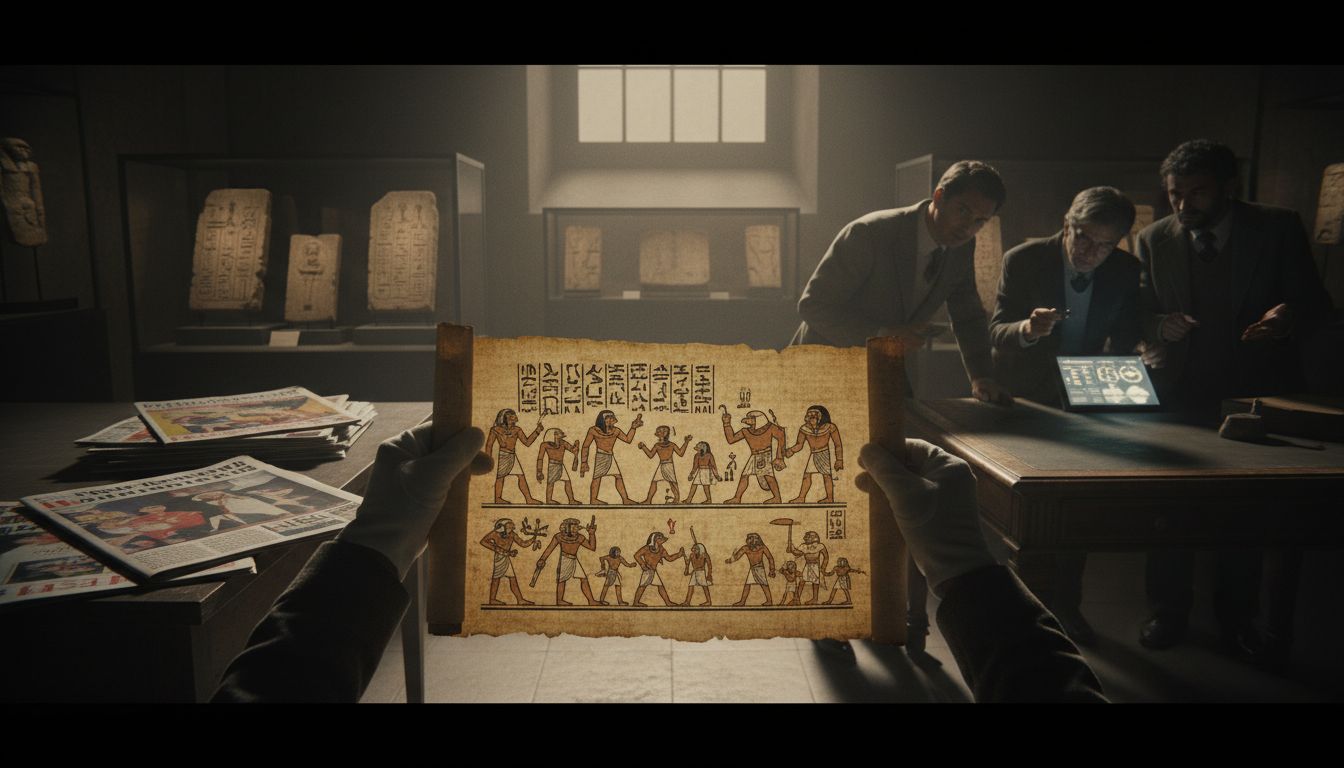
A fragment of an ancient Egyptian papyrus, housed in the British Museum’s collection, has resurfaced in recent weeks after being cited by several British tabloids as “proof of the biblical giants.” The document, catalogued as BM 10223, dates to the early New Kingdom (c. 1550‑1450 BCE) and is a training text used to teach scribes the art of composing military reports. While the sensational headlines have sparked online debate, Egyptologists stress that the scroll contains a satirical account of a fictional army campaign, not a factual record of giant peoples or supernatural beings.
The Papyrus and Its Content
The papyrus is a scribal exercise written in hieratic script, a cursive form of Egyptian writing employed for everyday administration. Its narrative describes a mock battle in which the Egyptian forces confront a “land of the giants” (ḥr‑kmt wꜥḏ), but the language is deliberately exaggerated, employing hyperbole and comedic tropes common in New Kingdom training manuals. Professor Miriam El‑Sayed of University College London explains, “The text uses the motif of oversized opponents to teach students how to handle complex descriptive passages, not to document real events.” The scroll also includes marginal glosses that instruct apprentices on proper spelling and syntax, confirming its pedagogical purpose.
Scholarly Interpretation
Researchers who have examined the fragment—including Dr Lars Klein of the Max Planck Institute for the Science of Human History—conclude that the document was intended as a model for composition, not as an ethnographic record. “Ancient Egyptian scribes routinely composed fictional war stories to practice rhetorical devices,” Klein notes. “The ‘giants’ are literary devices, akin to the giants of later mythologies, but they do not reflect an actual population.” The British Museum’s own catalogue entry describes the papyrus as “a didactic text for training junior scribes in the composition of battle reports,” reinforcing the scholarly consensus that the scroll should be read in its educational context.
Media Misuse and Public Reaction
Despite the academic clarification, several tabloids have republished excerpts, framing the fragment as “evidence that the giants of Genesis really walked the earth.” Social‑media posts have amplified these claims, prompting a wave of speculation about hidden histories and conspiracies. Egyptologists have warned that such misinterpretations undermine public understanding of ancient sources. “When sensationalist outlets cherry‑pick obscure texts, they create a false narrative that distracts from genuine archaeological discoveries,” says Dr El‑Sayed. The British Museum has issued a statement urging journalists to consult experts before publishing claims that could mislead readers.
Implications for the Debate on Biblical Figures
The episode highlights the broader challenge of correlating ancient Near Eastern documents with biblical narratives. While some scholars explore possible cultural overlaps, the consensus remains that no Egyptian source unequivocally mentions the biblical Nephilim or other giant figures. The papyrus in question, once placed in its proper scholarly frame, adds no new data to that discussion. Instead, it serves as a reminder that ancient literary conventions often employed fantastical elements for instructional purposes, a practice familiar across many early civilizations.
Looking Ahead
The British Museum plans to digitize the papyrus in collaboration with the Egypt Exploration Society, making high‑resolution images and transliterations available to researchers worldwide. Such transparency aims to curb future misrepresentations and promote informed dialogue between scholars and the public. As Professor Klein puts it, “Accurate knowledge of the past comes from careful, contextual study—not from headlines that promise sensational revelations.”


