Overview
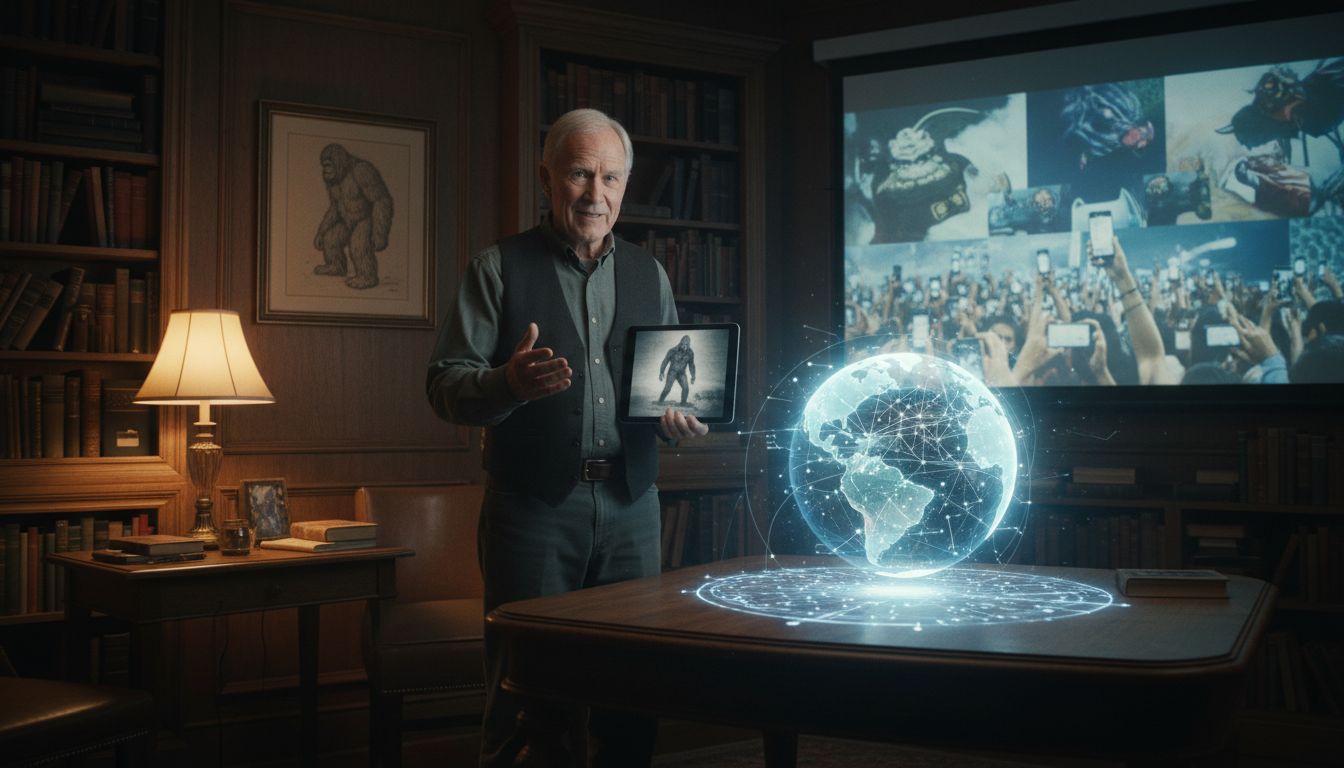
Loren Coleman, a veteran of the cryptozoology community with more than six decades of field work and over 50 published titles, sat down with The Other Maine in January 2026 to discuss the state of the discipline and his long‑awaited museum project in Bangor. While maintaining a measured skepticism, Coleman expressed a hopeful outlook, noting that advances in digital communication and analytical tools are reshaping how enthusiasts and scholars investigate elusive creatures. He also reiterated a striking 98 % confidence that the iconic Patterson‑Gimlin Bigfoot footage is genuine, a figure that underscores his belief that some “unknown” animals may eventually move from folklore to scientific acknowledgment.
Early Roots
Coleman traced his fascination to a single night in March 1960, when a local Illinois TV station aired the Japanese film Half Human (released abroad as Beastman Snowman). “It was heartbreaking,” he recalled, describing how the movie’s depiction of a Yeti killed by hunters sparked an enduring curiosity about cryptids. The next day, a teacher directed him to a World Book entry on a contemporary Himalayan expedition, and a flag from that journey arrived in his mailbox—a tangible link that cemented his lifelong pursuit. A childhood photograph of a young Coleman perched beside a homemade “Bigfoot” plaster cast, now part of his personal archive, illustrates how the legend of the Sasquatch entered his imagination early on and has remained a “keystone” of his research.
Patterson‑Gimlin Confidence
When asked about the 1970 Patterson‑Gimlin video, Coleman stated that a careful review of motion analysis, anatomical proportions, and the consistency of the subject’s gait leads him to assign a 98 % confidence that the footage captures a genuine, undocumented primate. He emphasized that this assessment is not based on anecdotal belief but on “a convergence of biomechanical data, corroborating eyewitness accounts, and the absence of any credible hoax evidence uncovered in the past half‑century.” While acknowledging that definitive proof remains elusive, Coleman argued that the video “continues to be the strongest single piece of empirical evidence we have” and deserves ongoing scientific scrutiny.
Digital Era Transformations
Coleman highlighted how social media and artificial intelligence have altered the cryptozoological landscape. Platforms such as TikTok and Reddit now enable rapid sharing of sighting reports, high‑resolution images, and acoustic recordings, creating a “global citizen‑science network” that was unimaginable in the 1970s. Meanwhile, AI‑driven image‑enhancement tools allow researchers to isolate subtle movement patterns in low‑quality footage, and machine‑learning classifiers can flag potential misidentifications among millions of wildlife photos. “These technologies don’t replace fieldwork,” Coleman warned, “but they dramatically expand our ability to sift through data and focus investigative resources where the signal is strongest.”
International Cryptozoology Museum
The centerpiece of Coleman’s current ambitions is the International Cryptozoology Museum slated to open in Bangor’s 490 Broadway building—a restored mid‑century modernist former bus depot. After four years of renovation, the museum will house thousands of artifacts, including a 2001 Thylacine footprint cast, massive Bigfoot sculptures, Moai replicas, and the aforementioned Yeti memorabilia. The venue, described by Coleman as a “hidden gem” amid commercial strip malls, will consolidate collections that were previously scattered across a cramped Portland residence and private storage. The museum’s inaugural exhibition is scheduled for April 2026, with full public access expected later in the year once final safety inspections are completed.
Looking Ahead
Coleman’s interview paints a picture of a field in transition: one that balances skepticism with optimism, leveraging new digital tools while honoring the meticulous documentation that has defined cryptozoology for decades. As the Bangor museum prepares to open its doors, he hopes it will serve as both a repository of historical evidence and a hub for interdisciplinary collaboration. “If we can bring together folklorists, biologists, and data scientists under one roof,” he said, “the chances of turning today’s mysteries into tomorrow’s discoveries increase dramatically.” The upcoming museum, combined with the growing influence of AI and social platforms, may well mark a turning point for a discipline that has long existed on the fringe of mainstream science.


