Overview
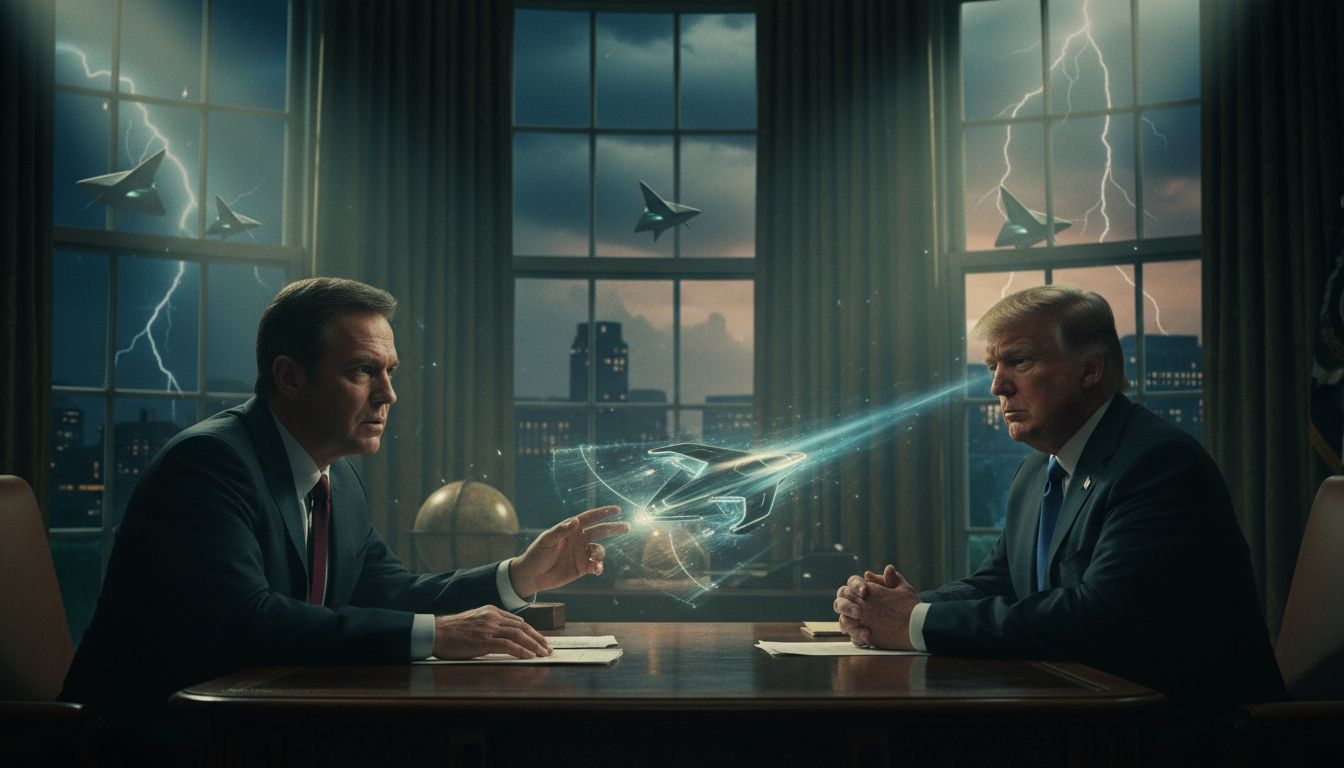
Former Pentagon UAP (Unidentified Aerial Phenomena) program director Lue Elizondo met with former President Donald Trump on Dec. 9, 2025, to deliver a stark assessment of emerging threats tied to advanced UAP technology. Elizondo warned that if the United States fails to secure the nascent capabilities demonstrated by recent UAP sightings, a “nightmare scenario” could unfold in which adversaries weaponize the technology against American interests. He also highlighted a parallel risk: the same breakthroughs could be repurposed for cyber‑espionage and cyber‑warfare, potentially compromising critical infrastructure if they fall into hostile hands.
Background
Elizondo, who led the Department of Defense’s Advanced Aerospace Threat Identification Program (AATIP) from 2007 until its public closure in 2012, has spent the past decade advocating for greater transparency and research into UAPs. His 2023 book, UFOs: Generals, Pilots, and the Government’s Secret Quest, argued that some UAPs exhibit propulsion, maneuverability, and sensor capabilities beyond known physics. In recent months, the All‑Domain Anomaly Resolution Office (AARO) has released de‑classified videos showing objects accelerating at rates exceeding 10 g and executing instantaneous direction changes, prompting renewed congressional interest.
The Warning to Trump
During the private briefing, Elizondo told Trump that “if an adversary were to reverse‑engineer even a fraction of what we’re seeing, they could develop a platform that bypasses our air‑defense layers and penetrates our cyber‑perimeters simultaneously.” He described the “nightmare scenario” as a convergence of hypersonic kinetic weapons and quantum‑level communication links that could render traditional detection and response systems ineffective. Elizondo’s memo, obtained by Cybernews, stresses that the United States must treat UAP-derived technology as a dual‑use asset—both a potential force multiplier and a strategic liability.
Cybersecurity Implications
The cybersecurity dimension of the threat is receiving particular attention from the National Security Agency (NSA) and the Cybersecurity and Infrastructure Security Agency (CISA). According to a senior CISA official briefed on the matter, UAP propulsion systems appear to rely on exotic energy fields that could enable ultra‑low‑latency data transmission, effectively creating a “stealth mesh network” immune to conventional jamming. If such a network were weaponized, it could facilitate real‑time infiltration of command‑and‑control systems, power grids, and satellite constellations. Elizondo warned that “the same physics that lets a craft disappear from radar could also let a malicious actor disappear from our cyber‑monitoring tools,” urging immediate cross‑agency collaboration to develop detection algorithms and hardened communication protocols.
Reactions and Next Steps
Congressional committees on intelligence and armed services have requested a formal report from the Department of Defense outlining mitigation strategies for both kinetic and cyber threats associated with UAP technology. Defense Secretary Lloyd Austin, in a statement released after the briefing, affirmed that “the United States will not allow any technology—whether of terrestrial or non‑terrestrial origin—to compromise our national security.” Meanwhile, cybersecurity firms such as Mandiant and CrowdStrike have announced exploratory partnerships with AARO to assess potential attack vectors. Analysts at the Center for Strategic and International Studies note that Elizondo’s warning underscores a broader shift: UAPs are moving from the realm of curiosity to a core component of strategic threat assessments.
The article draws on statements made by Lue Elizondo, briefings to former President Trump, and comments from U.S. defense and cybersecurity officials as reported by Cybernews on Dec. 10, 2025.