Overview
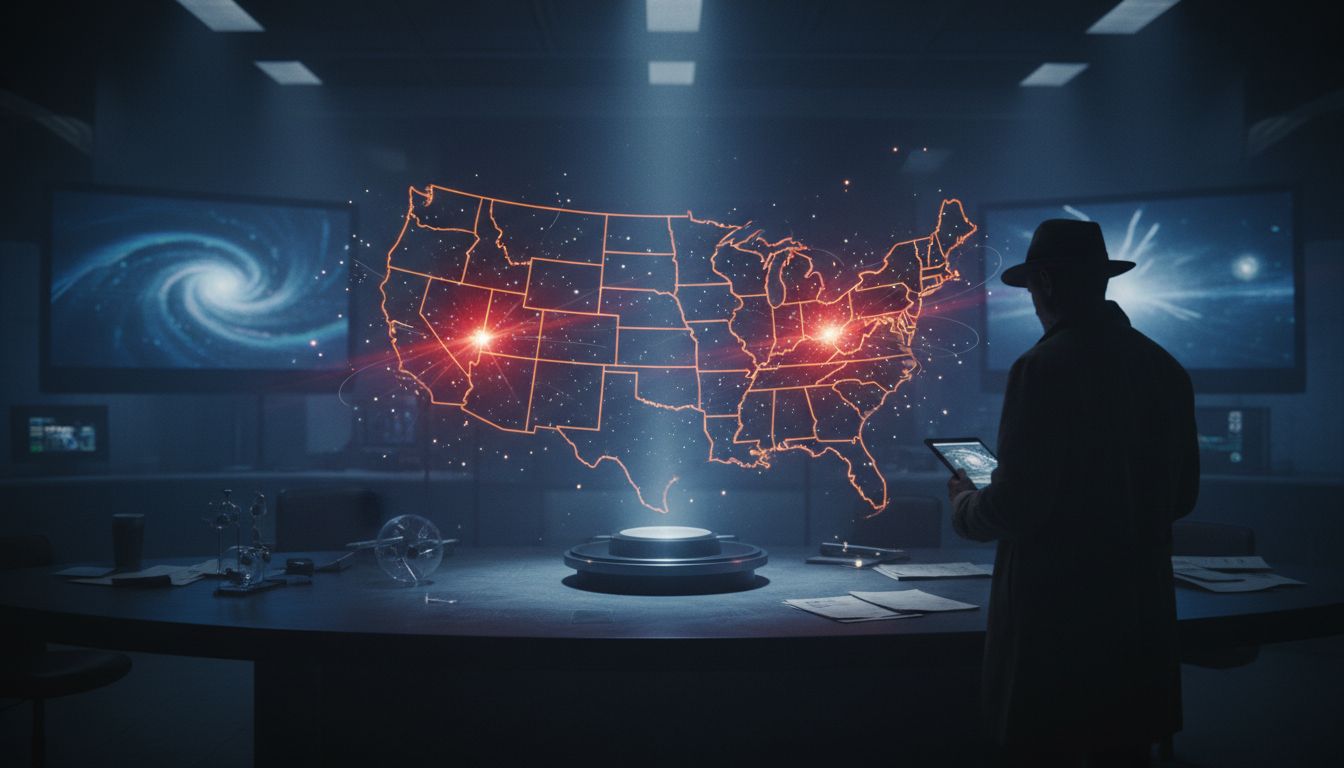
A new interactive map published by Newsweek ranks every U.S. state by the total number of reported UFO—or Unidentified Aerial Phenomena (UAP)—sightings. The visual, released on March 3, 2026, draws on several major reporting databases, including the Mutual UFO Network (MUFON), the National UFO Reporting Center (NUFORC), and recent Pentagon‑released UAP data. California, Florida and Texas occupy the top three positions, collectively accounting for more than one‑quarter of all documented encounters nationwide. The map underscores a measurable rise in public interest and intensifies calls from scientists and policymakers for a more systematic, government‑backed investigation of these phenomena.
Data Sources and Methodology
Newsweek’s compilation aggregates over 1.2 million sighting reports submitted between 1990 and 2025. Each entry is cross‑checked against the three primary civilian databases—MUFON, NUFORC, and the UAP Task Force’s public releases—to eliminate duplicate submissions. The agency then normalizes the figures by state population, producing both raw counts and per‑capita rates. While the raw totals highlight the sheer volume of reports from populous states, the per‑capita metric reveals that Washington, D.C., and Alaska also rank highly when adjusted for residents, a nuance the map makes visible through an interactive toggle.
The Leading States
- California leads with roughly 210,000 reported sightings, a figure bolstered by the state’s large aerospace industry, extensive coastal air traffic, and a culturally ingrained interest in extraterrestrial topics.
- Florida follows with approximately 165,000 reports, a number partly attributed to the state’s frequent military training exercises and its position as a hub for space‑related launches from Cape Canaveral.
- Texas rounds out the top three, tallying close to 150,000 sightings, reflecting its expansive skyward landscape and the presence of several major air‑space testing facilities.
These three states together represent about 43 % of all U.S. sightings recorded in the database, a concentration that aligns with their combined share of the national population.
Broader Context and Public Reaction
The map arrives amid a broader shift in how UFOs are discussed in mainstream circles. In 2022, the Pentagon declassified a preliminary UAP report, prompting congressional hearings and the establishment of a permanent UAP Office within the Department of Defense. Public polls conducted by the Pew Research Center in late 2025 indicated that 68 % of Americans now consider the investigation of UAPs a legitimate scientific priority. Advocacy groups such as the Scientific Coalition for UAP Research (SCU) have cited the map as evidence that civilian reporting continues to outpace official data collection, urging the government to create a unified, transparent reporting platform.
Calls for Systematic Investigation
Experts emphasize that the sheer volume of reports does not automatically equate to extraterrestrial activity, but it does signal gaps in current air‑space monitoring. Dr. Helen Ramirez, a senior researcher at the University of Colorado’s Atmospheric Sciences Department, notes, “When you have hundreds of thousands of credible, corroborated sightings, the responsible approach is to allocate resources for rigorous analysis—radar cross‑checks, sensor data, and atmospheric modeling.” Legislative proposals introduced in the 118th Congress now call for mandatory reporting of anomalous aerial events by all commercial and military pilots, as well as funding for a national UAP research center.
Looking Ahead
The Newsweek map serves as both a visual snapshot and a catalyst for deeper inquiry. By juxtaposing raw sighting counts with per‑capita rates, it highlights regional disparities that may point to underlying factors such as air traffic density, military activity, or even cultural propensity to report. As federal agencies move toward greater transparency, analysts anticipate that future iterations of the map will integrate real‑time sensor data, satellite imagery, and AI‑driven pattern recognition. Until then, the map remains a compelling reminder that the United States continues to generate the world’s largest repository of UFO reports—an archive that, if examined systematically, could yield insights far beyond the realm of speculation.


