Overview
Archaeologists announced on December 16, 2025 that they have uncovered the Valley Temple of King Nyuserre in Egypt’s Abu Ghurab region. Buried beneath more than a century of Nile silt, the massive structure is part of the Fifth Dynasty’s famed sun‑cult complex and promises fresh insight into the religious architecture and daily rituals of the period. The find comes as Egypt’s Ministry of Antiquities also unveiled newly restored colossal statues of Pharaoh Amenhotep III in Luxor, underscoring a broader governmental push to protect and showcase the country’s monumental heritage.
The Discovery
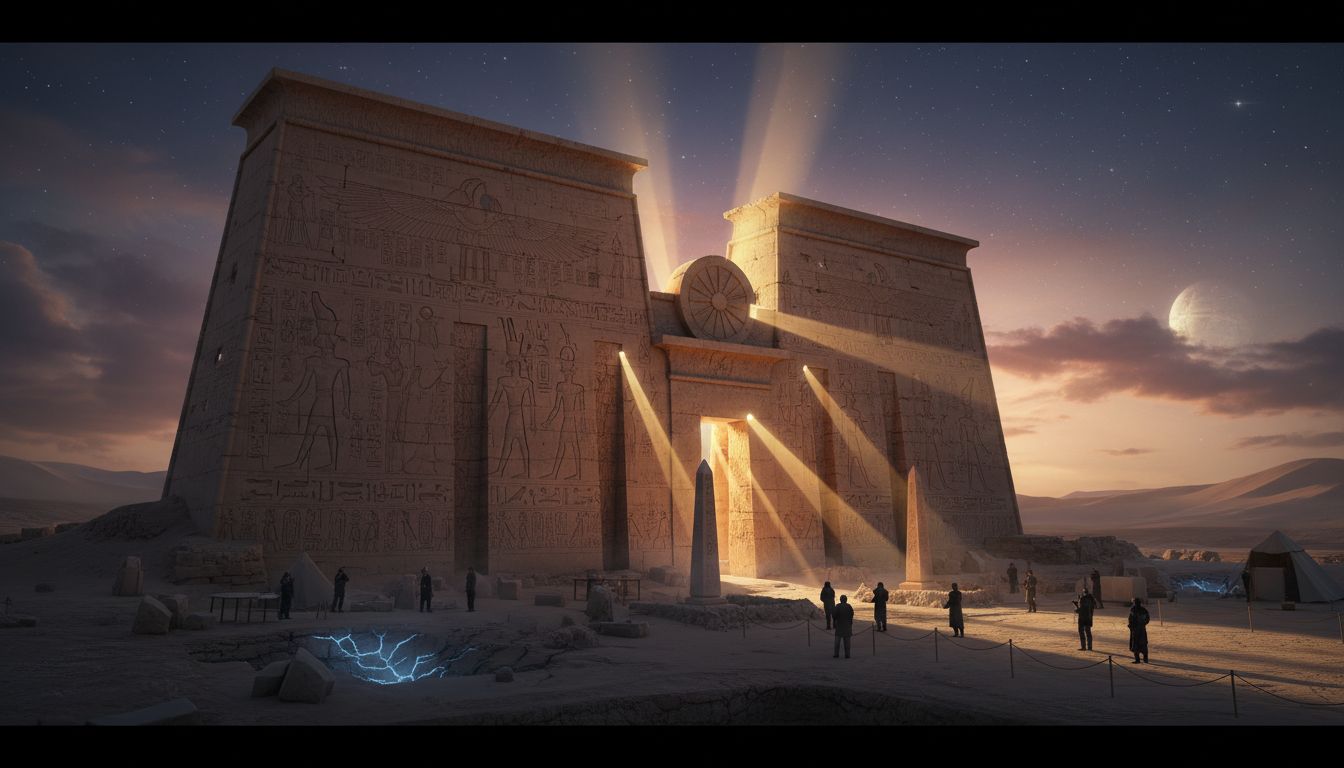
The excavation team, led by senior Egyptologist Dr. Slamani Aghilas, first identified the temple’s outline through high‑resolution satellite imagery and ground‑penetrating radar. “When the first stone was lifted we realized we were standing at the threshold of a lost royal sanctuary,” Aghilas said in a press briefing. The temple measures roughly 120 × 80 meters and is built from locally quarried limestone, featuring a central courtyard flanked by hypostyle halls. Intricate reliefs depict the sun‑god Ra in various guises, while a series of stone channels align precisely with the sunrise on the summer solstice, suggesting that the temple’s designers engineered the space to capture solar light at key moments of the year.
Historical Context
King Nyuserre, who ruled Egypt around 2450 BCE, is known from limited textual sources but never before associated with a dedicated valley temple. The Fifth Dynasty marked the height of the sun‑worship cult, a state‑sponsored religion that positioned Ra as the supreme deity and linked pharaonic legitimacy to celestial order. The newly uncovered carvings include scenes of the king presenting offerings to Ra, as well as depictions of daily temple activities—priestly purification, incense burning, and the ritual “opening of the eyes” ceremony. Such details fill gaps in our understanding of how royal ideology translated into concrete architectural programs across the Nile Valley.
Significance for Archaeology
Beyond its size, the temple’s astronomical alignments provide rare physical evidence of ancient Egyptian engineering precision. Researchers have already begun 3‑D modelling of the structure to test how light interacted with the reliefs during equinoxes and solstices. “This is one of the few sites where we can directly correlate textual references to solar festivals with built‑in architectural cues,” noted Dr. Mona El‑Sayed, a specialist in ancient Egyptian astronomy. The find also offers a comparative framework for other sun‑cult sites, such as the Abu Simbel temples of the New Kingdom, allowing scholars to trace the evolution of solar symbolism over centuries.
Broader Cultural Impact
The discovery coincides with the high‑profile unveiling of restored colossal statues of Amenhotep III in Luxor’s West Bank, a project that has drawn international media attention and substantial tourism revenue. Officials cite both events as evidence of Egypt’s renewed commitment to preserving and promoting its archaeological legacy. Minister of Antiquities Dr. Hany Mahfouz remarked, “From the Fifth Dynasty to the New Kingdom, our monuments tell a continuous story of innovation and devotion. By bringing these treasures back to the public eye, we reinforce Egypt’s identity as the cradle of civilization.”
Next Steps
The Abu Ghurab team plans a phased excavation, with the next season focusing on the temple’s inner sanctum and adjoining storage chambers. Conservation experts will stabilize the limestone reliefs before they are documented for possible inclusion in a future museum exhibition. Meanwhile, interdisciplinary collaborations are underway, pairing Egyptologists with astronomers, architects, and digital technologists to create immersive reconstructions for both scholars and the visiting public. As the sun‑cult temple emerges from the silt, it not only illuminates a forgotten chapter of ancient Egypt but also reinforces the nation’s ongoing dedication to uncovering, preserving, and sharing its timeless heritage.


