Overview
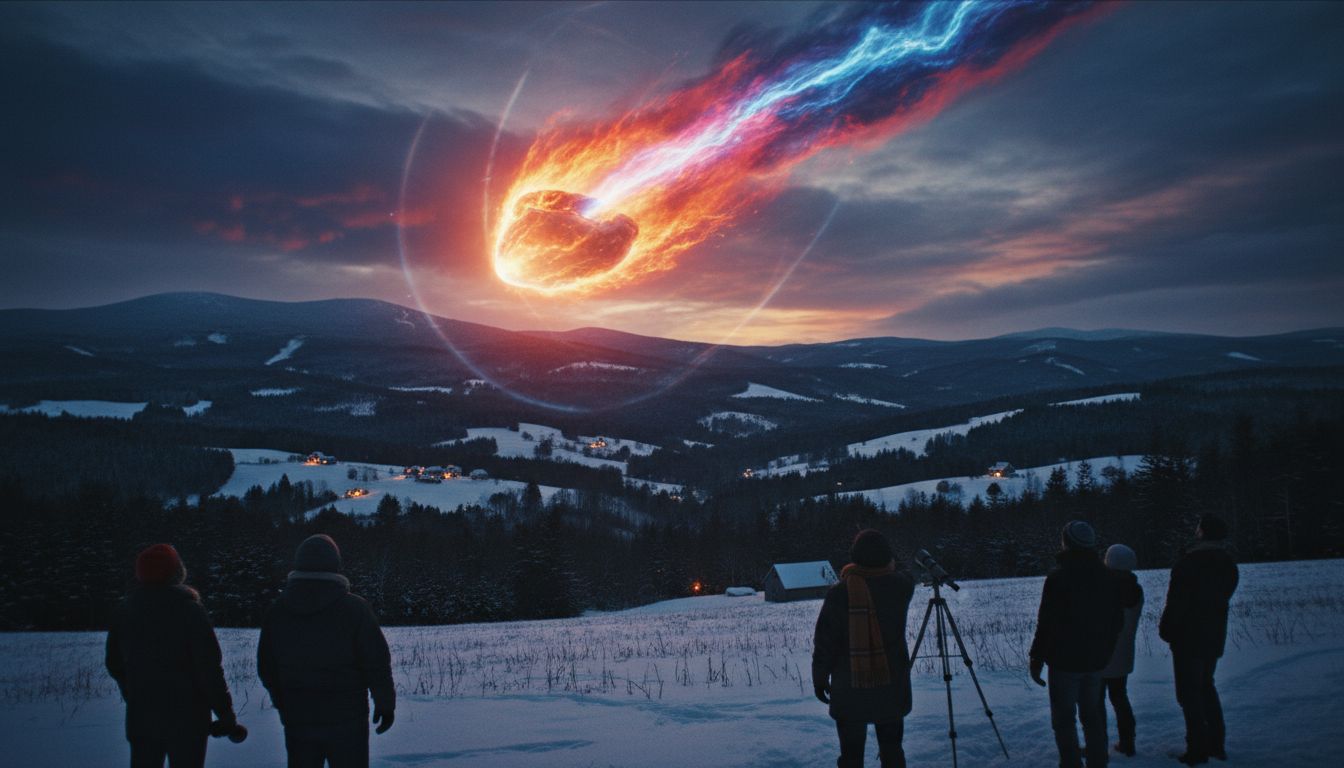
Late Thursday night, a bright fireball streaked across the skies of New England, its luminous trail visible from Boston to Portland. Preliminary calculations by NASA’s Near‑Earth Object Program estimate the object’s mass at roughly 5,000 to 6,000 pounds—comparable to an adult elephant. The event triggered a cascade of social‑media posts, many asking whether the flash was a “UFO” or an extraterrestrial craft. While the visual spectacle was dramatic, scientists quickly identified the phenomenon as a natural meteoroid entering Earth’s atmosphere.
Eyewitness Accounts
Residents in several towns described a sudden, thunderous roar followed by a brief shaking of houses, similar to the sensation of a distant train passing. “It was like the whole neighborhood got a jolt, and then the sky lit up in orange,” said Maria Delgado, a homeowner in Worcester, Massachusetts. Videos posted to TikTok and Twitter captured the fireball’s rapid descent, with some clips showing a brief, glowing fragment that appeared to linger before vanishing. The widespread sharing of these recordings amplified public curiosity and, in some circles, speculation about unidentified aerial phenomena.
Scientific Analysis
NASA’s Dr. Lena Patel, a senior researcher with the Center for Near‑Earth Object Studies, explained that the object’s size and speed match known characteristics of “bolides”—large meteoroids that burn up explosively in the upper atmosphere. “Based on the luminous intensity and the acoustic data recorded by infrasound stations across the region, we estimate the meteoroid entered at about 45 kilometers per second and disintegrated at an altitude of roughly 30 kilometers,” Patel said in a press briefing. The estimated mass, derived from the fireball’s brightness and trajectory, aligns with the “elephant‑sized” description circulating online. No debris has been recovered, and no damage beyond the reported tremors has been documented.
Public Reaction and UFO Speculation
The fireball reignited a long‑standing fascination with unidentified aerial phenomena (UAP) in the United States. Within hours, the hashtag #NewEnglandUFO trended on X, and local UFO research groups, such as the New England Sightings Alliance, issued statements urging investigators to keep an open mind. “While the scientific explanation is solid, we must remember that many UAP sightings have later been linked to atmospheric events we didn’t fully understand at the time,” said James Whitaker, the alliance’s spokesperson. Federal officials, however, reiterated that the event falls squarely within the parameters of a natural meteoric event, and no evidence suggests an artificial origin.
Broader Context
Fireball events are not uncommon; the American Meteor Society records several dozen annually across the continental United States. The most recent comparable incident occurred over Arizona in March 2025, when a 3‑ton meteoroid exploded over the desert, prompting a brief shockwave but no injuries. The New England fireball adds to a growing dataset that helps refine impact‑risk models and informs planetary‑defense strategies. As Dr. Patel noted, “Each event provides valuable data on how these objects behave, which improves our ability to predict and, if necessary, mitigate future threats.”
The episode underscores how dramatic natural phenomena can quickly become entangled with popular UFO narratives, reminding both the public and the scientific community of the importance of clear communication and rigorous analysis.