Overview
In the spring of 1895 residents of the Pine Lake area in Ontwa Township, Cass County, Michigan reported a series of attacks on livestock that were attributed to an unidentified predator. Contemporary newspaper accounts describe the creature as “large, lithe and ferocious,” with some witnesses likening its silhouette to a panther. The incidents—ranging from a startled horse that bolted and destroyed a buggy to the killing of ten sheep and a calf—generated local panic but left no physical evidence. While the events predate the modern “Dogman” legend by nearly a century, they have been cited in recent discussions of Michigan’s cryptid folklore as a possible historical antecedent.
The 1987 Dogman Narrative
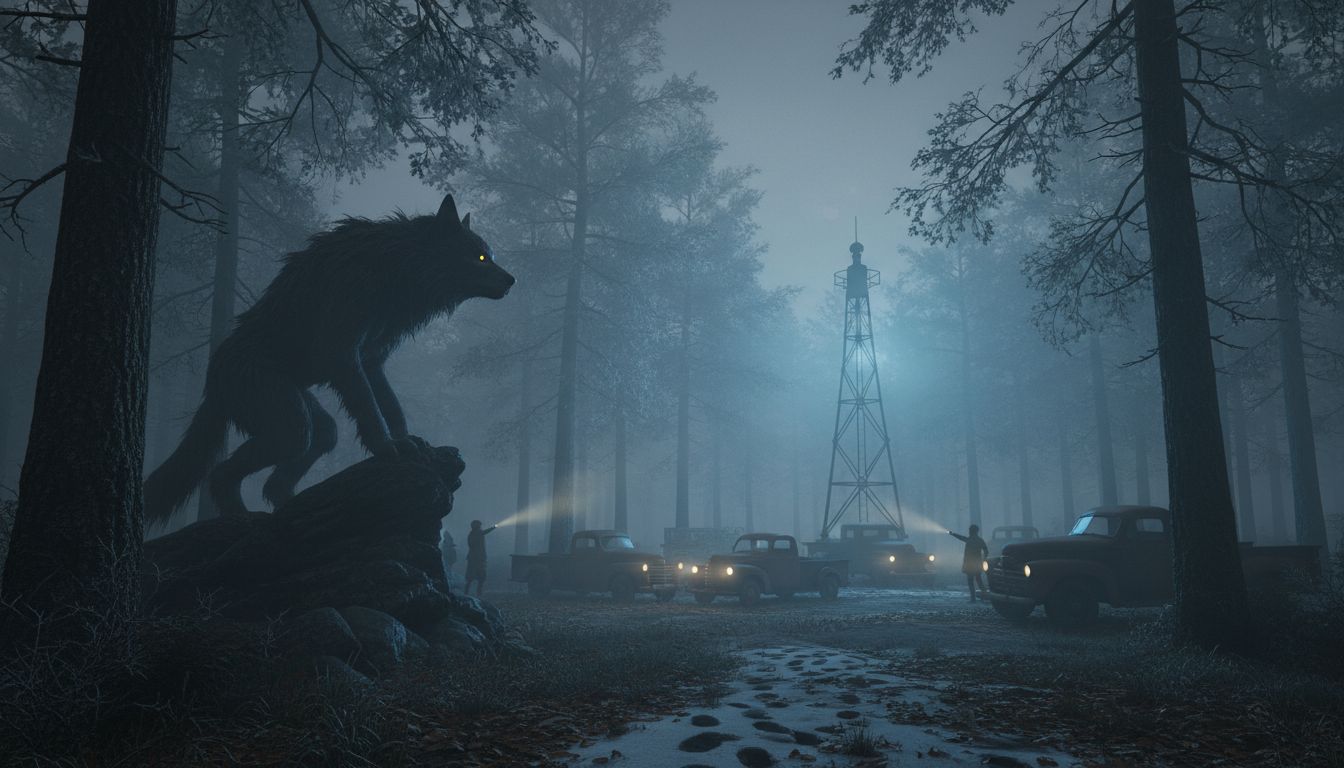
The Michigan Dogman entered popular consciousness in 1987 when Traverse City radio personality Steve Cook aired a novelty song titled “The Legend” on WTCM. Cook’s poem, set to music, described a seven‑foot‑tall, upright, canine‑like humanoid that allegedly appears every ten years, beginning with an 1887 encounter involving eleven lumberjacks on the Manistee River. Cook has repeatedly emphasized that the creature was a “fabricated folklore” created to give northern Michigan its own mythical monster, akin to Bigfoot or the Loch Ness Monster.
Despite the overtly fictional framing, the broadcast prompted a surge of listener calls. Callers claimed personal sightings or recounted second‑hand reports that seemed to confirm the Dogman’s existence. The phenomenon illustrates how media can catalyze collective memory: a single creative piece, presented as folklore, quickly becomes a reference point for interpreting ambiguous local experiences.
The Pine Lake Predator
The 1895 Pine Lake incidents provide a concrete historical backdrop that some modern enthusiasts link to the Dogman myth. According to the Niles Weekly Mirror (June 5, 1895), “farmers living near Pine Lake…are becoming frenzied over the appearance of a strange animal…the animal is said to resemble a panther.” Earlier that spring, two young men, Jay Truesley and Will White, reported hearing growls that spooked their horse, causing it to bolt and wreck their buggy. Shortly thereafter, Nathan Stewart lost ten sheep and Thomas Hobart lost a calf; authorities at the time blamed the losses on dogs, though the scale of the killings suggested a larger predator.
No photographs, tracks, or carcasses were recovered, and the reports remain limited to newspaper excerpts and oral recollections. The description of a “panther‑like” animal contrasts with Cook’s later depiction of an upright, bipedal canine, yet the lack of definitive identification leaves room for speculation. Researchers have proposed several mundane explanations, including a large feral dog pack, a roaming cougar (historically present in Michigan), or even a wolf pack exhibiting atypical hunting behavior.
Historical Context and Skepticism
Michigan’s wildlife in the late 19th century included wolves, coyotes, and occasional cougars, all of which could have been responsible for livestock predation. Historical records show that wolf populations were being aggressively reduced during that era, leading to heightened fear and occasional misidentification of other animals. Moreover, newspaper sensationalism was common; rural papers often embellished stories to attract readers, sometimes labeling any unknown predator as “panther‑like” regardless of actual morphology.
Academic folklorists stress that cryptid legends often arise from a confluence of genuine animal encounters, cultural anxieties, and narrative embellishment. The 1895 Pine Lake reports fit this pattern: a genuine, perhaps frightening, predator encounter becomes amplified in print, later reinterpreted through the lens of a modern myth. The absence of physical evidence—such as tracks, fur, or skeletal remains—makes it difficult to substantiate claims of an unknown species.
Ongoing Cryptid Interest
The resurgence of the Dogman story each decade, spurred by Cook’s original song and subsequent media coverage, demonstrates the durability of regional folklore. Contemporary cryptozoology forums frequently reference the 1895 Pine Lake attacks as an early “Dogman‑type” incident, despite the divergent descriptions. This blending of historical reports with modern myth underscores a broader trend: the human tendency to retrofit past mysteries into current narratives.
While the Pine Lake predator remains an unresolved episode in Michigan’s rural history, it serves as a reminder that folklore can both preserve and transform local experiences. For scholars and enthusiasts alike, the key lies in distinguishing documented fact—newspaper reports, livestock loss records—from later embellishments. As long as the Dogman continues to appear in popular culture, episodes like the 1895 attacks will likely retain a place in the ongoing dialogue between history and legend.