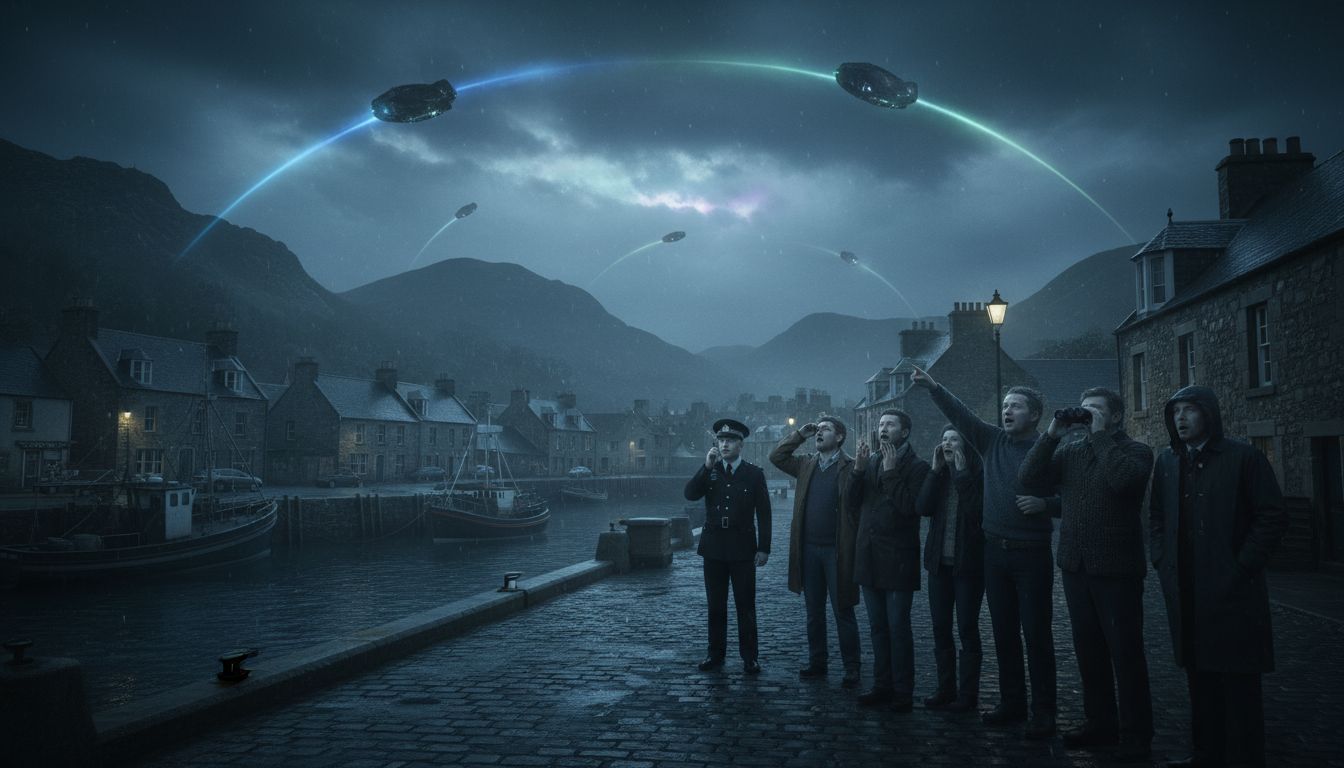
Residents of a small Scottish town reported a series of bright, erratically moving lights over the evening sky on Thursday, describing the phenomenon as “mind‑boggling.” Witnesses said the objects hovered for several minutes before accelerating away at speeds that seemed to defy conventional aircraft performance. One local, who asked to remain anonymous, told reporters, “I’ve lived here for 30 years and have never seen anything like it – they darted, stopped, then shot off in a flash.” The sightings, which occurred between 21:30 and 22:15 GMT, were captured by several by‑standers on smartphones, though the recordings have not yet been released to the public.
The town’s police force confirmed that it received multiple calls after the incident but said it had not identified any conventional explanation. “We have logged the reports and are liaising with the Ministry of Defence’s Unidentified Aerial Phenomena (UAP) desk,” said PC Alistair McDonald of the local constabulary. A spokesperson for the Royal Air Force declined to comment on specific incidents but noted that routine training flights are monitored in the region and that any unidentified activity would be investigated under existing protocols. No official statement from the Ministry of Defence has been issued, and the authorities have not ruled out atmospheric or astronomical causes.
The Scottish sighting adds to a noticeable rise in UAP reports across the United Kingdom over the past year. In June 2024, the UK government released its first comprehensive UAP assessment, acknowledging 130 credible sightings between 2008 and 2023, many of which remained unexplained. Since then, the Ministry of Defence has established a dedicated UAP task‑force, tasked with collecting and analysing data from civilian and military sources. In a recent briefing, Defence Minister James Heappey said the task‑force “will ensure that any potential threats to national security are examined rigorously, while also improving transparency for the public.” The Scottish incident is now part of that ongoing data set.
Aviation analyst Dr. Fiona MacLeod of the University of Edinburgh cautioned against jumping to extraordinary conclusions. “Unusual aerial displays can result from a range of factors – from drone swarms and high‑altitude balloons to rare meteorological reflections,” she explained. MacLeod added that the UK’s increased reporting mechanisms may simply be capturing events that would previously have gone unnoticed. Nonetheless, she noted that the “speed and maneuverability described by witnesses are not consistent with known commercial or military platforms,” underscoring the need for systematic investigation.
For now, the community remains divided between curiosity and skepticism. A local café owner, who displayed a printed screenshot of one of the videos, said, “It’s got everyone talking – some think it’s a prank, others think we’ve got something we don’t understand.” Police have asked residents to forward any additional footage or observations, and the UAP task‑force has indicated it will review the material in the coming weeks. As the inquiry proceeds, the town’s skywatchers will be watching the heavens a little more closely, hoping for answers that are as grounded as the questions themselves.