Overview
A new comparison of online ghost reports suggests that the way people describe apparitions has changed significantly over the past three decades, even though reported fear levels have remained stable. Author and ghost researcher M.J. Wayland examined 1,000 first-hand accounts published between 1994 and 2012 and compared them with 1,000 Reddit accounts posted between 2024 and 2026.
The study found that descriptions of pale, solid human figures have increasingly given way to faceless silhouettes and shadow-like entities. Shadow figures appeared in 14% of the newer accounts, compared with 6% in the earlier sample. However, the proportion of witnesses who said they felt afraid was identical in both periods: 57%.
Key Findings
Wayland’s team coded each account against the same 29 measures, including the appearance of the reported entity, sounds, location, witnesses present and the emotional response of the person describing the event. Artificial intelligence was used to assist with the counting and categorization, while Wayland and his team checked a random sample against the original reports.
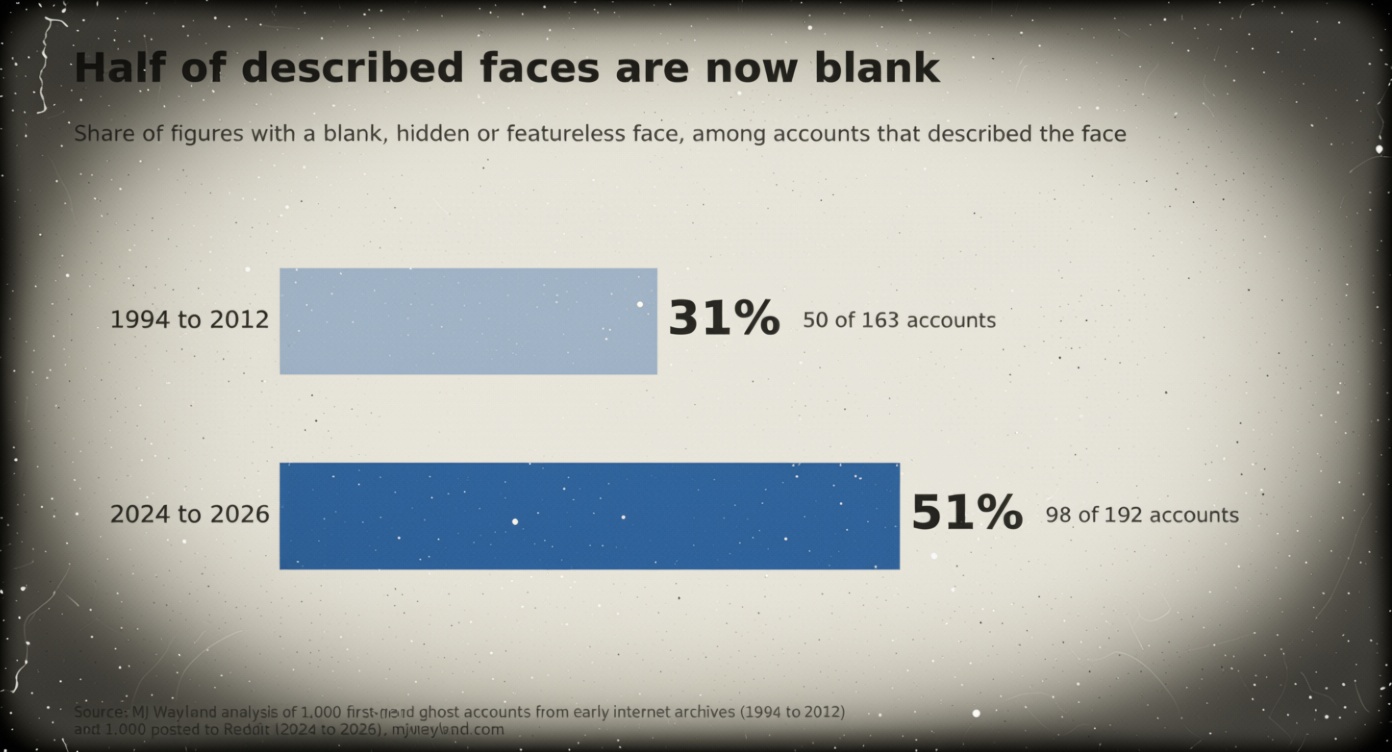
The shift toward shadow figures appeared in both Reddit communities examined. They accounted for 14.3% of reports in one group and 13.4% in the other. Among accounts that described an entity’s appearance, 50% of recent figures were characterized as shadowy silhouettes without detail, compared with 29% in the earlier material. Of figures whose faces were described, 51% of modern accounts referred to faces that were blank, hidden or featureless, up from 31%.
By contrast, solid figures resembling living people declined from 47% of described sightings to 35%. White, glowing or translucent figures fell from 24% to 15%. Wayland also noted a rise in references to hat-wearing entities, although the supplied findings do not provide a separate percentage for that category.
Context and Interpretation
“The ghost people used to describe was usually somebody, often a figure who looked as real as the witness did,” Wayland said. “What people describe now is far more often a shadow with no face. It was a big surprise, because the difference in sightings is huge.”
The broader circumstances of the reports changed less dramatically. Most encounters in both periods occurred at home and at night, with roughly half of indoor incidents taking place in bedrooms while witnesses were in bed or falling asleep. Reports involving another person who perceived the same event declined from 34% to 23%, while encounters involving deceased relatives dropped from 9% to 6%.
The findings also suggest that changing language may be more important than changing timing. In a smaller group of 74 modern accounts describing experiences that had occurred before 2010, shadow figures were reported in 19% of cases. Wayland said this indicates that people may reinterpret older experiences using contemporary paranormal vocabulary. “When people today look back on something that happened to them 20 years ago, they describe it in today’s terms,” he said.
Psychological and Social Explanations
One possible framework discussed alongside recurring paranormal reports is “Haunted People Syndrome,” a proposed psychological and social explanation for individuals who repeatedly experience or interpret unusual events as supernatural. Such a model may consider factors including sleep disruption, expectation, memory, online communities and cultural narratives.
Critics argue that explanations of this kind can be overly reductive, particularly when they treat witnesses as mistaken or imply that responsibility lies with the person reporting the encounter. They also contend that a psychological or social account may overlook witnesses’ claims that the events have an external or supernatural cause. Wayland’s comparison does not establish what produces the experiences; it documents changes in reporting patterns and language. As he acknowledged, the possible influence of phrases such as “shadow people” spreading through forums, radio and online horror stories remains a hypothesis rather than a demonstrated finding.