Overview
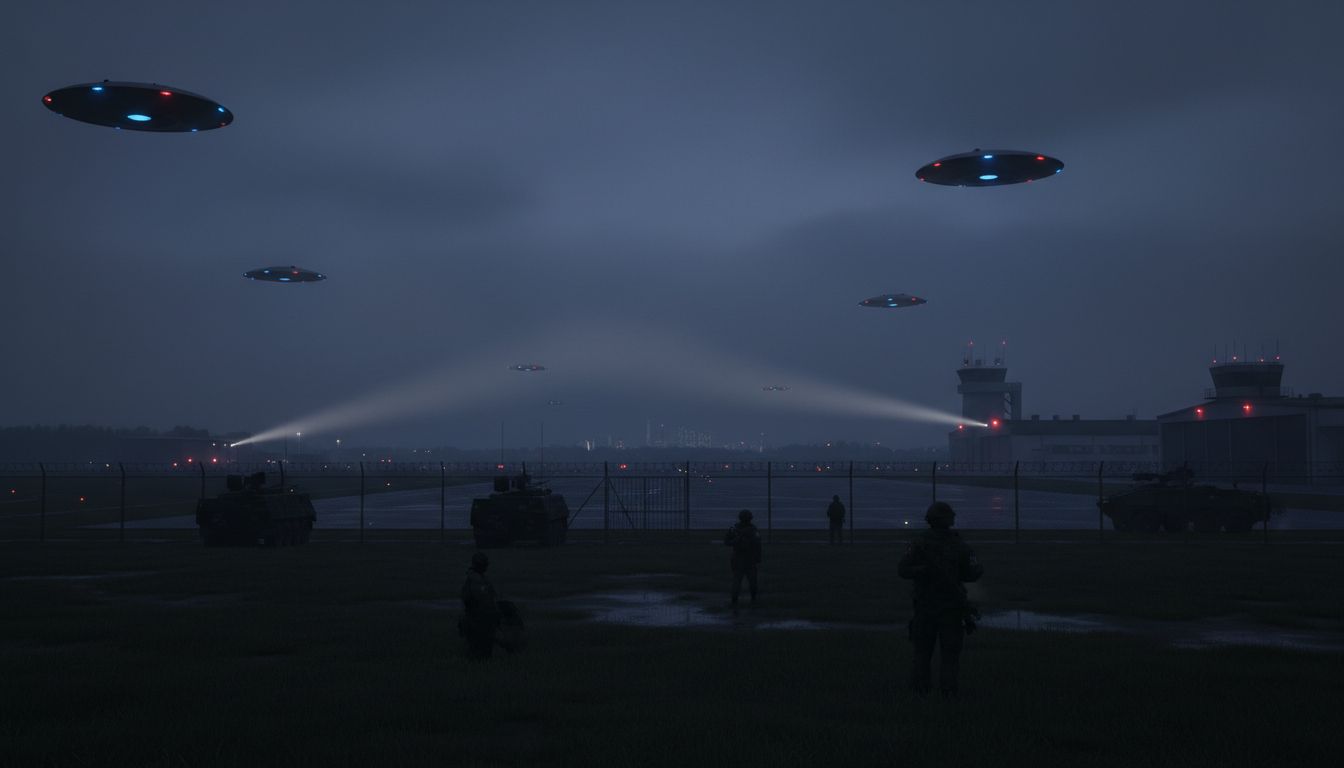
In the early evening of Saturday, 22 November 2025, a second wave of unmanned aerial systems was sighted over the Dutch Royal Air Force’s Volkel Air Base, just hours after a similar swarm forced a temporary shutdown of nearby Eindhoven Airport. Dutch Ministry of Defence officials confirmed the renewed incursion on Sunday, noting that the drones entered the base’s restricted airspace despite the activation of standard counter‑drone protocols. The incident, which lasted roughly ten minutes before the objects disappeared, has reignited concerns about persistent unauthorized aerial activity in a region already hosting a dense mix of civilian and military traffic.
Timeline of Events
The first intrusion occurred at 15:30 CET when several small‑scale drones breached the 5‑kilometre security perimeter of Eindhoven Airport, prompting air traffic controllers to halt departures and arrivals for about 45 minutes. Defence Minister Kajsa Ollongren later described the event as “a coordinated, low‑altitude operation that exploited gaps in our detection net.” Within two hours, at 19:10 CET, radar operators at Volkel Air Base reported multiple contacts moving at low altitude and high speed, matching the flight profile of the earlier drones. Ground‑based laser systems were activated, but no hostile engagement was recorded. By 19:20 CET, the drones had exited the base’s airspace, and normal flight operations resumed at the nearby airport.
Security and Defence Response
Volkel Air Base, home to U.S.‑operated F‑35A Lightning II squadrons under NATO’s forward‑deployment agreement, follows a layered air‑defence scheme that includes the Dutch Patriot system, ground‑based radars, and mobile Counter‑UAS units. According to a spokesperson for the Royal Netherlands Air Force (RNLAF), “Our sensors detected the objects, but their small radar cross‑section and erratic flight paths limited the effectiveness of kinetic counter‑measures.” The Dutch Ministry of Defence has launched an internal investigation to determine whether the drones were commercial hobbyist devices, commercially available “off‑the‑shelf” systems, or more sophisticated platforms. A joint task force with the Dutch National Police and Royal Military Police will review flight‑log data, video recordings, and any recovered debris.
International Coordination Concerns
The twin incidents have exposed coordination challenges between Dutch authorities and allied U.S. defence agencies stationed at Volkel. Lt. Col. Mark Stevens, a U.S. Air Force liaison, told Defense News that “information sharing protocols are robust on paper, but real‑time data exchange during fast‑moving events like this remains a work in progress.” The United States European Command (EUCOM) has been briefed, and a senior NATO liaison is expected to visit the base next week to assess joint response capabilities. Analysts point out that the proximity of civilian airspace to a high‑value NATO asset creates a “complex risk environment” that demands seamless cross‑border communication.
Analyst Perspectives and Broader Context
UFO‑focused journalists and security analysts have weighed in, cautioning against speculative narratives while acknowledging the “unusual persistence” of the incursions. Dr. Janine van der Meer, senior researcher at the Netherlands Institute of Security Studies, remarked, “Repeated drone sightings over both a civilian airport and a NATO air base within a short window suggest a coordinated testing of detection gaps rather than isolated hobbyist activity.” Meanwhile, UFO investigative outlet UFOWatch cited anonymous sources hinting at “potential classified aerial testing,” a claim the Dutch Ministry of Defence has neither confirmed nor denied. The incidents arrive amid a broader European uptick in unauthorized drone activity, prompting the European Union Aviation Safety Agency (EASA) to draft new low‑altitude flight regulations slated for early 2026.
The ongoing investigation will determine the technical specifications of the drones, their origin, and whether they represent a new threat vector for both civilian aviation and NATO operations. Until definitive findings emerge, authorities urge the public to report any suspicious aerial activity and reaffirm their commitment to safeguarding Dutch airspace.


