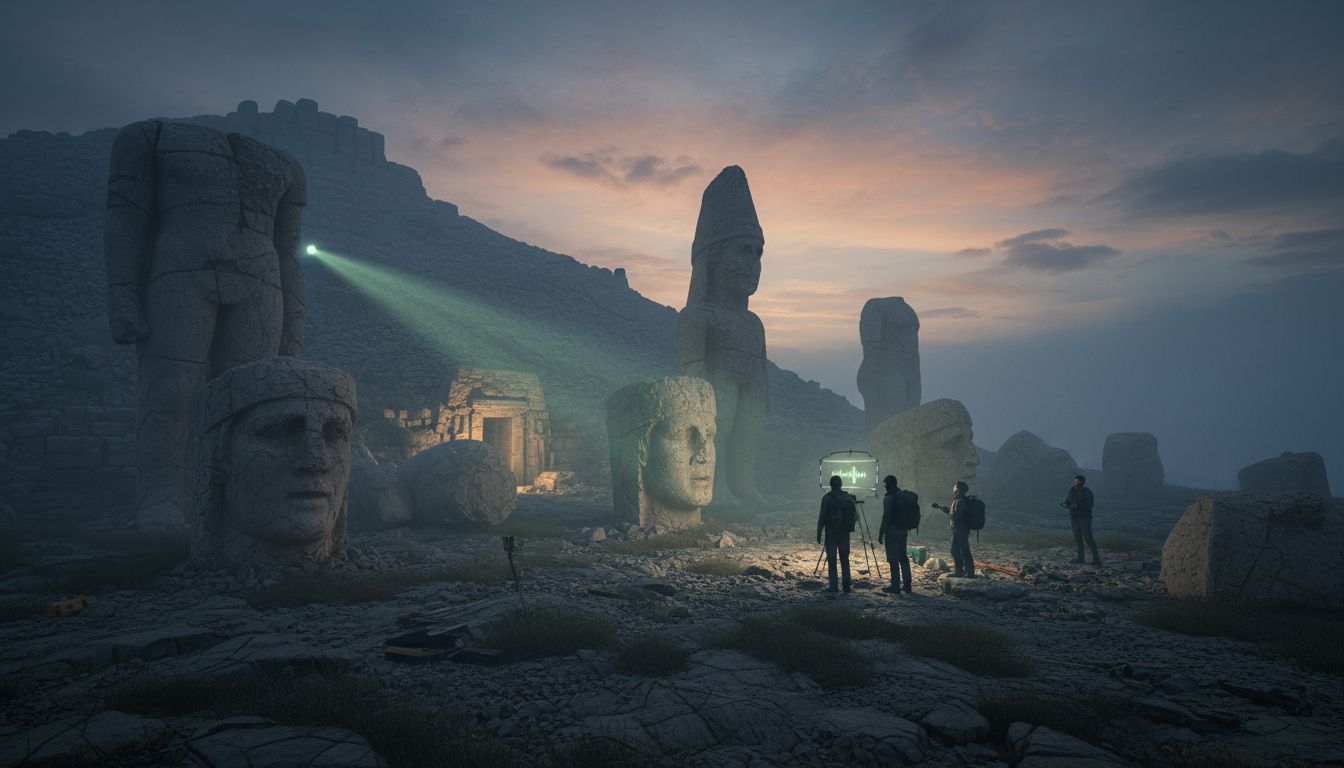
The limestone summit of Mount Nemrut, rising 2,134 metres above the Turkish‑Armenian border, has long drawn visitors to its eerie procession of colossal stone heads. Carved in the first century BCE by King Antiochus I of Commagene, the monument was intended as a royal sanctuary where the king could commune with a pantheon that blended Greek and Persian deities. Each of the thirty‑odd statues—some exceeding three metres in height—represents a god, a hero or the king himself, their solemn gazes fixed on the horizon as if guarding the burial chamber that lies beneath the artificial mound. The site, a UNESCO World Heritage listing since 1987, remains one of the most striking examples of Hellenistic‑Eastern syncretism in the ancient world.
Recent fieldwork, conducted by a coalition of Turkish and international researchers, has focused on the hidden tomb that Antiochus is believed to have built beneath the altar. Using ground‑penetrating radar (GPR), LiDAR scanning and portable X‑ray fluorescence (pXRF) devices, the team has mapped subsurface anomalies without disturbing the stone platform. “The non‑invasive techniques allow us to see where voids and structural changes exist, giving us a clearer picture of the burial architecture,” said Dr. Ahmet Öztürk, lead archaeologist from the University of Istanbul’s Department of Near Eastern Studies. Preliminary results suggest a central chamber surrounded by a series of peripheral rooms, a layout that aligns with contemporary royal tombs in the Near East, but the exact location of the sarcophagus remains unconfirmed.
The research has also shed light on the statues’ original appearance. Microscopic pigment analysis indicates that the heads were once painted in vivid reds, blues and gold leaf, a fact that contradicts the monochrome image most visitors associate with the site. “The colors would have made the deities appear almost divine against the stark mountain sky,” noted Maria Keller, a conservation specialist with the International Council on Monuments and Sites (ICOMOS). While the pigments have long since faded, the findings have prompted a proposal for a limited, reversible color reconstruction in a virtual reality exhibit at the on‑site museum, allowing tourists to visualise the monument as it might have looked two millennia ago.
Tourism to Nemrut has surged in recent years, with visitor numbers climbing by 18 percent in 2024 after the Turkish Ministry of Culture and Tourism launched a new “Ancient Horizons” campaign. The influx has spurred both economic benefits for nearby villages and concerns about site preservation. Authorities have introduced a timed‑entry system, limiting daily visitors to 3,000 and mandating guided tours to keep foot traffic away from vulnerable areas. “Balancing access with conservation is a delicate task,” said Fatma Yılmaz, a spokesperson for the Ministry. “Our goal is to share this heritage responsibly while protecting it for future generations.”
Beyond the immediate archaeological intrigue, Mount Nemrut offers a broader lens on the political aspirations of Antiochus I, who sought to legitise his rule by positioning himself as a bridge between East and West. The king’s own inscription, carved into a limestone slab at the site, declares his lineage from both Persian and Macedonian ancestors and outlines a vision of unity under a shared divine order. Scholars continue to debate the extent to which the sanctuary functioned as a genuine religious centre versus a monumental propaganda piece. As non‑invasive technologies peel back layers of stone and soil, the balance of myth and history at Nemrut becomes ever more nuanced, preserving the mystery that has kept scholars and travelers alike staring up at those stone gods for two thousand years.