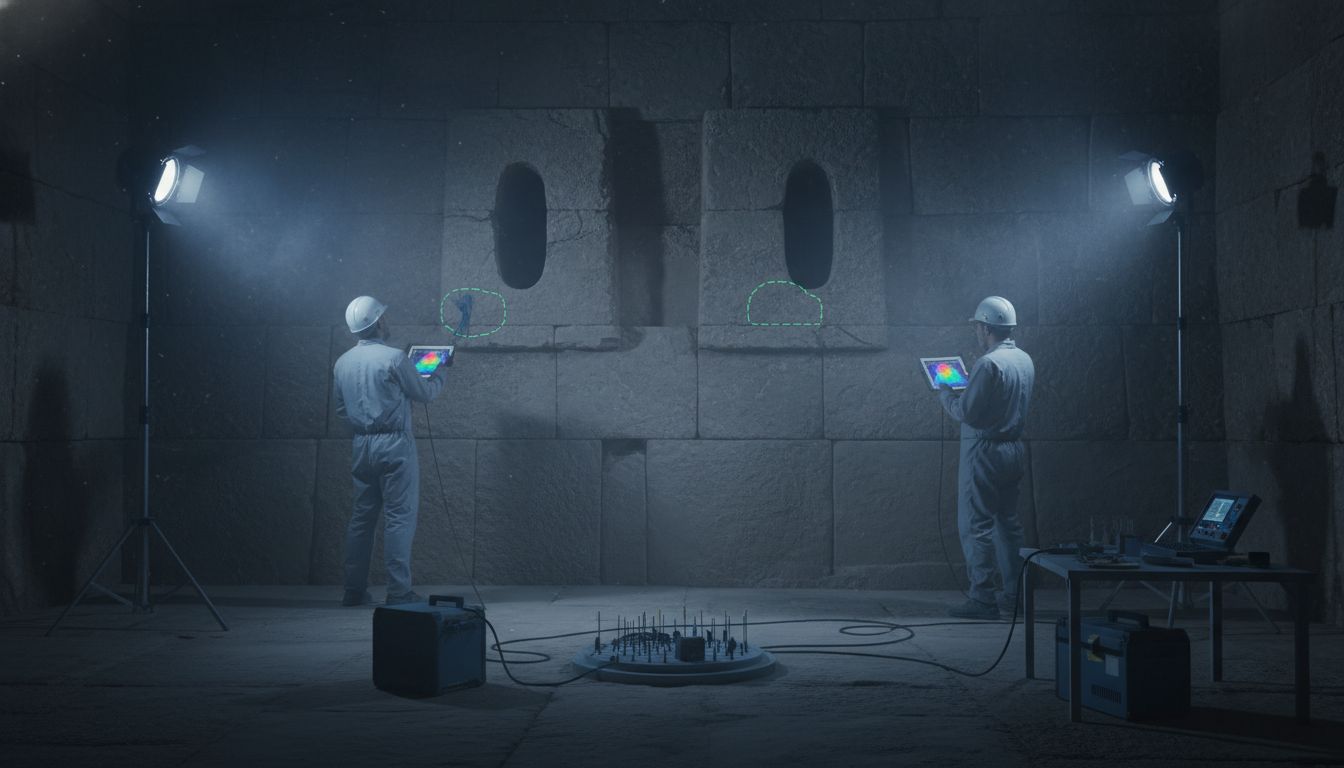
Researchers from the Scan Pyramids project have identified two previously unknown air‑filled voids behind the eastern façade of the Menkaure pyramid at Giza, bolstering a century‑old hypothesis that the third‑largest pyramid once featured a concealed entrance. The discovery was made using a suite of non‑invasive techniques—electrical resistivity tomography (ERT), ground‑penetrating radar (GPR) and high‑frequency ultrasonic testing—that together mapped variations in density and material composition within the stone mass without any physical intrusion.
The voids, each roughly the size of a modest bedroom, were detected at a depth of about 7 metres beneath the outer limestone casing. Their location aligns with the “Eastern Chamber” described in a 19th‑century French survey of the pyramid, which suggested a hidden passage leading from the outer wall toward the interior burial chambers. “The signatures we recorded are consistent with empty space rather than masonry or rubble,” said Dr. Laila Hassan, the project’s lead geophysicist. “When the same methods were applied to the Great Pyramid last year, they revealed the so‑called “Grand Gallery” anomaly, and the parallel results here give us confidence that we are looking at genuine voids.”
The Scan Pyramids initiative, a collaborative effort involving Egypt’s Ministry of Antiquities, the German Archaeological Institute and several university partners, has been applying cutting‑edge geophysical tools to the Giza plateau since 2022. Its most publicised success came in 2023 when GPR and muon‑particle detection uncovered a previously unknown “relieving chamber” above the King’s Chamber in the Great Pyramid, prompting a wave of renewed scholarly interest in the engineering of ancient Egyptian monuments. The Menkaure findings extend that momentum, suggesting that the smaller, less‑studied pyramids may also conceal architectural complexities that have escaped traditional excavation.
Historians have long debated whether Menkaure, the fourth pharaoh of the Fourth Dynasty, incorporated a concealed entrance for ritual or protective purposes. Classical writers such as Herodotus mentioned hidden doors in the pyramids, and 19th‑century Egyptologists like Flinders Pryce recorded anomalies in the eastern wall of Menkaure’s structure. The new data provide the first scientific verification of those observations. “If these voids connect to a narrow corridor, they could represent a functional entry point used during the pyramid’s construction or for later ceremonial access,” noted Professor Ahmed El‑Shazly, an Egyptologist at Cairo University. “Such a passage would have allowed workers to move stone blocks without exposing the burial chamber, a practice hinted at in ancient building manuals.”
While the presence of the voids is now well‑documented, researchers caution that further work is needed before any definitive conclusions about their purpose can be drawn. The team plans to conduct additional ultrasonic tomography and, if feasible, deploy micro‑drone probes that could navigate the spaces without disturbing the surrounding stone. Until then, the find underscores the growing role of non‑destructive technologies in archaeology, allowing scholars to probe millennia‑old structures with unprecedented precision while preserving their integrity for future generations.


