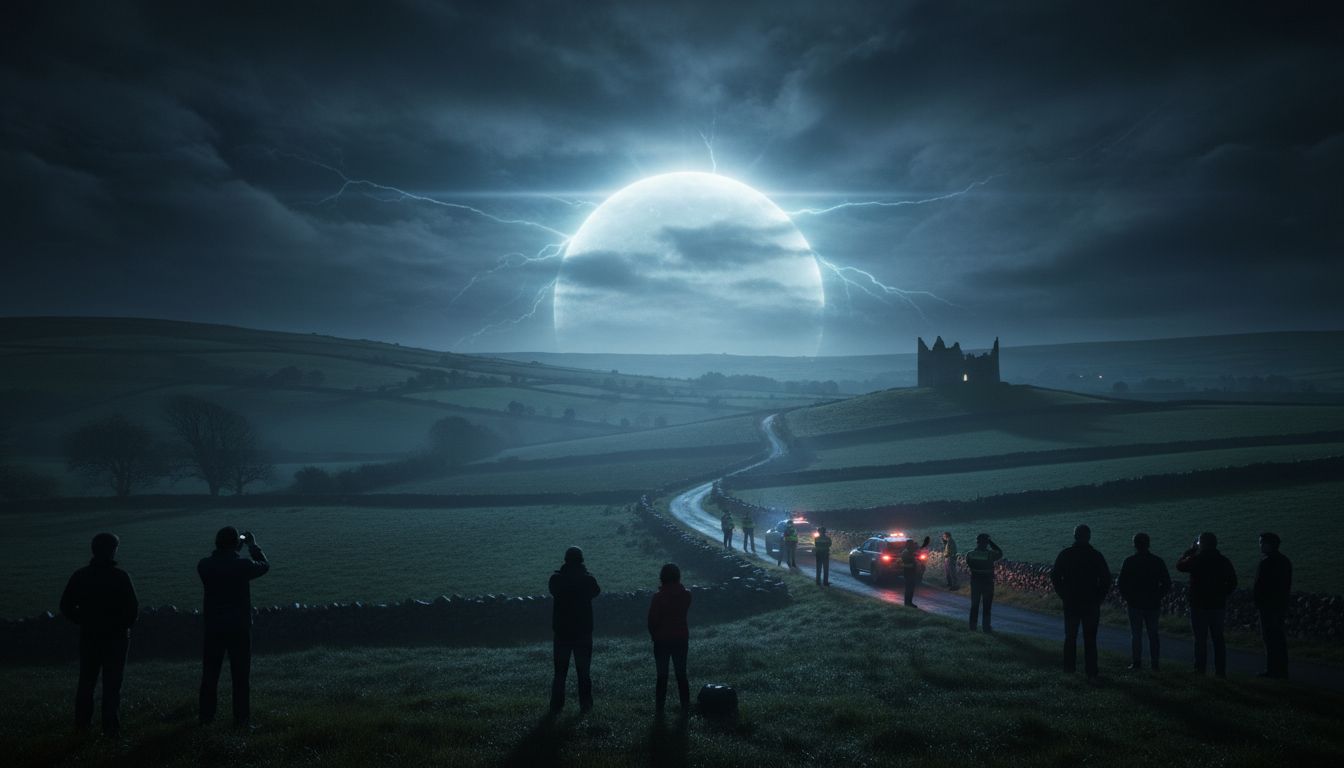
A luminous object that appeared over much of the Republic of Ireland on the evening of 30 October has ignited a wave of speculation on social media, with many users labeling it a “UFO” and posting videos that show a steady, bright point moving slowly across the horizon. The phenomenon was first reported around 19:45 GMT by motorists on the M7 near Naas and quickly spread to Twitter, where the hashtag #IrishSkyLight amassed more than 12 000 mentions within an hour. Witnesses described the light as “brighter than a full‑moon” and “hovering for several minutes before disappearing to the north‑west,” but the exact duration and trajectory remain difficult to confirm due to the varying angles of the recordings.
The Department of Defence confirmed that it has opened a formal inquiry, coordinating with the Irish Aviation Authority (IAA) and the Garda Síochána’s Public Order Unit. “We are treating the report as a routine aviation incident until we have concrete data,” said Defence Minister Simon Harris in a brief statement released on 31 October. “Our priority is to verify whether the sighting was caused by any aircraft, drone activity, or other aerial objects that may pose a safety risk.” The IAA’s preliminary bulletin, posted on its website early Tuesday, noted that no commercial flights were scheduled over the affected airspace at the time and that radar logs have not yet shown any unidentified return. An official from the IAA, who requested anonymity pending the investigation’s outcome, added that “unusual atmospheric phenomena, such as lenticular clouds illuminated by city lights, can sometimes be misinterpreted as solid objects, especially when observed from the ground at night.”
Astronomers at the Irish Astronomical Society (IAS) have offered a more technical perspective. Dr. Aoife Ní Chonaill, the society’s senior lecturer in astrophysics at University College Dublin, explained that “a bright, stationary point that moves slowly could be consistent with a high‑altitude satellite re‑entering the atmosphere, or a piece of space debris reflecting sunlight after sunset.” She noted that the timing of the event coincided with the twilight window when the Sun sits just below the horizon, a condition that can make low‑orbit objects appear unusually luminous. “We are currently cross‑checking the sighting against the known satellite passes for that night, including the Iridium and Starlink constellations,” Dr. Ní Chonaill said.
The sighting has also revived public interest in Ireland’s historical record of anomalous aerial observations. The Irish UFO Research Group (IURG), which maintains a database of reports dating back to the 1950s, logged 27 similar incidents in the past decade, most of which were later attributed to aircraft, weather balloons, or astronomical events. “While the majority of reports have conventional explanations, a small fraction remains unexplained after exhaustive analysis,” said IURG coordinator Liam O’Shea. “That does not necessarily imply extraterrestrial activity; it simply reflects the limits of our current data.” O’Shea cautioned against drawing premature conclusions, emphasizing the need for systematic evidence such as radar tracks, photographic metadata, or corroborating eyewitness testimony.
In the meantime, authorities have urged the public to refrain from speculation that could hinder the investigation. “We understand the curiosity such an event generates, but we ask anyone who captured footage or has additional information to forward it to the Garda’s national hotline (191) or the IAA’s incident desk,” the Defence Ministry reiterated. As the inquiry proceeds, the focus will remain on establishing a factual account of the light’s origin, ensuring aviation safety, and providing clear communication to the public. Whether the bright apparition will be classified as a mundane atmospheric or technological occurrence, or remain an unresolved mystery, the incident underscores the continued intersection of public fascination and scientific scrutiny in the age of ubiquitous sky‑watching.