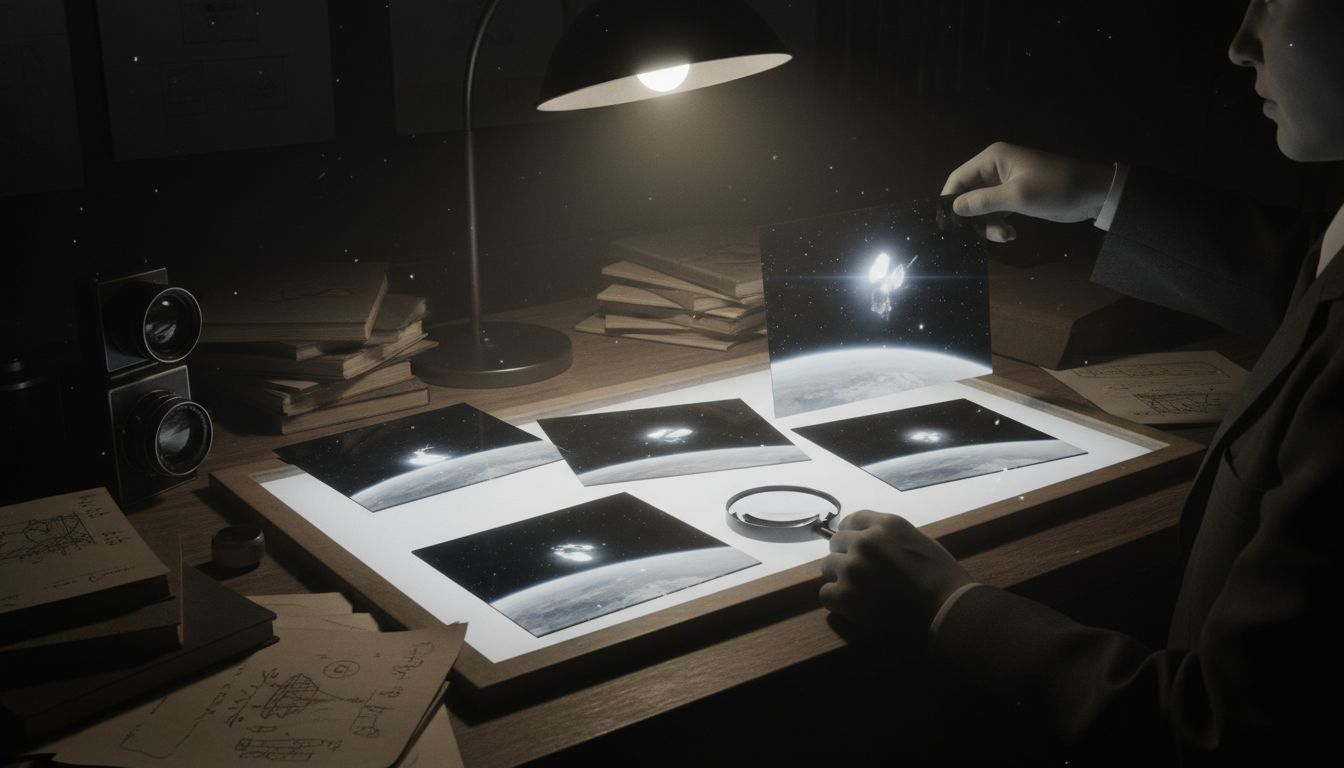
Photographic plates taken by astronomers and amateur sky‑watchers in the decades before the launch of Sputnik 1 in October 1957 have resurfaced in a new analysis published by the Spanish‑language outlet La Brújula Verde. The researchers who revisited the images argue that a series of unusually bright, point‑like flashes captured on the emulsion may represent “artificial reflective objects in orbit,” suggesting that some form of human‑made debris – or perhaps something else – was circling the planet well before the first confirmed satellite. The claim has sparked a fresh round of debate among historians of spaceflight, optical astronomers, and UFO researchers, who are now weighing the plausibility of an early, undocumented orbital presence against more conventional explanations such as meteors, aircraft, or photographic artefacts.
The plates in question come from a variety of observatories across Europe and North America, most notably the Harvard College Observatory’s “Plate Archive” and the Royal Observatory, Edinburgh’s sky‑survey series. They date from the early 1940s through the mid‑1950s and were originally intended to document variable stars, nebulae, and cometary activity. In several frames, analysts identified small, intensely luminous points that appear in a straight‑line progression across successive exposures, a pattern that, according to the La Brújula Verde team, is inconsistent with the random trajectories of meteors. “When we over‑laid the timestamps and the plate coordinates, the objects move at a constant angular velocity that matches what we would expect from an object in low Earth orbit,” said Dr. Elena Martínez, a physicist who led the re‑examination. She added that the objects’ brightness and lack of trailing suggest a highly reflective surface, possibly metallic, rather than the incandescent glow typical of meteoric entry.
Skeptics, however, caution that the evidence remains circumstantial. “Photographic plates are notoriously sensitive to a range of artefacts – dust, chemical imperfections, even the pressure of the plate holder can produce spurious spots,” noted Professor James Whitaker, an optical instrumentation specialist at the University of Cambridge. He pointed out that the plates were developed using a variety of chemical baths, and that “a small particle of silver nitrate, for instance, can create a bright, point‑like impression that mimics a distant light source.” Moreover, the historical record shows no credible documentation of any nation possessing orbital launch capability before 1957, and the secretive nature of early Cold‑War projects would likely have left some trace in declassified archives, a point emphasized by Dr. Karen Liu, a historian of aerospace programs at the Smithsonian Institution.
The notion of pre‑Sputnik artificial objects is not entirely new. In the 1970s, a handful of researchers proposed that the “Luminous Phenomena” recorded during the 1950s could be the result of classified test flights of high‑altitude rockets or experimental gliders equipped with reflective panels. Yet, those theories have never gained mainstream acceptance because they lack corroborating telemetry or launch records. La Brújula Verde’s article cites a 1955 memorandum from a Soviet design bureau that mentions “testing of reflective devices for atmospheric studies,” but the memo does not specify an orbital intent. The outlet also references a 1949 U.S. Air Force report on “unidentified aerial phenomena” that recorded similar bright points, though the report ultimately attributed most sightings to aircraft and weather balloons.
As the discussion unfolds, the scientific community stresses the need for rigorous peer‑reviewed analysis before revising the timeline of humanity’s first steps into orbit. “Extraordinary claims require extraordinary evidence,” Professor Whitaker reminded, echoing a principle that has guided astrophysical research for decades. The La Brújula Verde team plans to digitize the plates and apply modern image‑processing algorithms to isolate genuine celestial signals from noise, a step that could either bolster their hypothesis or confirm that the mysterious flashes were simply artefacts of early photographic practice. Until such data are publicly scrutinized, the bright dots on the old plates will remain an intriguing footnote in the long‑standing quest to understand our sky’s most elusive visitors.