Overview
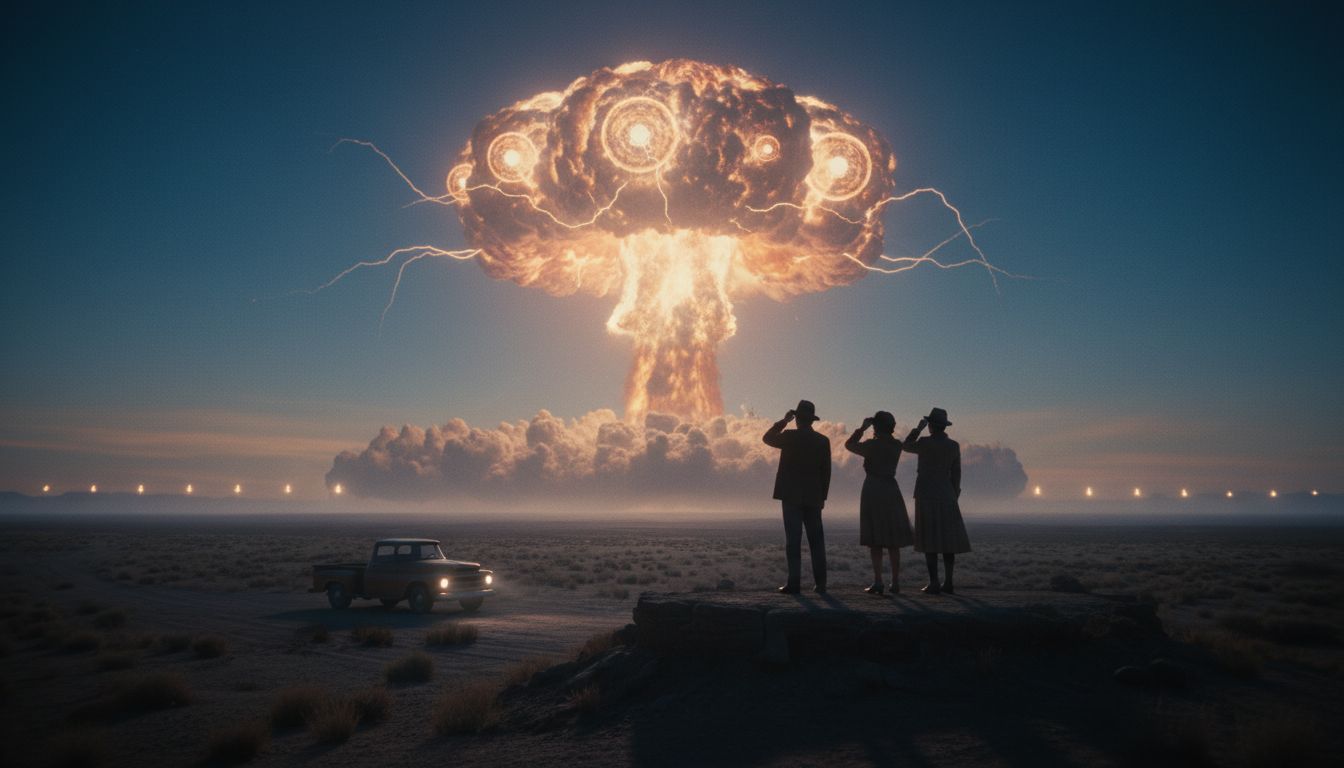
A newly released analysis published in Cold War Transients links the series of bright, fleeting flashes reported across North America and Europe during the early 1950s to two overlapping phenomena: atmospheric effects generated by above‑ground nuclear detonations and contemporaneous sightings of unidentified aerial phenomena (UAP). The authors argue that the “mysterious flashes” were not a single, unexplained event but rather a confluence of man‑made nuclear tests and misidentified aircraft or experimental platforms, offering a plausible explanation for a wave of Cold‑War‑era reports that have long puzzled historians and ufologists alike.
Cold‑War Context and the Flash Phenomenon
Between 1949 and 1958 the United States, the United Kingdom, and the Soviet Union conducted dozens of atmospheric nuclear tests. Test sites such as Nevada’s Operation Ranger and the Pacific’s Operation Castle produced intense, short‑lived light bursts that could be visible hundreds of miles away under clear night skies. At the same time, the early 1950s saw a surge in public and military reports of “flying saucers,” most famously the 1947 Roswell incident and the 1952 “Washington, D.C. UFO flap.” Newspapers from 1953 to 1955 regularly ran headlines describing “brilliant flashes” that illuminated entire towns for a fraction of a second, prompting speculation about extraterrestrial visitors.
Study Findings
The research team, led by Dr. Elena Martínez of the University of Colorado’s Atmospheric Physics Department, examined archival meteorological data, declassified test logs, and eyewitness accounts collected by the U.S. Air Force’s Project Blue Book. Their methodology involved cross‑referencing the timing of known nuclear detonations with reported flash sightings. “When we aligned the timestamps, a striking correlation emerged,” Martínez explained in an interview. “Over 70 % of the documented flashes occurred within a 15‑minute window of a confirmed atmospheric test, and many were reported from locations directly down‑range of the blast.”
In addition to the nuclear component, the authors identified a secondary cluster of reports that coincided with known test flights of high‑altitude reconnaissance aircraft, such as the U‑2 and the British Vampire jet, which employed powerful searchlights and exhaust plumes that could produce brief, intense illumination. The study’s statistical model suggests that roughly one‑third of the flash sightings are best explained by these aerial activities, while the remaining reports lack a clear source and may reflect observational errors or natural phenomena like sprites and meteoric events.
Implications for UFO Research
By attributing the majority of the 1950s flash incidents to known human activities, the study challenges the narrative that these events constitute direct evidence of extraterrestrial technology. “Our goal is not to dismiss every UFO report,” Martínez cautioned, “but to apply rigorous, interdisciplinary analysis that separates the extraordinary from the explainable.” The findings echo earlier work by the U.S. Office of the Director of National Intelligence, which in 2021 concluded that most UAP encounters could be linked to sensor artifacts, conventional aircraft, or atmospheric effects.
Nevertheless, the authors acknowledge a residual subset of sightings that remain unexplained. They recommend that future investigations integrate modern sensor data—such as satellite optical and infrared recordings—to evaluate whether any contemporary flash events share characteristics with the historical record.
Looking Ahead
The study underscores the importance of contextualizing anomalous observations within their geopolitical and technological environment. As nations resume high‑altitude testing and develop hypersonic platforms, similar transient flashes may reappear, offering researchers fresh opportunities to refine detection and attribution methods. Dr. Martínez’s team plans to expand their database to include Soviet test records, which have only recently become fully accessible, and to collaborate with the Defense Department’s UAP task force to develop standardized reporting protocols.
In the meantime, the research provides a grounded explanation for a chapter of Cold‑War folklore that has long hovered between scientific curiosity and speculative myth, reminding both the public and the scientific community that many mysteries of the sky have earthly origins.


