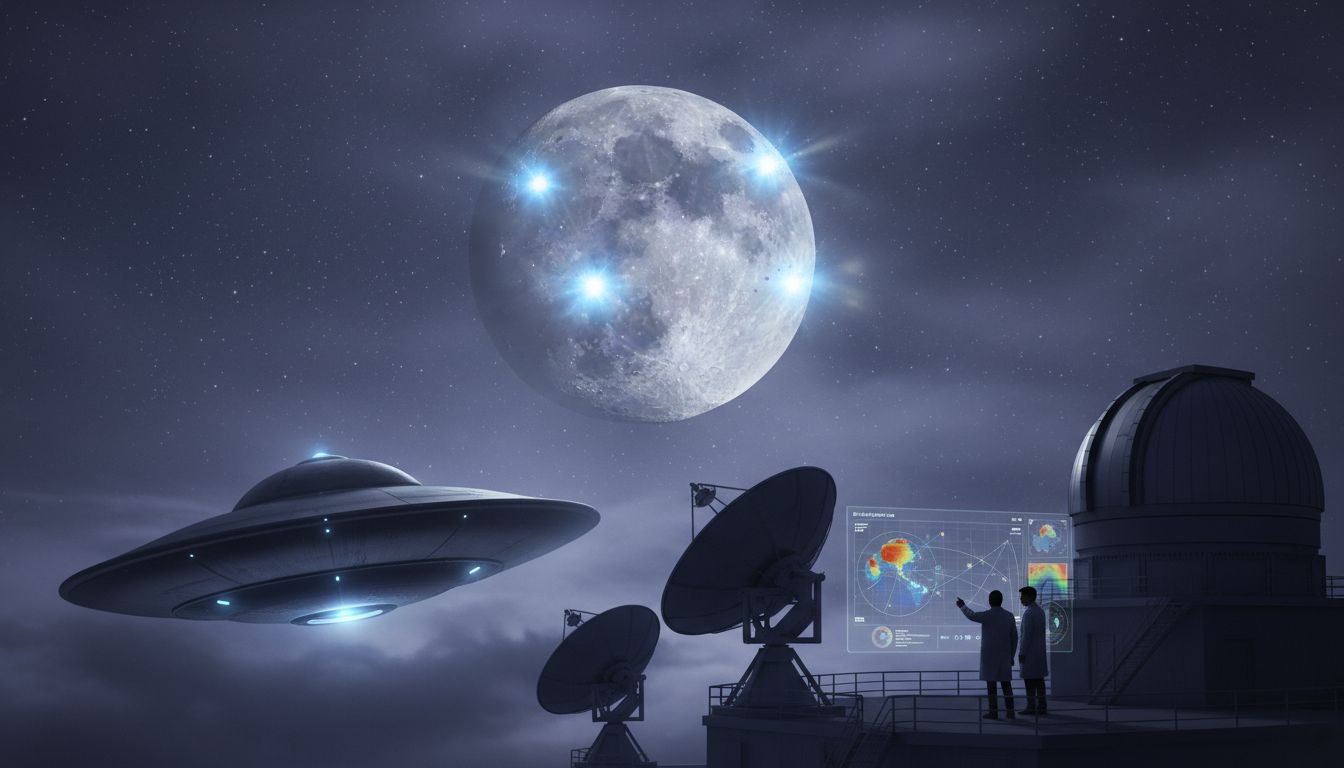
Bright flashes that lit up the lunar surface over the past week have been captured by a network of amateur astronomers and professional observatories alike. The brief, high‑intensity bursts, lasting only fractions of a second, are consistent with the impact of meteoroids striking the Moon’s dark side and releasing a plume of vapor that briefly reflects sunlight. Analysis of the timing and trajectory of the flashes points to the Taurid meteor stream – a debris trail left by the comet 2P/Encke – as the most plausible source. “The characteristics of the flashes match what we expect from Taurid particles entering the Moon’s surface at high velocity,” said Dr. Peter Jenniskens, a leading meteoritics researcher at the SETI Institute.
The Taurid stream, which Earth traverses each year between late October and early December, is known for producing a higher frequency of bright fireballs than most other showers. Recent modeling suggests that the stream is undergoing a gradual fragmentation, potentially increasing the number of larger fragments that intersect Earth’s orbit. Dr. Robert McNutt of NASA’s Marshall Space Flight Center warned that “within the next decade the Taurid complex could deliver a greater number of sizable meteoroids, raising the statistical likelihood of impacts on both Earth and the Moon.” While the Moon’s lack of atmosphere means such impacts leave no lasting crater visible from Earth, they can still pose a risk to lunar surface assets, including upcoming commercial landers and habitats.
The renewed public interest in the lunar flashes has also revived fringe theories about extraterrestrial visitation. A viral claim circulating on social media alleges that the flashes are deliberate signals from an unknown intelligence, and even goes further to suggest the existence of a 50,000‑year‑old human civilization on the Moon. Scientists have repeatedly dismissed these ideas as unfounded. “There is no credible evidence linking these optical events to any artificial source,” emphasized Dr. Jenniskens. “The physics of meteoroid impacts provides a straightforward, natural explanation that fits all the observed data.” The claim of an ancient lunar civilization, meanwhile, lacks any archaeological or geological support and is not recognized by the planetary science community.
The phenomenon does, however, underscore the growing importance of systematic lunar monitoring. Projects such as the Lunar Impact Monitoring System (LIMS), coordinated by the International Astronomical Union, now compile flash data from observatories worldwide to refine impact rate estimates. These datasets help calibrate models of meteoroid flux, which are essential for designing shielding for future lunar habitats and for assessing the long‑term safety of orbiting assets. “Every flash we record adds a data point that improves our understanding of the near‑Earth environment,” noted Dr. McNutt.
As humanity prepares for a new era of lunar exploration, the flashes serve as a reminder that the Moon remains an active, dynamic body, subject to the same cosmic hazards that affect Earth. While the allure of mystery captivates the public imagination, the scientific consensus points to a well‑understood natural cause and highlights a genuine, if modest, risk that must be managed as commercial and governmental missions return to the lunar surface.


