Overview
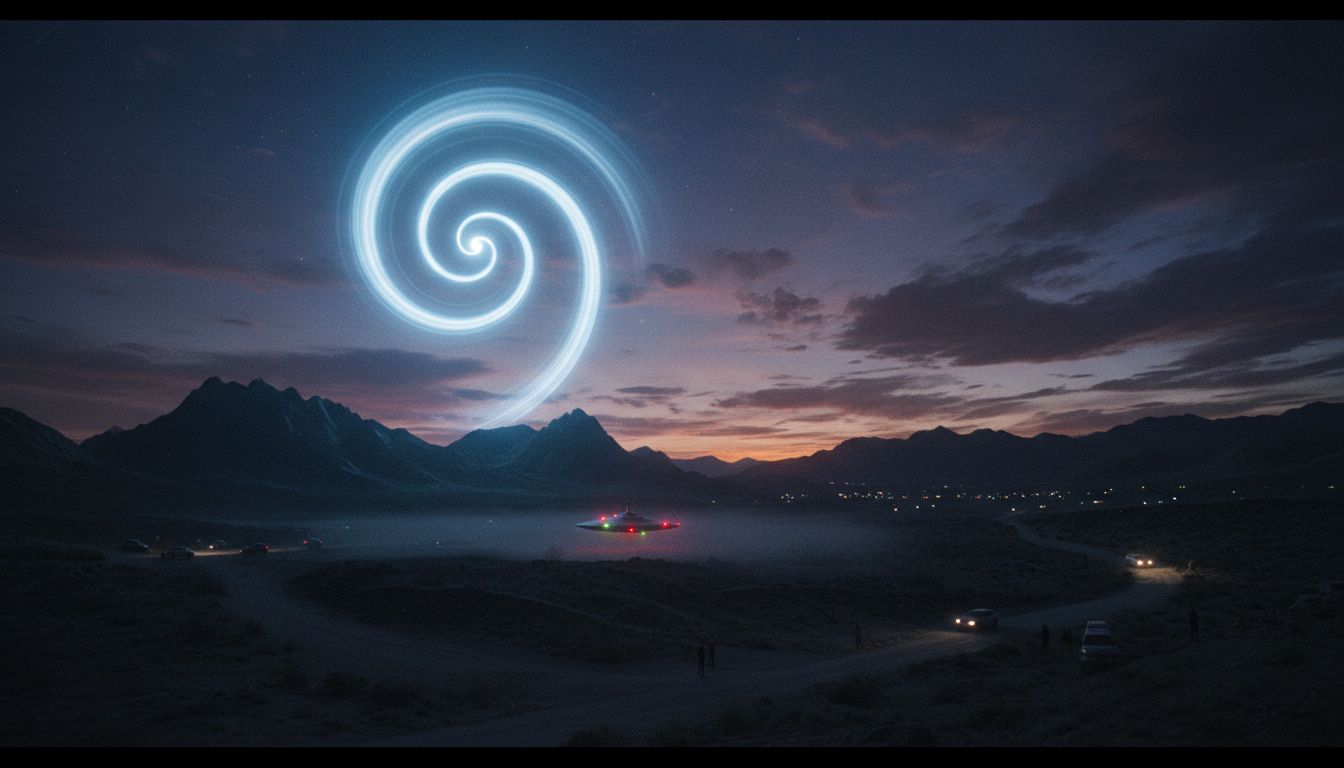
On the night of January 1, 2026, a bright, spiral‑shaped light was reported over the coastal region of Cornwall, England. The luminous display appeared just a few miles from the site of a widely publicised UFO sighting that occurred on Christmas Day 2025. While the phenomenon has reignited public interest in unidentified aerial phenomena (UAP), officials stress that the incident remains under investigation and that ordinary atmospheric or technical explanations are still plausible.
Incident Details
The sighting was made by a 42‑year‑old driver, who told local police that the “glowing spiral seemed to hover above the cliffs, rotating slowly before disappearing in a flash.” According to the Cornwall Constabulary’s initial report, the light was visible for approximately three minutes and was described as “vividly colored, with a distinct spiral pattern that resembled a galaxy.” The driver captured a short video on his smartphone, which has since been forwarded to the Ministry of Defence’s UAP desk for analysis. No other vehicles or pedestrians reported the same visual, and no immediate hazards were recorded.
Historical Context
The location is not new to UAP reports. In late December 2025, a separate incident on Christmas Day involved a lone motorist who claimed to have seen a “silvery disc” hovering near the same stretch of coastline before it vanished without a sound. That earlier report was logged by the UK’s Defence Science and Technology Laboratory (DSTL) and prompted a brief statement from the Ministry of Defence indicating that “no immediate threat was identified” and that the sighting was being forwarded to the UAP Task Force for routine review. The proximity of the new spiral to that earlier event has led to renewed speculation, but investigators caution against drawing conclusions before a full forensic analysis of the video and radar data.
Expert Commentary
Dr. Emily Carter, senior researcher at the Royal Astronomical Society, noted that “spiral‑shaped luminous events can sometimes be attributed to atmospheric optics, such as a rare type of sun pillar combined with ice crystals, or to the re‑entry of a satellite component.” She added that “the timing—just after midnight on New Year’s—makes it worth checking whether any scheduled launches or fireworks displays could have produced a similar visual effect.”
Wing Commander (Ret.) James Patel, who leads the MoD’s UAP liaison office, said, “We treat every credible report seriously. Our first step is to cross‑reference the timestamp with known aerospace activity, including commercial launches, missile tests, and meteorological data. At this stage, we have not identified any conventional source, but the investigation is ongoing.”
Local astronomer Tom Hughes of the Cornwall Astronomical Society offered a more grounded hypothesis: “The area’s coastal humidity often creates lenticular clouds that can reflect ground‑based lights in unusual ways, especially when illuminated by nearby towns or passing aircraft.” He urged the public to refrain from speculation until the video is examined by experts in optics and aerospace engineering.
Next Steps
The Ministry of Defence has confirmed that the video will be subjected to frame‑by‑frame analysis, including spectral imaging to determine the light’s composition. Cornwall Constabulary is also reviewing traffic‑camera footage from nearby roadways to see if the phenomenon was captured from other angles. Meanwhile, the UAP Task Force, established under the 2023 UAP Transparency Act, will compile a report for parliamentary review later this year.
Until official findings are released, authorities advise residents to report any further unusual lights to the UAP hotline (0800 555 UAP) and to avoid drawing premature conclusions. As Dr. Carter emphasized, “Extraordinary claims require extraordinary evidence, and the scientific method remains our best tool for separating fact from conjecture.”


