Overview
A Greek inscription uncovered during recent restoration work at the Great Mosque of Homs has reignited scholarly debate over the whereabouts of an ancient sun‑worship temple that once dominated the city known in antiquity as Emesa. Published in the archaeology journal Shedet, the study led by Dr. Maamoun Saleh Abdulkarim of the University of Sharjah argues that the inscription provides the first concrete clue linking the mosque to the Temple of Elagabal, a sanctuary dedicated to the Syrian sun god and famously associated with the third‑century Roman emperor‑priest Elagabalus. The find suggests that the site’s religious identity evolved gradually—from pagan rites to Christianity and later Islam—rather than undergoing abrupt, isolated conversions.
The Discovery
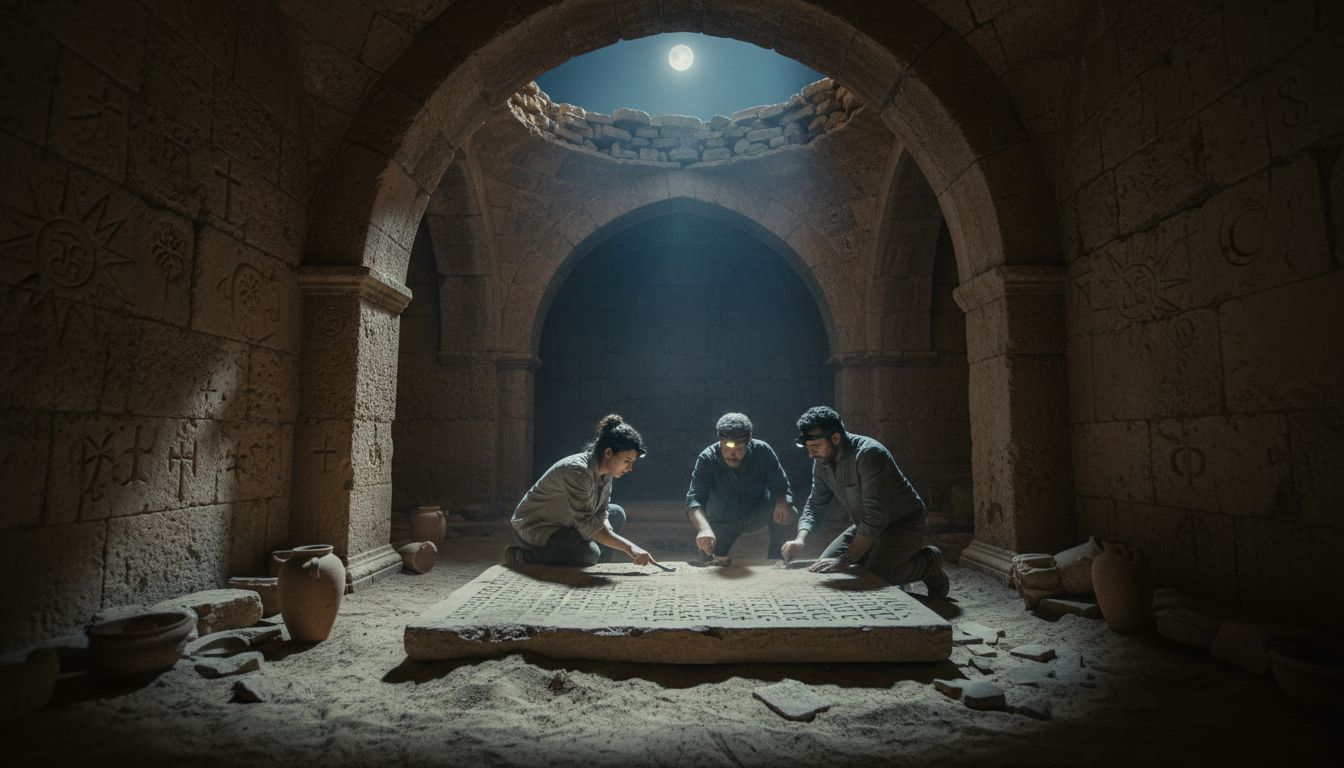
The inscription was located at the base of a supporting column in the Great Mosque’s interior, a structure noted for its distinctive oval plan and centuries‑old religious significance. Restoration crews reported that the stone slab bears a symmetrical, formal Greek script arranged in horizontal lines—a style typical of dedication or commemorative texts in the Roman world. The wording, described by the excavation team as “heroic and militaristic,” likens a ruler to “the wind, the storm, and the leopard,” portraying a victorious warrior‑king exacting tribute.
Photographs released by the research team show the inscription’s crisp lettering, and initial epigraphic analysis confirms that the Greek used aligns with late‑imperial conventions (3rd–4th century AD). “The text’s tone and formulaic structure are consistent with official dedications to a deity rather than a secular monument,” Dr. Abdulkarim noted in an interview.
Historical Context
Emesa’s strategic position on the Orontes River made it a cultural crossroads long before the rise of Islam. In the early Roman period, the city hosted the Temple of Elagabal, dedicated to the local sun god. The temple’s high priest, Simeon Bar‑Kahba, famously ascended to the imperial throne as Emperor Elagabalus (218‑222 AD), bringing the cult to the heart of Rome.
When Christianity spread across the Levant in the 4th and 5th centuries, many pagan sanctuaries were either abandoned or repurposed as churches. Archaeological evidence suggests that a church dedicated to St. John the Baptist once stood on the present mosque’s footprint, likely erected atop the earlier temple’s foundations. The current Great Mosque, commissioned by the 12th‑century Zengid ruler Nur ad‑Din, is believed to have been built over that church, continuing the pattern of successive sacred layers.
Scholarly Interpretation
Dr. Abdulkarim’s team argues that the inscription’s content—particularly references to a “warrior‑king” receiving tribute—mirrors known epigraphic formulas used in dedications to Elagabal. By cross‑referencing the phrasing with other documented inscriptions from the Syrian coast, the researchers propose that the slab originally adorned a altar within the sun temple.
“This is the missing piece that ties the linguistic, architectural, and historical strands together,” Dr. Abdulkarim said. “Rather than a sudden demolition of pagan worship, the evidence points to a gradual overlay of religious practices, where each new faith built upon the sacred geography of its predecessor.”
The study also highlights the broader methodological shift in Near Eastern archaeology toward multilayered site analysis, emphasizing that religious transformation often involved continuity and adaptation rather than wholesale eradication.
Implications and Future Work
If the inscription indeed originated from the Temple of Elagabal, it would be the first material proof locating the long‑speculated sun sanctuary beneath the Great Mosque of Homs. Such confirmation would reshape understandings of how imperial Roman religious politics intersected with local Syrian traditions, and how those dynamics persisted through the Byzantine, Islamic, and Crusader periods.
The research team plans to conduct non‑invasive ground‑penetrating radar surveys around the mosque’s perimeter to map any remaining structural footprints of the temple. They also aim to publish a full transliteration and translation of the inscription in an upcoming issue of Shedet, inviting peer review from epigraphists worldwide.
Beyond academic circles, the discovery may influence heritage preservation strategies in conflict‑affected regions. Recognizing the layered sacredness of sites like Homs’ Great Mosque could foster interfaith dialogue and underscore the shared cultural legacy that transcends contemporary religious identities.
The article reflects findings reported by ScienceDaily on April 2, 2026, and incorporates statements from Dr. Maamoun Saleh Abdulkarim and other scholars involved in the study.


