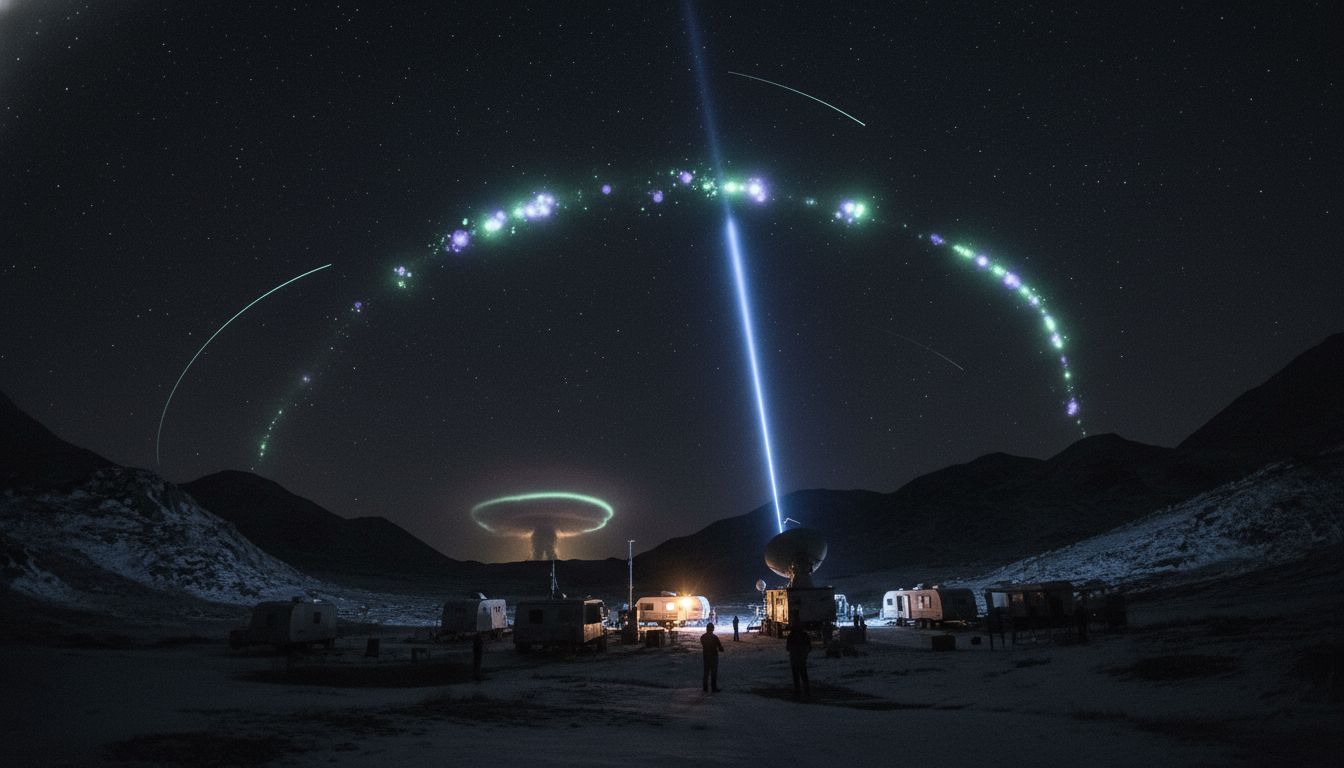
Researchers analyzing decades‑long atmospheric data have identified a class of brief, luminous phenomena that appear high in the sky and seem to cluster around periods of nuclear weapons testing. The study, led by Dr. Elena Martínez of the International Center for Atmospheric Research (ICAR) and published this week in the Journal of Atmospheric and Space Sciences, examined over 12,000 transient luminous events (TLEs) recorded by a network of ground‑based photometers, low‑Earth‑orbit satellites, and high‑altitude balloons between 1955 and 2024. Of those, roughly 1.8 % occurred within a 48‑hour window of a documented nuclear detonation, a rate the authors say is “statistically significant” compared with the baseline occurrence of such events during non‑testing periods.
The team’s methodology involved cross‑referencing the timestamps of the TLEs with the United Nations Register of Conventional Arms and the Comprehensive Nuclear‑Test‑Ban Treaty Organization’s (CTBTO) International Monitoring System. “When we overlaid the two datasets, a clear pattern emerged,” Martínez explained in an interview. “During the height of atmospheric testing in the 1960s, especially around the 1962 ‘Starfish Prime’ high‑altitude blast, we see a spike in short‑duration, blue‑white glows that linger for less than a second and are detectable up to 120 km altitude.” The researchers propose that the intense gamma‑ray and X‑ray bursts from a nuclear explosion can ionize the upper atmosphere, creating conditions that favor the rapid formation of plasma filaments—phenomena that manifest as the observed transient lights.
What makes the findings particularly intriguing is the overlap with reports of unidentified anomalous phenomena (UAP) from both civilian witnesses and military pilots. The authors note that many of the recorded TLEs share visual characteristics—such as sudden onset, high altitude, and lack of apparent propulsion—with declassified UAP sightings logged by the U.S. Department of Defense’s Unidentified Aerial Phenomena Task Force. “We are not claiming that these luminous events are ‘UFOs’ in the popular sense,” Martínez cautioned. “However, the data suggest that a subset of UAP reports could be explained by natural or anthropogenic atmospheric effects that have been previously underappreciated.” The paper references several declassified flight‑deck recordings from the 1970s in which pilots reported bright, fast‑moving objects coinciding with known underground nuclear tests in the Pacific.
The study has drawn interest from defense and scientific agencies alike. Admiral James Whitaker, a senior advisor to the Pentagon’s Office of the Under Secretary of Defense for Research and Engineering, remarked that the research “offers a plausible physical mechanism that could account for some of the unexplained aerial observations that have been reported over the past decades.” He added that the Department is funding a follow‑up program to deploy additional high‑speed photometric sensors near known test sites, aiming to capture any future transient events in real time. Meanwhile, the CTBTO’s Director‑General, Dr. Li Wei, emphasized that the findings reinforce the importance of the International Monitoring System’s ability to detect not only seismic and acoustic signatures of nuclear explosions but also their atmospheric by‑products.
Although the correlation is compelling, Martínez stresses that causation has not been definitively established. “Our analysis shows a temporal link, but the exact physical pathway—from nuclear detonation to observable TLE—requires further experimental validation,” she said. The team plans to simulate high‑energy bursts in laboratory plasma chambers and to coordinate with upcoming sub‑orbital missions that can directly sample the ionospheric disturbances following a controlled high‑altitude release. Until such experiments are completed, the mysterious transient objects will remain an intriguing intersection of nuclear history, atmospheric physics, and the ongoing quest to understand unidentified aerial phenomena.