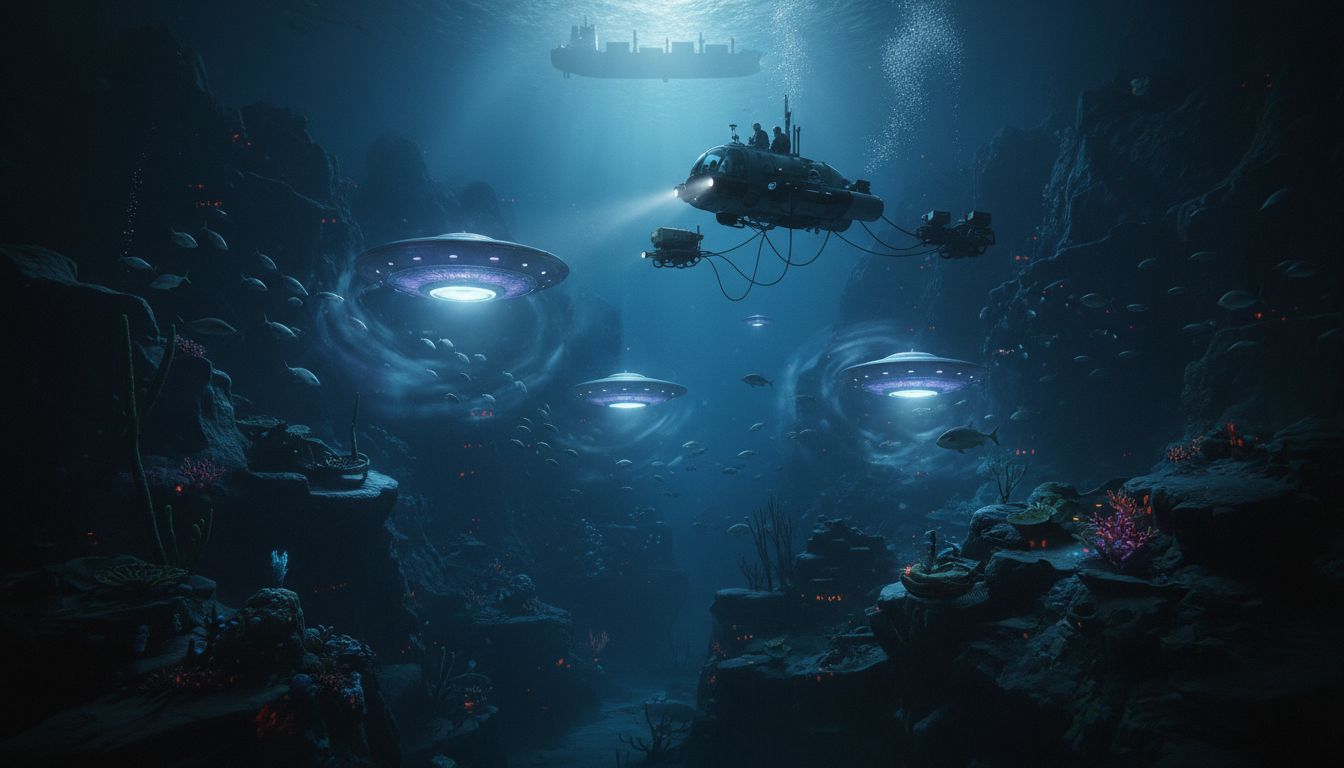
Overview
A new geospatial analysis of United States UFO (unidentified aerial phenomena) reports has identified concentrated “hotspots” near deep underwater canyons along both the Atlantic and Pacific coasts. The study, conducted by a team of independent researchers at the Oceanic Anomaly Research Institute (OARI), cross‑referenced more than 12,000 civilian sightings and 2,400 de‑classified military observations collected between 2015 and 2025. The resulting heat‑map shows statistically significant clustering around the Hudson Canyon off New York, the Blake Plateau off the southeastern Atlantic seaboard, the Monterey Submarine Canyon off California, and the Aleutian Trench in the Bering Sea.
Methodology
OARI’s lead analyst, Dr. Megan Torres, explained that the team employed a “kernel density estimation” algorithm to overlay sighting coordinates onto high‑resolution bathymetric charts supplied by the National Oceanic and Atmospheric Administration (NOAA). “We deliberately excluded reports that lacked precise location data or time stamps,” Torres said, “to avoid inflating the signal with ambiguous entries.” The researchers also filtered out known aircraft flight paths, weather balloons, and commercial drone activity, ensuring that the remaining dataset represented genuinely unexplained observations.
Key Findings
The analysis revealed three distinct patterns:
- Altitude Correlation – The majority of sightings near the canyons were reported at altitudes between 3,000 and 12,000 feet, a range that coincides with the typical cruise altitude of military reconnaissance aircraft.
- Temporal Clustering – Peaks in activity occurred during the spring and autumn months, aligning with seasonal oceanic upwelling events that affect water temperature and density.
- Behavioral Anomalies – Witnesses described objects executing rapid accelerations, abrupt direction changes, and “hover‑then‑disappear” maneuvers that defy conventional aeronautical performance.
One veteran pilot, who requested anonymity, recounted a 2023 encounter off the Monterey Submarine Canyon: “The radar lock was solid, but the visual cue vanished in a fraction of a second, leaving a faint ionized glow that lingered for a few seconds.”
Context and Interpretation
The link between underwater topography and aerial anomalies is not entirely new; similar associations have been noted in the 2021 “Great Lakes Rift” study, which suggested that geological stress points could influence electromagnetic fields. However, the OARI report is the first to systematically map UAP activity to submarine canyon systems on a national scale. Some experts, such as former Pentagon UAP Task Force member Lt. Cmdr. James Patel, caution against jumping to conclusions. “While the statistical correlation is intriguing, we must consider alternative explanations—such as increased air traffic over coastal research zones or atmospheric phenomena amplified by the canyon’s microclimate,” Patel remarked.
Calls for Further Research
The findings have prompted a bipartisan group of legislators to request a briefing from the Department of Defense’s newly formed Office of Scientific Inquiry into Aerial Phenomena. In a statement released on February 28, 2026, Senator Laura Mitchell (D‑NY) urged “a coordinated, interdisciplinary investigation that brings together oceanographers, atmospheric scientists, and aerospace engineers.” OARI has offered its dataset to federal agencies and is seeking funding for a field campaign that would deploy lidar and radar stations on research vessels positioned within the identified canyons.
As the scientific community grapples with these “underwater‑canyon UAP hotspots,” the consensus remains cautious yet curious. If a causal relationship exists, it could reshape our understanding of how atmospheric and oceanic systems interact with anomalous aerial objects—whether they are advanced terrestrial technologies, natural phenomena, or something altogether different.


