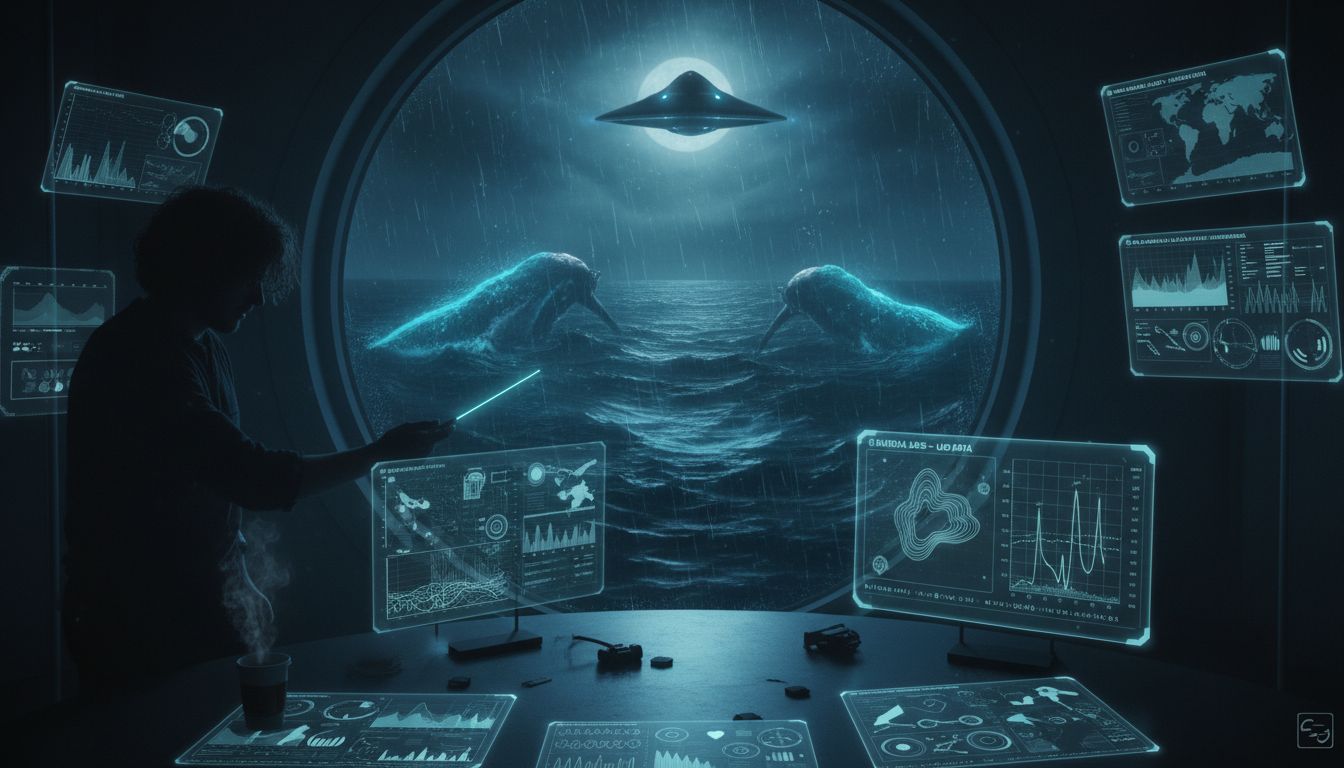
In recent weeks, a series of sightings along the United States coastline has reignited public and scientific interest in unidentified aerial and submerged phenomena. The observations, reported by civilian pilots, commercial fishermen, and coastal residents, describe objects moving at speeds and with maneuverability that exceed known aircraft capabilities, as well as luminous shapes appearing just below the water’s surface. While the incidents remain unverified, they have drawn attention from both government-affiliated research groups and academic voices, prompting a renewed dialogue on the nature of these anomalies.
The most comprehensive data set to date comes from Enigma Labs, a private organization that aggregates reports of unidentified submerged objects (USOs) and aerial encounters. According to the lab’s latest release, the coast from Maine to California has logged more than 200 credible reports in the past three months, a marked increase from the 60 incidents recorded over the same period last year. Enigma’s analysts note that many of the sightings share common characteristics: rapid acceleration, abrupt direction changes, and a lack of conventional propulsion signatures on radar. “The frequency and consistency of these reports suggest a pattern that warrants systematic investigation,” said Dr. Elena Ramirez, senior researcher at Enigma Labs, in an emailed statement.
Retired Navy Rear Admiral Tim Gallaudet, who served as the Navy’s chief of the Unidentified Aerial Phenomena (UAP) task force, weighed in on the emerging data. Speaking to Newsweek, Gallaudet emphasized that the Department of Defense’s recent policy changes—mandating the reporting of all UAP encounters by service members—have likely contributed to the surge in documented cases. “When you remove the stigma and require formal reporting, you get a clearer picture of what’s happening in our airspace and maritime domain,” he explained. Gallaudet added that while most encounters can eventually be attributed to sensor glitches or known platforms, a “small but significant subset” remains unexplained after rigorous analysis.
The conversation has also reached the realm of theoretical physics. Renowned astrophysicist Michio Kaku, a professor at the City College of New York, offered a cautious perspective on the possibility of extraterrestrial involvement. In a recent interview, Kaku remarked, “If these objects are indeed capable of interstellar travel, they would have to employ physics far beyond our current understanding—perhaps manipulating spacetime or harnessing quantum vacuum energy.” He clarified, however, that such speculation is provisional: “We must first exhaust all conventional explanations before invoking alien technology.” Kaku’s comments have resonated on social media, where discussions oscillate between scientific curiosity and popular intrigue.
International reactions mirror the United States’ mixed stance of skepticism and fascination. In Europe, the European Space Agency’s UAP Working Group has released a brief report acknowledging increased reports from coastal nations, urging member states to share sensor data and standardize reporting protocols. Meanwhile, in Japan, a parliamentary committee is reviewing the Ministry of Defense’s handling of maritime anomalies, citing concerns over national security and the need for transparent oversight. These global efforts underscore a growing consensus that coordinated, cross‑border research is essential to discern whether the phenomena are localized technical artifacts, natural atmospheric events, or something altogether novel.
As the season progresses and more data becomes available, experts agree that the key to understanding these sightings lies in rigorous, peer‑reviewed analysis rather than sensational headlines. “The scientific method demands that we collect, corroborate, and test,” said Dr. Ramirez. “Only then can we separate noise from a potential signal that might reshape our view of the skies—and the seas—around us.” Until such conclusions are reached, the coastlines of the United States will continue to be a focal point for both curiosity seekers and the agencies tasked with safeguarding national air and maritime domains.


