Overview
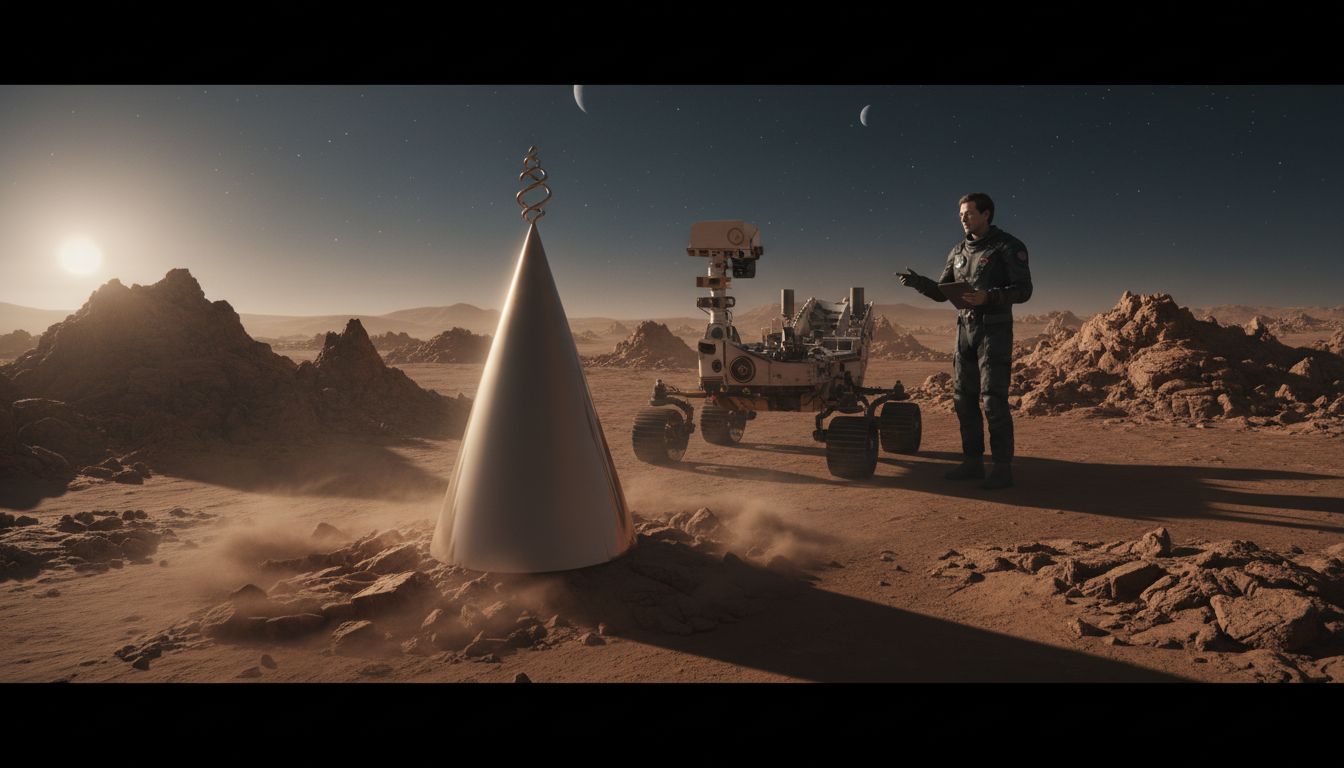
A small, cone‑shaped formation captured by NASA’s Perseverance rover on the Martian surface has reignited debate over how scientists interpret unusual terrain features. The object, quickly dubbed a “party‑hat” by the online community, sparked a wave of speculation ranging from wind‑carved rock to potential artificial artifact. On March 28, NASA released a detailed analysis asserting that the formation is a natural rock sculpted by aeolian processes, while Harvard astrophysicist Avi Loeb publicly challenged that conclusion, arguing that its smooth, cylindrical geometry lacks a clear terrestrial analogue.
NASA’s Explanation
In a press briefing, NASA planetary geologist Dr. Maya Patel described the feature as “a classic example of pareidolia—the human tendency to see familiar shapes where none exist.” High‑resolution imaging from the rover’s Mastcam‑Z and SuperCam instruments revealed fine‑scale striations consistent with wind‑driven abrasion. “The surrounding regolith shows ripple marks and yardangs that align with prevailing wind vectors, indicating that the ‘hat’ was likely rounded and then preferentially eroded on one side,” Patel explained. The agency’s assessment relies on comparative analysis with other Martian wind‑shaped structures, such as the “Mojave” and “Horseshoe” rocks identified in previous missions, which exhibit similar asymmetrical wear patterns.
Loeb’s Counterpoint
Harvard’s Avi Loeb, known for his advocacy of rigorous scrutiny of anomalous astronomical observations, offered a dissenting view in a brief commentary posted to his personal blog. “The object’s smooth cylindrical shaft and sharply defined brim are unlike any wind‑eroded rocks we have catalogued on Mars,” Loeb wrote. He pointed to the absence of comparable formations in the extensive image archives of the Curiosity and Opportunity rovers, suggesting that the feature may represent an outlier that warrants further investigation. Loeb also warned that dismissing such anomalies too quickly could overlook potential evidence of past or present non‑geological processes.
Scientific Context
The debate highlights a broader methodological tension in planetary science: balancing statistical pattern recognition with the risk of over‑interpretation. Pareidolia has historically led to mischaracterizations—most famously the “Face on Mars” photographed by Viking 1 in 1976, later revealed to be an ordinary mesa after higher‑resolution imaging. Conversely, the identification of mineral veins and sedimentary layers on Mars, once considered ambiguous, has been pivotal in confirming the planet’s watery past. Researchers emphasize that contextual data—such as wind direction, grain size distribution, and local geology—are essential for distinguishing between natural and artificial origins.
Implications and Next Steps
While NASA’s current stance leans toward a natural explanation, the discourse underscores the importance of transparent peer review and the inclusion of external expertise. The agency has scheduled additional observations with the rover’s SHERLOC spectrometer to assess mineral composition, which could either reinforce the wind‑erosion hypothesis or reveal anomalous signatures. Meanwhile, Loeb’s call for an independent analysis has prompted several planetary scientists to request access to the raw datasets for independent verification.
As the scientific community awaits further data, the “party‑hat” rock serves as a reminder that Mars continues to challenge our assumptions, urging both caution and curiosity in the interpretation of its enigmatic landscape.


