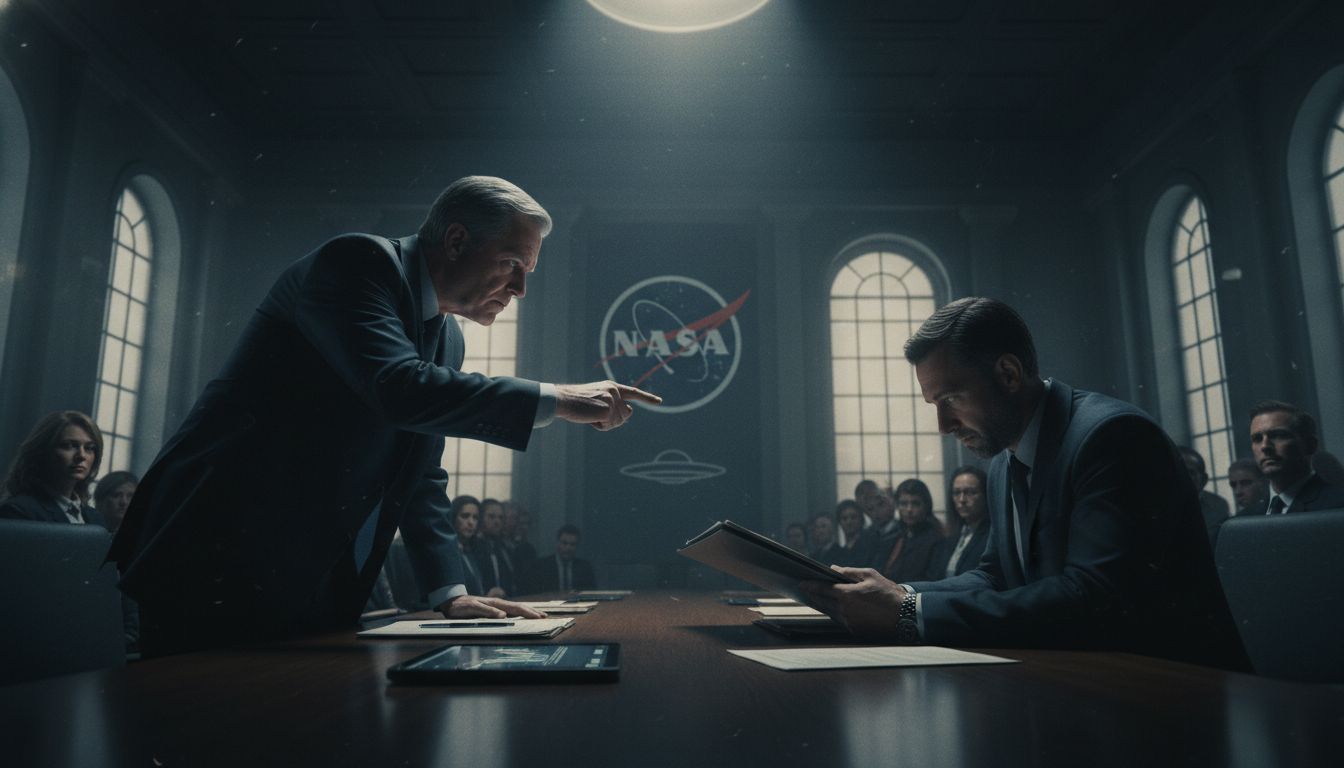
NASA Administrator Bill Nelson used a recent congressional briefing to press the whistle‑blower who has become a focal point of the UAP debate, asking pointedly, “Where’s the evidence?” Speaking before a joint hearing of the House Intelligence and Armed Services committees, Nelson reminded lawmakers that the agency operates under strict scientific protocols and that no extraterrestrial material has ever been turned over to NASA for analysis. “We have not, and we do not claim to have, any verified alien artifacts in our custody,” he said, underscoring the difference between classified intelligence assessments and the peer‑reviewed research that defines the agency’s work.
The hearing centered on the testimony of former intelligence officer David Grusch, who in July alleged that the U.S. government possesses “intact and partially intact” non‑human craft and that a secret program has been retrieving material from crashed objects. Grusch’s claims, detailed in a 19‑page affidavit and later in a public interview, have sparked a surge of media attention and prompted the Pentagon’s Office of the Director of National Intelligence to release an unclassified report on UAPs in June. While the report acknowledged that many sightings remain unexplained, it stopped short of confirming any extraterrestrial origin, a distinction that Nelson emphasized. “Our job is to apply the scientific method, not to jump to conclusions based on speculation,” he told the panel.
Nelson’s remarks reflect a broader tension within the federal community between intelligence agencies, which often operate under secrecy, and civilian scientific bodies that demand reproducibility and transparency. In a statement released after the hearing, NASA’s Office of the Chief Scientist reiterated that any material claimed to be of non‑human origin would be subjected to rigorous testing, including isotopic analysis, microscopy and, if warranted, peer‑reviewed publication. “If such material were ever presented to us, we would follow the same protocols we use for any extraterrestrial sample, such as those returned by the Artemis missions,” the office noted. The agency’s stance is consistent with its historical approach to planetary protection, which treats unknown substances with caution but also with a commitment to open scientific inquiry.
Critics of the administration’s handling of the UAP issue argue that the lack of concrete data fuels public mistrust. Former Senator Harry Reid, who championed the 2020 Pentagon UAP task force, warned that “the longer we wait to release what we can, the more speculation fills the vacuum.” Grusch, for his part, has repeatedly offered to provide physical evidence to a select group of congressional staffers, though he says the material is stored in a secure, undisclosed location. “I’m not a conspiracy theorist; I’m a former intelligence officer with a duty to report what I’ve seen,” Grusch told C‑SPAN, adding that the reluctance to share evidence is “a matter of national security.”
The debate has also reignited interest in past government programs such as Project Blue Book and the more recent Advanced Aerospace Threat Identification Program, both of which examined anomalous aerial phenomena but were ultimately terminated without definitive conclusions. As the Senate prepares its own UAP subcommittee for the next fiscal year, Nelson’s call for evidence may shape how future investigations are structured. “If the government truly has something to show, it should be subject to the same scrutiny we apply to any scientific claim,” he concluded, signaling that NASA is prepared to engage, but only on the basis of verifiable data.


