Overview
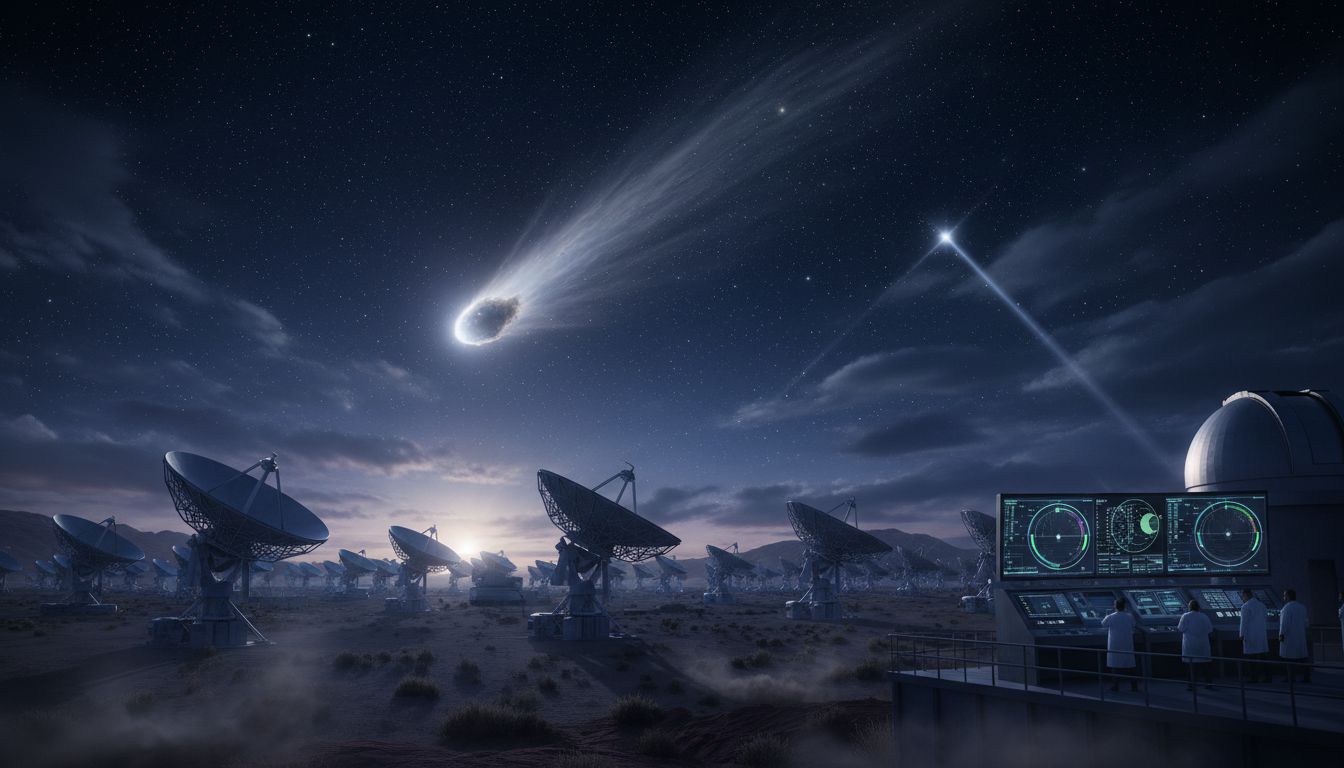
NASA announced today that the fast‑moving interstellar visitor designated 3I/ATLAS is a natural comet, ending a week‑long wave of online speculation that the object might be an alien probe or a human‑made artifact. The conclusion follows a coordinated observation campaign that employed more than 20 ground‑based telescopes and space‑based assets, including the Hubble Space Telescope, the James Webb Space Telescope (JWST), and the European Southern Observatory’s Very Large Telescope (VLT).
Observation Campaign
The investigation began shortly after 3I/ATLAS was first detected on 2025 October 28 by the Pan‑STARRS survey in Hawaii. Its hyperbolic trajectory—traveling at roughly 70 km s⁻¹ relative to the Sun—clearly indicated an origin outside the Solar System, making it only the third confirmed interstellar object after 1I/‘Oumuamua (2017) and 2I/Borisov (2019).
Within 48 hours, NASA’s Near‑Earth Object Observations (NEOO) program mobilized a network of observatories. Spectroscopic data from the Keck Observatory in Hawaii and the Gemini South telescope in Chile revealed strong signatures of water‑ice sublimation, a hallmark of cometary activity. Simultaneously, JWST’s Near‑Infrared Spectrograph captured a faint but distinct coma, while Hubble’s ultraviolet instruments detected hydroxyl (OH) emission—a direct tracer of water outgassing.
“The multi‑wavelength data leave no doubt,” said Dr. Elena Ramirez, senior scientist at NASA’s Jet Propulsion Laboratory. “We see the same volatile signatures that define comets in our own backyard, just on a much faster, interstellar trajectory.”
Scientific Significance
Confirming 3I/ATLAS as a comet provides a rare opportunity to study the composition of material ejected from another star system. Preliminary analysis suggests the object contains a mixture of water ice, carbon monoxide, and complex organics, comparable to the volatile inventory of 2I/Borisov.
“This is a textbook case of an icy body that survived ejection from its parent system and has now entered ours,” noted Prof. Michael Chen, planetary scientist at the University of Arizona. “Each interstellar comet we characterize refines our models of planetary formation and the distribution of water in the galaxy.”
The rapid response also demonstrated the growing capability of the astronomical community to coordinate observations across continents and orbit. The data set, now archived in NASA’s Planetary Data System, will support comparative studies that could reveal whether interstellar comets share a common chemical fingerprint or display a wide diversity reflective of their varied origins.
Public Reaction and Online Theories
The discovery of 3I/ATLAS sparked a flurry of speculation on social media platforms, with some users proposing exotic explanations ranging from extraterrestrial probes to secret government technology. Hashtags such as #ATLASAlien trended on Twitter for several days, prompting NASA’s public affairs office to issue a clarification.
“While curiosity drives public interest, it’s important to rely on peer‑reviewed science,” emphasized NASA spokesperson Lisa Patel in a press briefing. “The evidence we have is consistent with a natural comet, not an engineered object.”
The episode underscores the challenges scientists face in communicating complex findings amid a rapid news cycle, but also highlights the public’s enthusiasm for space exploration.
Next Steps
Although 3I/ATLAS will exit the inner Solar System by early 2026, the data gathered will continue to be analyzed for clues about its formation environment. NASA plans to publish a comprehensive peer‑reviewed paper later this year, detailing the spectroscopic measurements and dynamical modeling of its trajectory.
In parallel, the agency is refining its rapid‑response protocols for future interstellar visitors. “Every new object teaches us how to act faster and more efficiently,” said Dr. Ramirez. “With upcoming facilities like the Vera C. Rubin Observatory, we expect to detect many more interstellar interlopers, and we’ll be ready to study them in real time.”
The confirmation of 3I/ATLAS as a natural comet not only settles the recent speculation but also adds a valuable data point to the growing catalog of extrasolar debris, bringing us one step closer to understanding the broader chemical landscape of our galaxy.


