Overview
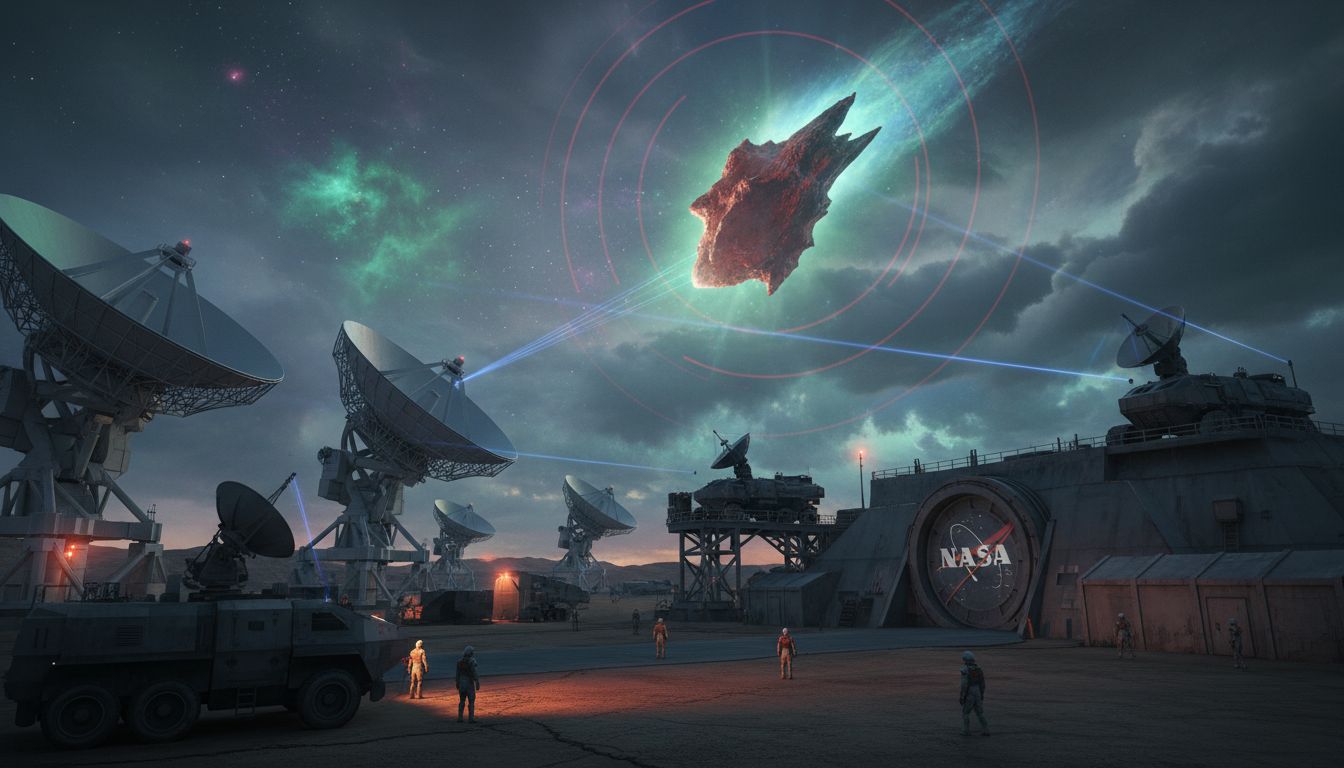
NASA announced on February 16 that it has activated its planetary‑defense protocols in response to the interstellar comet 3I/ATLAS, which was observed emitting atypical radio frequencies and displaying an extensive X‑ray halo. The comet, first detected earlier this year by the Pan‑STARRS survey, is estimated to be a fragment ranging from 320 meters to 5.6 kilometers in diameter. Its composition, dominated by silicate rock rather than the volatile ices that characterize most solar‑system comets, suggests it originated from a distant planetary system and was ejected millions of years ago.
Unusual Observations
The anomalous signals were recorded by the Deep Space Network (DSN) during routine monitoring of 3I/ATLAS’s approach to the inner solar system. “We detected a narrow‑band radio emission centered near 1.42 GHz, a frequency not typically associated with cometary activity,” said Dr. Elena Ramirez, senior scientist at NASA’s Planetary Defense Coordination Office (PDCO). Simultaneously, the Chandra X‑ray Observatory captured a diffuse halo of soft X‑rays surrounding the nucleus, a phenomenon usually linked to strong solar‑wind interactions with icy comets. The rocky nature of the fragment, confirmed by spectroscopic analysis from the European Southern Observatory’s Very Large Telescope, further differentiates it from known solar comets such as 67P/Churyumov‑Gerasimenko.
Planetary‑Defense Response
In accordance with NASA’s established response plan for potentially hazardous objects, the agency has deployed additional radar assets—including the Goldstone Deep Space Communications Complex and the Arecibo‑style radar at the Green Bank Telescope—to refine the comet’s trajectory. “Our priority is to obtain the highest‑precision orbit determination possible, so we can assess any impact risk well before the object reaches perihelion,” explained Dr. Ramirez. The PDCO has also coordinated with the International Astronomical Union’s Minor Planet Center and the European Space Agency’s Space Situational Awareness program to share real‑time data. While current models indicate a low probability of Earth impact, the unusual physical characteristics have prompted a “heightened watch” status, meaning continuous monitoring through the comet’s passage.
Scientific Implications
The detection of radio emissions from an interstellar object is unprecedented. Dr. Hiroshi Tanaka, a planetary scientist at the University of Tokyo, cautioned against speculative interpretations: “Radio signatures can arise from natural processes such as plasma interactions or charged dust grains. Until we have a comprehensive spectral analysis, we should not infer artificial origins.” Nonetheless, the rocky composition of 3I/ATLAS offers a rare glimpse into the building blocks of planetary systems beyond our own. “Most interstellar visitors we’ve observed, like ‘Oumuamua and 2I/Borisov, were either icy or displayed ambiguous spectra. This object provides a tangible sample of exoplanetary crust material,” noted Dr. Maya Patel of the SETI Institute.
Next Steps
NASA plans to continue spectroscopic monitoring through the comet’s perihelion, expected in late March, and to evaluate the feasibility of a potential fly‑by mission using a small, fast‑response spacecraft. The agency’s Planetary Defense Coordination Office will issue periodic briefings to the public and the scientific community, ensuring transparency about any changes in risk assessment. Meanwhile, the broader astronomical community is preparing a coordinated campaign of ground‑based and space‑based observations to map the comet’s surface features, outgassing behavior, and magnetic environment. As Dr. Ramirez summarized, “3I/ATLAS challenges our assumptions about what interstellar objects can look like, and it reinforces the importance of a robust planetary‑defense infrastructure that can adapt to the unexpected.”