Overview
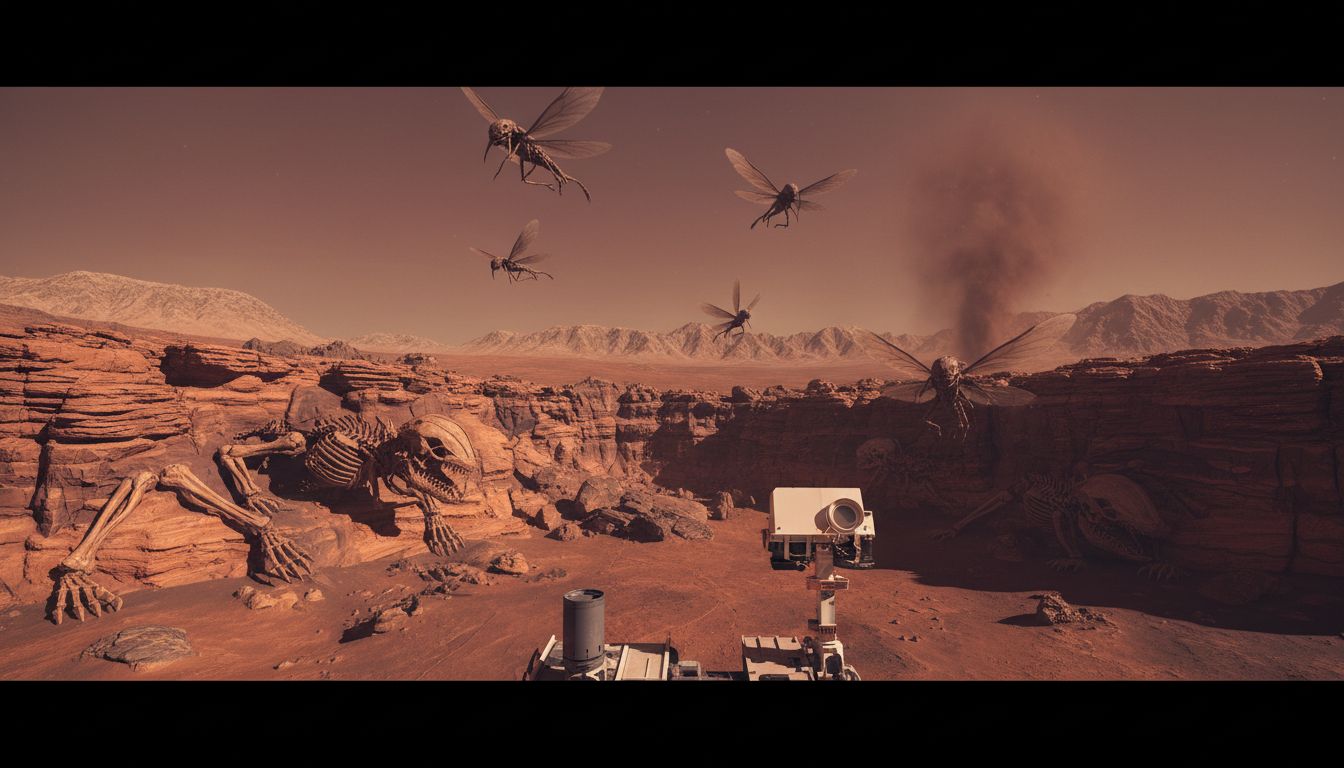
A set of high‑resolution photographs taken by NASA’s Curiosity rover in Gale Crater has been re‑examined by entomologist William Romoser, who argues that the images reveal insect‑like organisms in flight and fossilized reptile‑like predators. Romoser’s interpretation, originally presented at the 2019 National Meeting of the Entomological Society of America, resurfaced in recent media coverage, prompting renewed debate over whether the rover’s cameras have captured evidence of complex life on Mars. The claims have been met with strong skepticism from planetary scientists who attribute the patterns to pareidolia—our brain’s tendency to impose familiar shapes on random textures.
Romoser’s Claims
Romoser identifies several recurring visual motifs that he describes as “compound eyes,” wing venation, and jointed legs. In one sequence, he says a creature appears to execute an “acrobatic flight maneuver,” diving steeply before leveling out, a motion he likens to that of terrestrial insects. He also points to what he calls “reptile‑like fossils” featuring bilateral symmetry and a head shape reminiscent of an Eastern King Snake, suggesting a predatory role that includes preying on the smaller, winged forms. “The ‘bees’ vary in size and type, and distinct anatomical features are identifiable across multiple images,” Romoser stated during his presentation, emphasizing that the observed forms are not isolated anomalies but part of a broader mosaic.
Scientific Counter‑Interpretation
Planetary geologists and astrobiologists stress that the rover’s images, while exceptionally detailed, depict a landscape dominated by sedimentary layers, wind‑eroded rocks, and mineral deposits. Dr. Maya Patel, a senior researcher at the Jet Propulsion Laboratory, explains that “the Martian surface is full of textures—fractures, mineral veins, and dust coatings—that can easily be misread as biological structures when viewed at certain scales.” She adds that rigorous verification of extraterrestrial life requires multiple lines of evidence, such as chemical biosignatures or contextual geological data, none of which accompany Romoser’s visual observations. The consensus among experts is that the patterns are best explained by pareidolia, a well‑documented cognitive bias that has led to similar misinterpretations of lunar and Martian photographs in the past.
Historical Context and Media Amplification
Claims of macroscopic life on Mars have surfaced intermittently since the first images from Mariner 9 and Viking missions, often gaining traction in popular media before being dismissed by the scientific community. The current episode mirrors earlier incidents, such as the 2014 “face on Mars” controversy, where low‑resolution images suggested a humanoid silhouette that was later resolved as a natural mesa. The Indian Defence Review article that revived Romoser’s analysis frames the story with dramatic language—referring to “insect‑like fauna” and “predatory ecosystems”—which can amplify public interest but also risk overstating the evidentiary basis. Responsible reporting, therefore, must balance intrigue with the rigorous standards that govern astrobiological research.
Outlook
While Romoser’s hypothesis is intriguing and highlights the importance of open data—Curiosity’s images are publicly available for independent analysis—the prevailing view among planetary scientists remains that extraordinary claims demand extraordinary evidence. Ongoing missions such as NASA’s Perseverance rover and the upcoming Mars Sample Return campaign aim to collect and return rock and soil samples for detailed laboratory analysis, offering a more definitive pathway to detect past or present life. Until such data are obtained, the images in question are best regarded as ambiguous geological features, reminding both researchers and the public of the challenges inherent in interpreting alien terrains from afar.