Overview
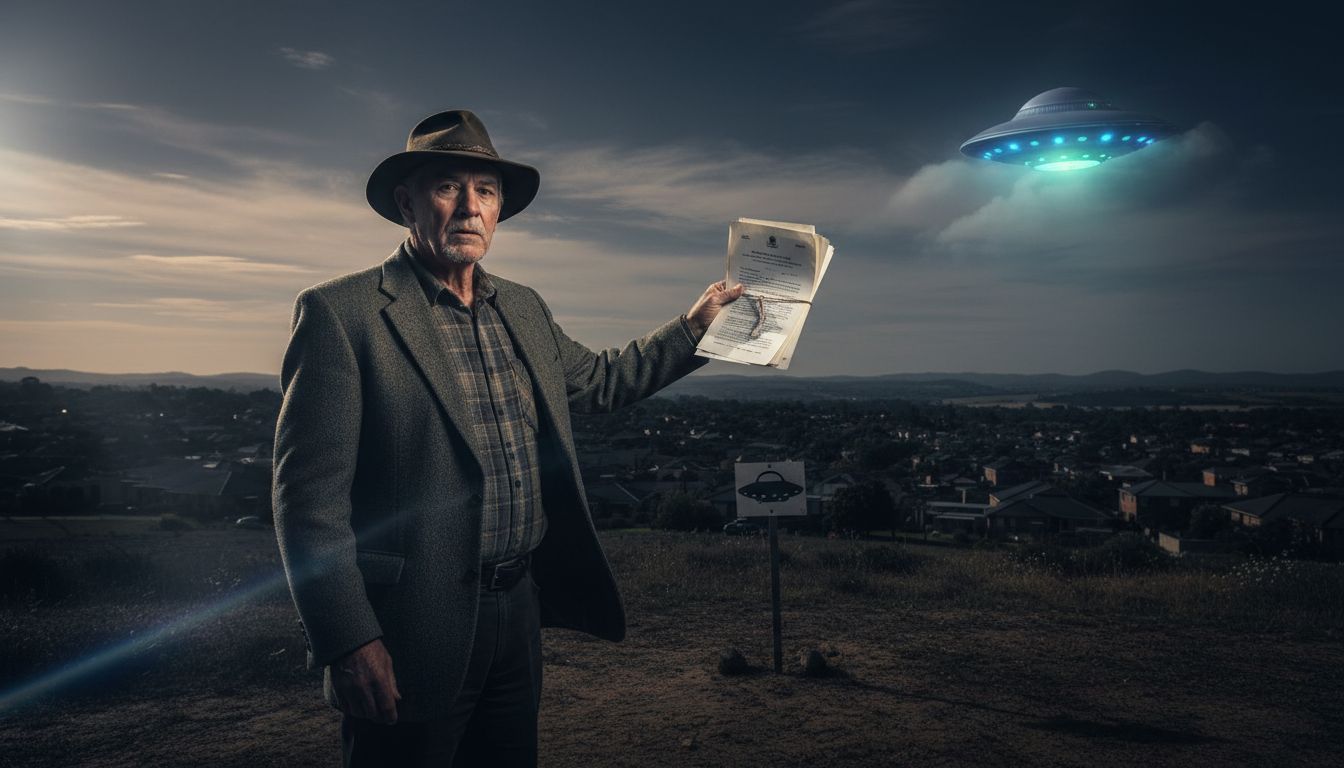
A resident of New Lambton, Dean Garner, has come forward with a detailed account of a UFO sighting he witnessed last month. Garner’s testimony is now being used to press the Australian government for the same level of transparency that the United States achieved after the Trump administration released its UFO/UAP files in 2022. The call adds momentum to an already growing public demand for the declassification of Australia’s own unidentified aerial phenomena (UAP) records.
The New Lambton Sighting
According to Garner, the incident occurred on the night of 22 February 2026 while he was walking his dog near the intersection of Lambton Road and New Lambton Road. He described a “silvery, disc‑shaped object” hovering at an estimated altitude of 1,200 metres for approximately three minutes before accelerating upward at a speed he could not gauge. “It was completely silent, and the lights on its underside pulsed in a rhythm that didn’t match any aircraft I’ve ever seen,” Garner told the Newcastle Herald. He reported that the sighting was corroborated by a neighbour who also observed a bright, moving light in the same area, though the neighbour declined to be named.
Garner filed a formal report with the Australian Defence Force’s (ADF) Unidentified Aerial Phenomena (UAP) Taskforce on 1 March. The taskforce, established in 2023, is mandated to collect, analyse, and forward credible civilian reports to the Department of Defence, but it has yet to release any findings related to the New Lambton case.
Call for Transparency
Inspired by the U.S. precedent, Garner has launched a petition demanding that the Australian government declassify all UFO‑related files held by the Defence and intelligence agencies. “If the United States can release thousands of pages of documents, why can’t Australia do the same?” he asked in a recent interview. Garner’s petition, which has already gathered over 3,500 signatures, urges the government to follow the National Archives’ 2025 decision to make non‑sensitive UAP material publicly available within a 12‑month timeframe.
Political analysts note that Garner’s appeal aligns with a broader push from Australian senators, including Senator James Paterson (Liberal), who in a 2024 Senate inquiry called for a “national UAP disclosure policy.” The petition also references the U.S. Office of the Director of National Intelligence (ODNI) report released in June 2023, which acknowledged 144 UAP incidents that could not be readily explained.
Government Response
A spokesperson for the Department of Defence responded to Garner’s request on 5 March, stating that “the safety and security of Australian airspace remains a priority” and that “any release of information will be consistent with national security obligations.” The department reiterated that the UAP Taskforce continues to evaluate civilian reports and that a comprehensive, redacted summary of its findings is slated for release to Parliament in the upcoming fiscal year.
Meanwhile, the Office of the Australian Information Commissioner (OAIC) confirmed that it is reviewing the petition’s request under the Freedom of Information Act 1982. The OAIC has not yet indicated whether a formal determination will be made, but it noted that similar requests in the past have resulted in partial disclosures after extensive redaction.
Wider Context
Garner’s case arrives at a moment when global interest in UAPs is resurging. The United States’ 2022 release of over 130,000 pages of classified material sparked renewed scrutiny of allied nations’ handling of aerial anomalies. In Europe, the UK Ministry of Defence published its own “UAP dossier” in 2024, acknowledging over 200 unexplained sightings since 2008.
Australian public opinion appears to be shifting as well. A Roy Morgan poll conducted in January 2026 found that 58 % of Australians support full disclosure of UFO-related government records, up from 42 % in 2022. Advocacy groups such as UFO Australia have cited Garner’s petition as a catalyst for a new wave of citizen‑science reporting, urging the public to submit observations through the UAP Taskforce’s online portal.
While the scientific community remains cautious, noting that most UAP reports have conventional explanations, the accumulation of credible civilian accounts—like Garner’s—continues to pressure policymakers. As the Australian Parliament prepares to debate the upcoming UAP Transparency Bill, the New Lambton sighting may prove to be a pivotal anecdote in the nation’s ongoing quest for answers.


