Overview
A new study is challenging one of paleoanthropology’s most enduring questions: what exactly did Homo floresiensis eat, and how did the tiny hominin survive on the Indonesian island of Flores? Known popularly as the “hobbit” for its unusually small stature, Homo floresiensis has long been debated as either a descendant of modern humans that shrank through island dwarfism or a much older offshoot of the human family tree. The latest research, published in Science Advances, leans toward a more surprising answer: rather than hunting large prey and cooking it, these ancient hominins may have lived partly on leftovers from Komodo dragons.
Reassessing the Flores Evidence
The central site in the debate is Liang Bua cave, where the first H. floresiensis remains were discovered in 2003 and where archaeologists have since tried to reconstruct the species’ diet and behavior. Earlier interpretations suggested the species may have hunted and processed animals, perhaps even using fire. But the new paper, led by Elizabeth Veatch of the Smithsonian National Museum of Natural History and the University of Tübingen, along with Matthew Tocheri, Thomas Sutikna, and colleagues, argues that the evidence for fire use at the cave does not belong to H. floresiensis at all. Instead, the researchers say the burnt animal bones are more likely linked to later modern humans who arrived on Flores after the species had already disappeared.
That distinction matters. Fire use is often treated as a marker of more advanced hominins, associated with species such as Homo erectus, Neanderthals, Denisovans, and ultimately modern humans. If H. floresiensis was not controlling fire, then the species may have lacked some of the behavioral traits commonly used to place it on a more “advanced” evolutionary branch.
A Predator, a Goat, and a Competing Theory
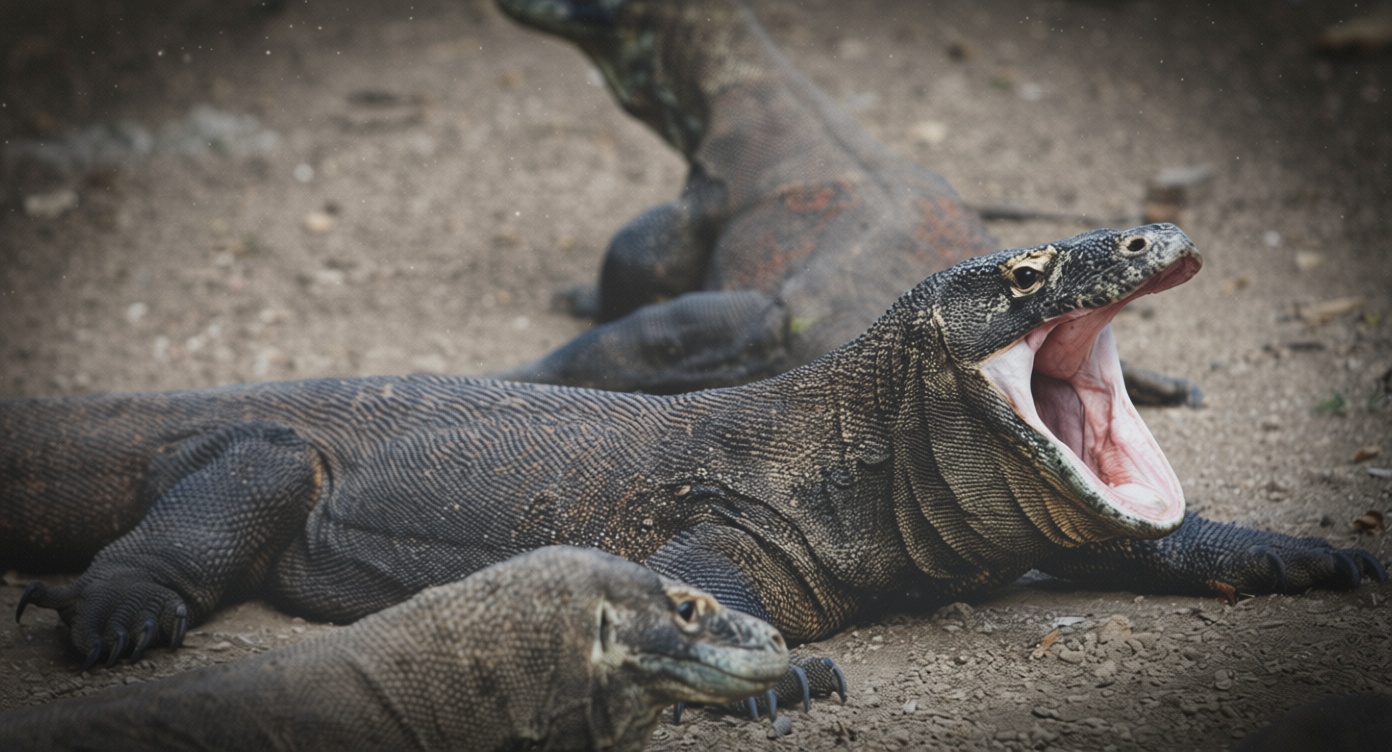
To test the new hypothesis, the researchers took an unusual approach: they served a beheaded goat to a Komodo dragon and studied the remains. Combined with a reanalysis of rat and other small-animal bones from Liang Bua, the experiment was designed to understand whether the cave’s bone assemblage reflected hunting, scavenging, or the actions of another predator entirely. The team’s interpretation is that Komodo dragons may have been the main hunters on the landscape, killing prey that H. floresiensis then scavenged rather than captured itself.
In that reading, Flores’s diminutive hominins were not apex hunters but opportunistic foragers, possibly feeding on carcasses left behind by the island’s top predator. It is a less heroic image than the traditional hunter-gatherer model, but one that may fit the available evidence more closely.
Why the Debate Still Matters
The study also feeds into a broader question that continues to animate human origins research: how many hominin lineages actually left Africa, and how diverse were they once they did? The fact that Homo floresiensis appears to have lived on Flores for more than a million years — far longer than our own species has existed — strengthens the view that it was not simply a small-bodied modern human. Instead, researchers increasingly see it as representing a deeply archaic lineage, one that may preserve a very old branch of the human family tree.
For now, the new paper does not close the book on the “hobbit” mystery. But it does sharpen the picture: Homo floresiensis may have survived not by dominating its environment, but by adapting to it, making do with raw food, island resources, and perhaps the meals abandoned by one of the most formidable reptiles still alive today.