Overview
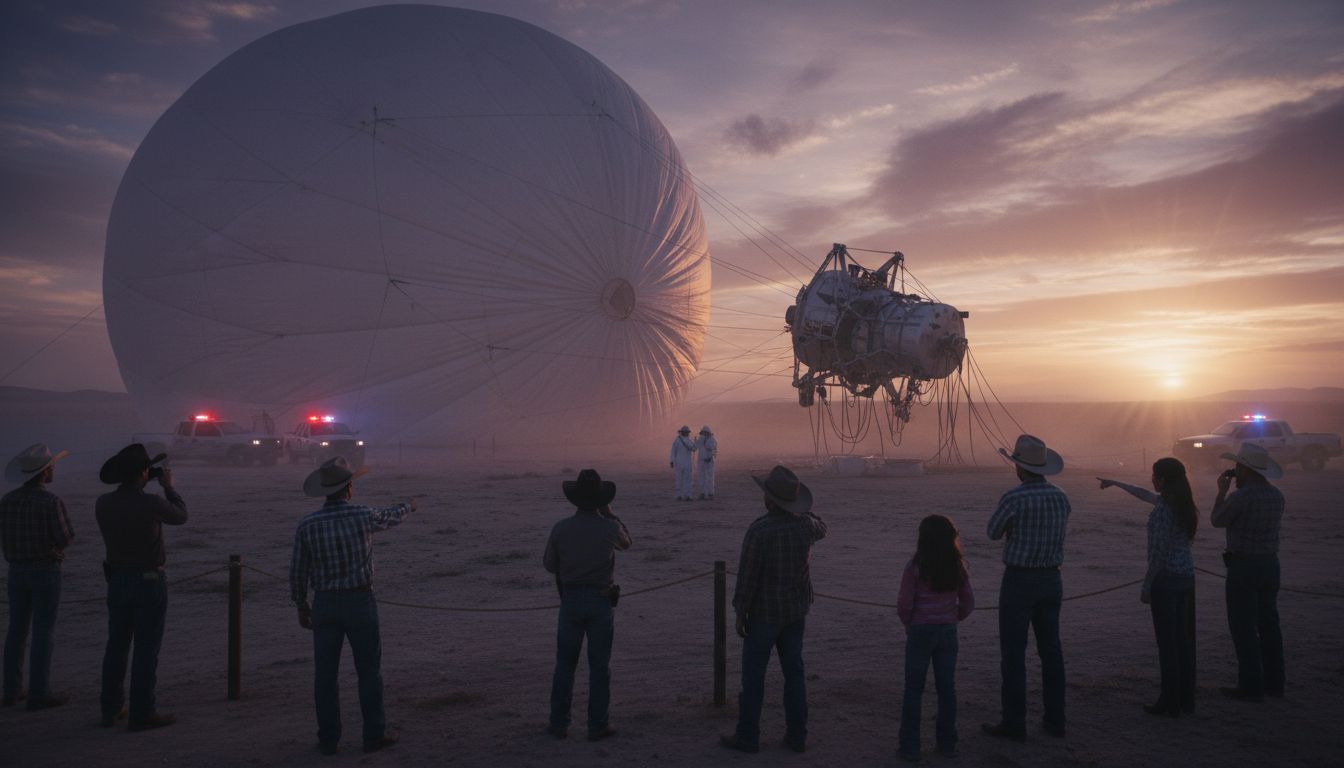
Early Thursday afternoon residents of the small West Texas community of Kermit reported a mysterious, glowing object descending from the sky and coming to rest in an open field near the town’s perimeter. Initial social‑media posts described the sighting as a “UFO” and quickly spread across regional platforms, prompting a flurry of speculation about extraterrestrial activity. Within hours, local law‑enforcement officials, the Texas Department of Public Safety, and representatives from the National Weather Service arrived on scene to assess the object and determine its nature.
Investigation
The object measured roughly 30 feet in diameter and was constructed of a lightweight, reflective fabric that shimmered in the bright Texas sun. Witnesses described a faint humming sound and a slow, controlled descent that contrasted with the erratic motion typical of conventional aircraft. Texas Highway Patrol officers secured the area and coordinated with the U.S. Air Force’s 45th Space Wing, which monitors aerospace activities over the southern United States.
“From a safety standpoint we needed to verify that the craft posed no hazard to the public or air traffic,” said Lt. Cmdr. Sarah Martinez, the officer leading the response. “Our initial visual assessment suggested a non‑threatening, man‑made balloon, but we waited for specialist input before releasing any statements.”
Official Identification
After a thorough on‑site examination, experts from the National Oceanic and Atmospheric Administration (NOAA) and the University of Texas at Austin’s Atmospheric Research Center identified the object as a high‑altitude research balloon launched for meteorological data collection. The balloon’s envelope bore markings consistent with NOAA’s “Super‑Pressure Balloon” program, which tests new materials for long‑duration flights in the stratosphere.
“The balloon is equipped with a suite of sensors that measure temperature, pressure, humidity, and wind vectors at altitudes up to 120,000 feet,” explained Dr. Elena Ruiz, a senior atmospheric scientist at the university. “It was designed to descend safely after completing its mission, and the controlled landing you observed is a standard recovery procedure.”
Both NOAA and the university confirmed that the balloon was not an experimental aircraft, a military device, or any form of extraterrestrial technology. The agency has initiated a routine post‑flight analysis to retrieve the payload and assess instrument performance.
Community Reaction
Local residents expressed a mixture of curiosity and relief once the balloon’s true purpose was confirmed. “At first we thought it was something out of a movie,” said Maria Lopez, a longtime Kermit homeowner. “But seeing the scientists come out with their equipment made it clear it was just science doing its job.”
The incident, however, reignited ongoing discussions in West Texas about the region’s frequent sightings of unidentified aerial phenomena. According to a 2023 survey by the UFO Research Center of Texas, the state averages 12 reported sightings per month, many of which are later explained as balloons, drones, or atmospheric anomalies.
Broader Context
The West Texas event adds to a growing list of high‑altitude balloon recoveries that have been misidentified as UFOs in recent years. In 2021, a similar balloon launched from New Mexico landed in Colorado, prompting a brief wave of media speculation before being clarified by NOAA. These incidents underscore the challenges of distinguishing between legitimate scientific endeavors and the public’s fascination with the unknown.
Experts caution that transparent communication from scientific agencies is essential to prevent misinformation. “When a balloon descends in a populated area, it’s natural for people to wonder what they’re seeing,” said Dr. Ruiz. “Providing timely, factual information helps maintain public trust and keeps the focus on the valuable data these missions collect for weather forecasting and climate research.”
As the research team prepares to retrieve the payload later this week, officials encourage residents to report any future aerial observations to local authorities, emphasizing that most will likely have a conventional explanation. The West Texas balloon landing serves as a reminder that, while the skies may still hold mysteries, many of today’s “UFOs” are simply tools advancing our understanding of the atmosphere.