Overview
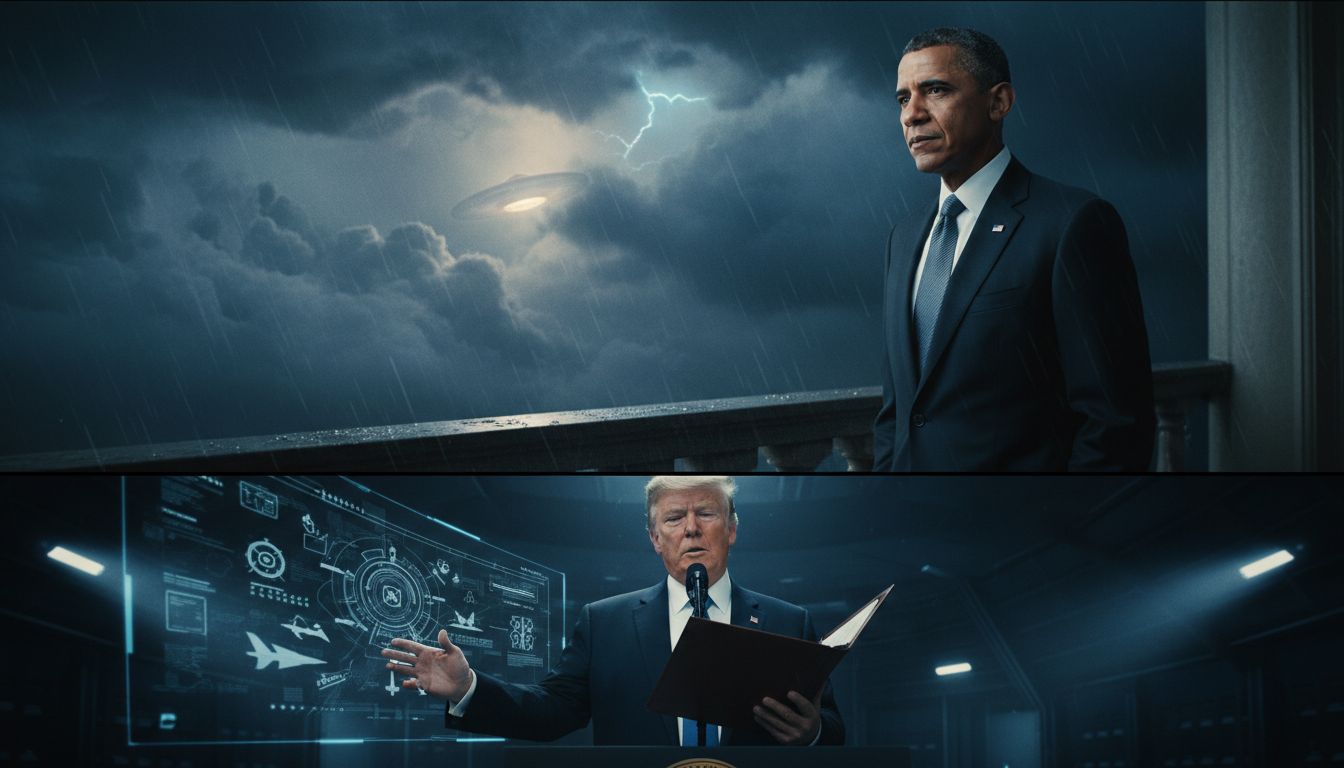
Former U.S. presidents Barack Obama and Donald Trump have recently entered the public debate on unidentified aerial phenomena (UAP), reigniting questions about how close humanity is to confirming extraterrestrial life. In a 2024 interview, Obama said that “unidentified aerial phenomena are real and deserve serious study,” while Trump posted on X that he has a prepared speech on the subject and that his administration will push the Pentagon and intelligence agencies to release any remaining classified records. Their remarks come amid a growing governmental push for transparency and a surge of scientific interest in UAP data collected over the past decade.
Former Presidents Weigh In
Obama’s comment, made during a conversation on a popular podcast, was brief but unequivocal: “We can’t dismiss what pilots and radar operators have observed. The phenomena are real, even if we don’t yet know what they are.” The former president’s statement aligns with the 2023 Office of the Director of National Intelligence (ODNI) report that catalogued 144 UAP incidents, many of which remained unexplained after analysis.
Trump, who has long hinted at a “UFO agenda,” used his social‑media platform to announce that he has a “UFO speech ready” and that his administration will direct the Department of Defense to declassify any remaining files. In his post, he added, “The American people deserve to know what’s out there, and I will make sure the truth is on the table.” While Trump’s claim has not yet been accompanied by an official briefing, it signals a willingness to accelerate the release of documents that have been the subject of congressional hearings since 2021.
Government Moves Toward Disclosure
Both statements echo a broader shift within the U.S. government. After the 2022 congressional hearing on UAPs, the Pentagon established the All‑Domain Anomaly Resolution Office (AARO) to centralize reporting from the Air Force, Navy, and other services. In February 2026, the Department of Defense announced a timeline to release a supplemental “UAP dossier” that includes additional sensor data, pilot testimonies, and analysis from civilian experts.
The anticipated files are expected to come from the National Archives, the Defense Intelligence Agency, and the Office of the Director of National Intelligence. While officials caution that the documents are unlikely to provide definitive evidence of alien technology, they may clarify the performance characteristics of observed objects—speed, maneuverability, and radar signatures—that have puzzled experts for years.
Scientific Community Response
Astronomers and astrobiologists have welcomed the increased attention but stress the need for rigorous methodology. Dr. Elena Ramirez, a senior researcher at NASA’s Astrobiology Institute, said, “UAP investigations can be valuable if they are conducted with the same standards we apply to any scientific anomaly.” She noted that the recent discovery of phosphine in the atmosphere of Venus and the detection of technosignatures in distant exoplanet spectra have already expanded the search for life beyond Earth.
Critics warn against conflating unexplained aerial observations with evidence of extraterrestrials. The American Astronomical Society’s Committee on UAPs issued a statement in March 2026 urging policymakers to distinguish between classified aerospace phenomena and the broader quest for microbial or intelligent life, which relies on different observational tools such as telescopes, probes, and laboratory analysis.
What Lies Ahead
The combined pressure from former presidents, congressional committees, and the scientific community suggests that a more transparent era for UAP information is on the horizon. If the upcoming Pentagon release includes high‑resolution video or sensor data, it could prompt independent analysis by universities and private research groups, potentially leading to peer‑reviewed publications.
However, experts agree that the existence of UAPs does not equate to proof of alien spacecraft. The path to confirming extraterrestrial life remains rooted in astrophysical observations, sample return missions, and the detection of biosignatures. The current discourse, amplified by Obama’s acknowledgment and Trump’s promise of a speech, may accelerate data sharing but is unlikely to deliver a definitive answer on aliens in the near term.
For now, the public’s “tremendous interest” is met with a measured rollout of information, and the scientific method continues to guide the search for life beyond our planet.


