Overview
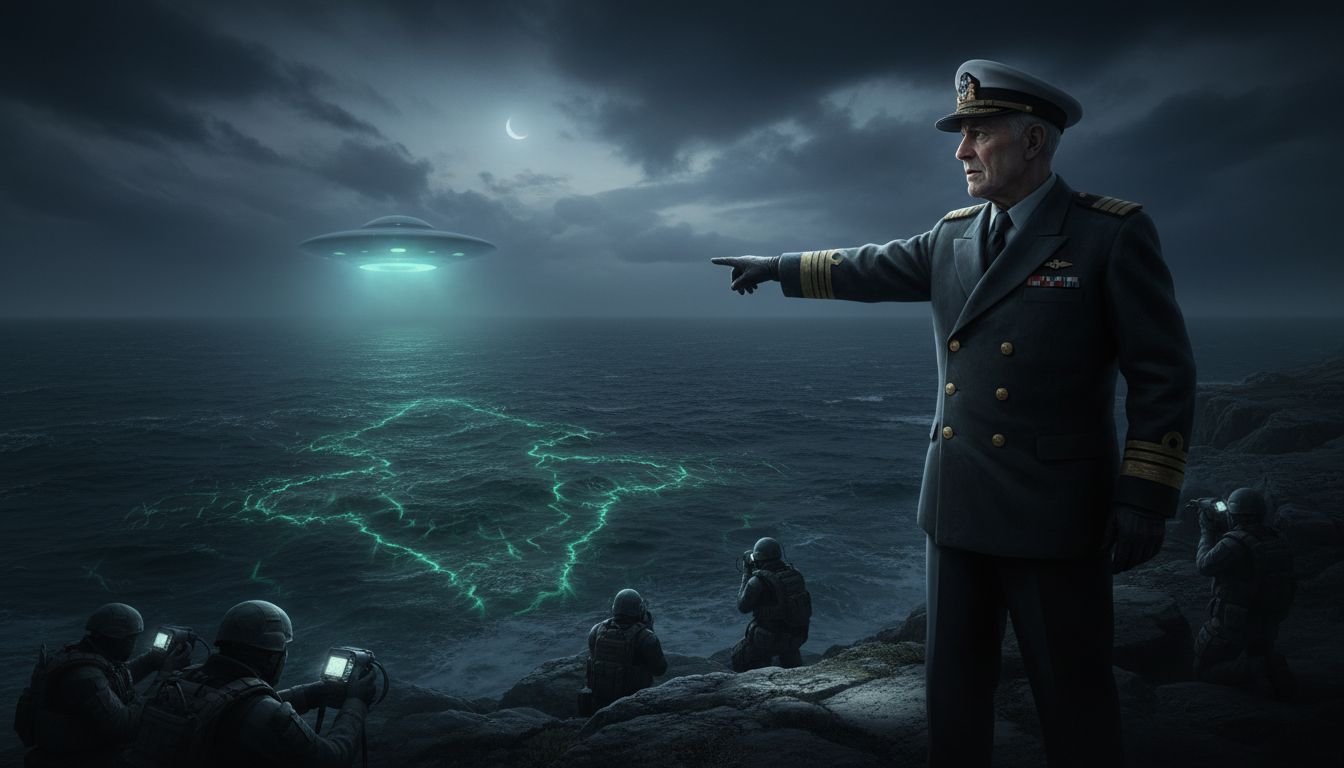
In a rare public statement, a retired U.S. Navy admiral warned that the surge of attention on unidentified aerial phenomena (UAP) has left a critical blind spot: the world’s oceans. Speaking to NewsNation on December 11, 2025, the former senior officer emphasized that “the oceans are the last frontier of unknown phenomena, and we cannot afford to ignore them.” His remarks come as the Department of Defense’s All‑Domain Anomaly Resolution Office (AARO) expands its mandate beyond the skies, yet intelligence and defense agencies still devote a disproportionate share of resources to aerial sightings.
Maritime Anomalies in Focus
Historically, UAP investigations have centered on aircraft‑level encounters, exemplified by the 2004 “Nimitz” incident and the 2023 Pentagon‑released videos. By contrast, maritime UAP reports remain sparse and fragmented, largely because they are logged within classified naval channels. In the past year, several notable incidents have surfaced: a 2024 sonar contact aboard the USS Theodore Roosevelt that produced a “high‑frequency acoustic signature” unlike any known submarine, and a 2025 video released by a commercial cargo vessel showing a luminous object hovering just beneath the surface for several minutes before vanishing. None of these events have been publicly linked to foreign adversary activity, and the lack of systematic analysis has left analysts “flying blind,” according to the admiral.
Admiral’s Call to Action
The retired admiral—identified as James H. Collins, former commander of U.S. Fleet Forces—urged the Office of Naval Intelligence, the Navy’s Undersea Warfare community, and the AARO to integrate maritime data streams into the broader UAP investigative framework. “We have sophisticated sonar arrays, unmanned underwater vehicles, and satellite‑based ocean‑surface monitoring,” Collins said. “Deploying those assets in a coordinated, transparent manner could reveal whether we are dealing with novel natural phenomena, foreign technology, or something else entirely.” He also recommended establishing a joint inter‑agency task force with NOAA, the Coast Guard, and academic oceanography programs to standardize reporting and analysis of anomalous oceanic events.
Implications for Security and Science
Beyond national‑security concerns, the admiral highlighted the potential scientific payoff of a systematic oceanic UAP inquiry. Unexplained acoustic or visual phenomena could point to undiscovered marine life, unknown physical processes, or even breakthroughs in propulsion technology. From a defense perspective, unidentified objects that can maneuver silently underwater could represent a strategic threat—potentially bypassing traditional anti‑submarine warfare defenses. The admiral’s remarks echo bipartisan congressional interest; the Senate Intelligence Committee’s 2024 hearing on UAPs specifically asked the Department of Defense to “expand its scope to include the maritime domain.”
Looking Ahead
In response to the admiral’s appeal, the Pentagon announced on December 10 that it will allocate $45 million over the next two fiscal years to upgrade undersea sensor networks and fund joint research projects with civilian institutions. AARO director Dr. Sean Kirkpatrick confirmed that a “maritime sub‑task” will be operational by mid‑2026, tasked with aggregating data from naval vessels, commercial ships, and autonomous platforms. As the U.S. grapples with an unprecedented wave of UAP disclosures, the admiral’s warning serves as a reminder that the depths of the ocean may hold clues as vital as those in the skies—and that overlooking them could leave a significant gap in both security preparedness and scientific understanding.