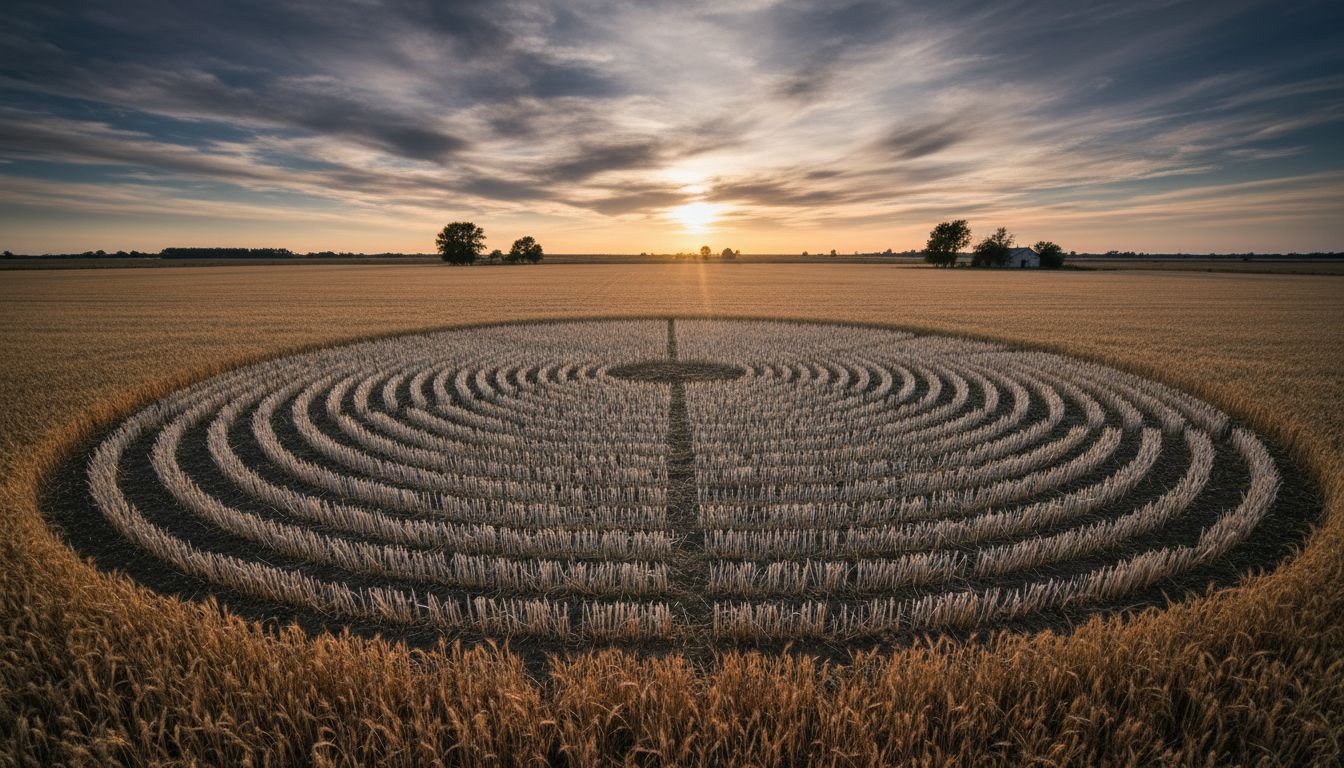
In the province of Santa Fe, Argentina, a wheat field that appeared ordinary last month now bears a series of parallel lines that have left the stalks perfectly “shelled” – the kernels are missing while the stems remain upright. The formation, which local media described as a “crop doodle,” stretches for several hundred meters and consists of straight, evenly spaced ridges that are too regular to be the result of wind or routine farming equipment. According to the farmer who first reported the anomaly, Juan Perez, “the wheat is still standing, but the grain is gone. It’s as if something lifted the kernels without crushing the stalks.”
Agronomists who examined the site quickly ruled out the most common explanations for crop disturbances. “Motorcycle tracks, rollers or any kind of pressing device would flatten the stalks, not leave them standing and stripped of grain,” said Dr. Lucía Alvarez, an agronomist with the National Institute of Agricultural Technology (INTA). Soil samples taken from the edges of the lines showed no signs of compression, and the pattern’s precision suggests an external influence that acted uniformly across the field. The investigators have therefore turned to a more cautious approach: they plan to collect soil cores before the upcoming harvest to preserve the undisturbed sections for laboratory analysis.
The Argentine case is not isolated. A similar set of unexplained lines was reported in the state of Paraná, Brazil, earlier this year, where farmers also found wheat stalks stripped of grain but otherwise intact. In both instances, the formations appeared overnight, and no conventional agricultural activity could account for the timing. “These patterns are appearing across national borders, which makes it harder to dismiss them as isolated prank or equipment failure,” noted Carlos Mendoza, a researcher at the Brazilian Agricultural Research Corporation (Embrapa). He added that the Brazilian team is also preparing to analyze soil chemistry and magnetic signatures to determine whether any anomalous forces were present.
Local authorities have taken the reports seriously enough to issue a temporary hold on harvesting the affected plots. “We want to ensure that any scientific evidence is not lost before we can conduct a thorough investigation,” said María González, a representative of the Santa Fe Department of Agriculture. The department has coordinated with university labs to perform microscopic examinations of the soil and plant tissue, looking for signs of heat, radiation, or chemical residues that might explain the sudden loss of grain.
The phenomenon has drawn the attention of UFO and unexplained‑phenomena researchers, but scientists involved in the fieldwork stress the need for rigorous data before drawing any conclusions. “Extraordinary claims require extraordinary evidence,” Dr. Alvarez reminded, echoing a principle that has guided investigations of crop circles since they first appeared in the United Kingdom in the 1970s. While the visual similarity to classic crop circles is evident, the Argentine “crop doodle” differs in that the wheat remains upright, challenging the usual theories of mechanical pressure or human‑made devices. As soil samples are taken and analyses begin, the agricultural community awaits results that could either demystify the event or add a new layer to the ongoing study of unexplained agricultural patterns.


