Overview
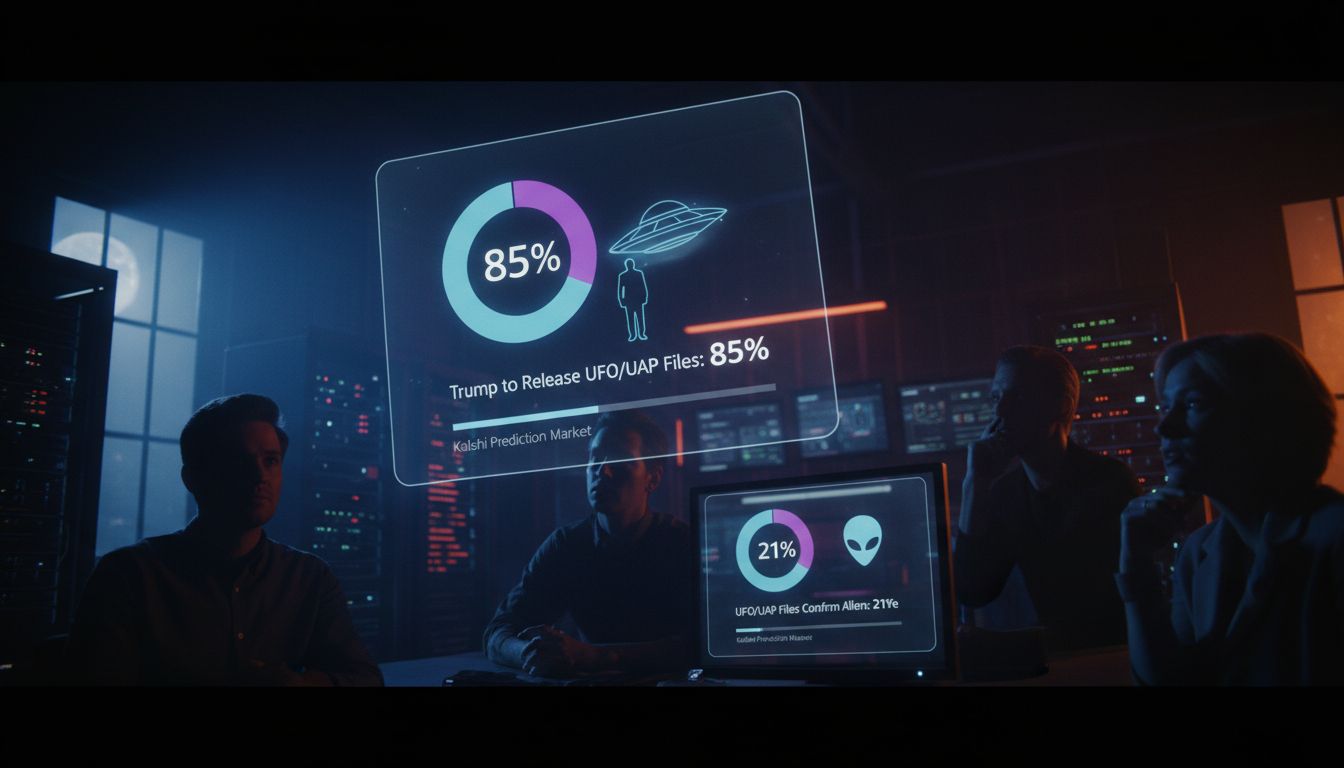
A recent prediction‑market analysis from Kalshi, a regulated U.S. exchange for event‑based contracts, shows the probability that former President Donald Trump will authorize the release of new UFO/UAP (unidentified aerial phenomena) files has risen to 85 %. By contrast, the same market places the odds that those documents will contain definitive evidence of extraterrestrial life at only 21 %. The gap underscores a strong political expectation that more material will become public, while scientific and public confidence in an “alien confirmation” remains cautious.
How the Market Works
Kalshi allows traders to buy and sell contracts that settle on binary outcomes—yes or no—based on real‑world events. The price of a contract, expressed as a percentage, reflects the collective judgment of participants about the likelihood of that outcome. In the case of the “Trump UFO release” contract, the price climbed from roughly 60 % in early March to the current 85 % after a series of political developments, including recent statements from the former president’s office indicating a willingness to declassify additional material.
A separate contract, “UFO files confirm alien life,” has lingered near the low‑20 % range. Kalshi’s senior market analyst, Megan Liu, explained, “Traders are distinguishing between the act of releasing documents and the content of those documents. The market is pricing political will higher than the probability of a groundbreaking scientific revelation.”
Political Context
President Trump, who left office in January 2021, has intermittently hinted at possessing “classified information” on UFOs that the public has not yet seen. In a recent interview with a conservative news outlet, he suggested that “the truth is out there” and that his administration had “files that would surprise many.” These remarks have spurred speculation among both supporters and critics that a formal release could be used to bolster his post‑presidential profile.
Political analysts note that the timing aligns with upcoming mid‑term elections, where national security and transparency have become rallying points for several candidates. Dr. Alan Rivera, a political science professor at Georgetown University, observed, “The 85 % figure reflects a convergence of Trump’s own statements, pressure from UFO advocacy groups, and a broader bipartisan push for more openness on UAP investigations.”
Scientific Skepticism
Despite the political momentum, the scientific community remains guarded. The 21 % odds for an alien confirmation mirror the historical pattern: previous releases—such as the 2020 Department of Defense videos and the 2021 Office of the Director of National Intelligence (ODNI) report—provided additional data but fell short of proving extraterrestrial origins.
Dr. Lisa Patel, an astrophysicist at the SETI Institute, cautioned, “Even if new files surface, the burden of proof for alien technology is extraordinarily high. Most of the material is likely to be radar or sensor anomalies, sensor malfunctions, or classified aircraft.” She added that “the market’s low confidence is consistent with the scientific consensus that extraordinary claims require extraordinary evidence.”
Outlook
The divergent odds suggest that while the political will to increase transparency on UFOs appears strong, the expectation of a definitive alien disclosure remains modest. If Trump’s administration does move forward with a release, analysts anticipate a flood of documents that could reignite congressional hearings and possibly prompt legislative action to create a permanent UAP oversight body.
However, the modest 21 % probability signals that the public and expert communities should temper expectations of a sensational revelation. As Kalshi’s data illustrate, the line between “more information” and “proof of extraterrestrials” is still a wide one, and any forthcoming files will likely be scrutinized for incremental insights rather than headline‑grabbing confirmations.


