The Document at the Center of the Dispute
A newly published analysis argues that a purported 1954 U.S. military manual about extraterrestrial crash recovery was modeled on an ordinary Army technical publication. The document, known as SOM1-01, “Extraterrestrial Entities and Technology, Recovery and Disposal,” has long been cited in UFO research as possible evidence of a secret government program called Majestic-12. The analysis, published September 24, 2026, does not establish that SOM1-01 is genuine—or that Majestic-12 ever existed—but instead examines how the document may have been constructed.
SOM1-01 first entered public discussion in 1994, when UFO researcher Don Berliner received an anonymously mailed roll of undeveloped film at his home. After processing, the film reportedly showed pages of a purported classified military manual. The document was dated April 7, 1954, identified the issuing authority as the “Majestic-12 Group,” and carried the markings “TOP SECRET / MAJIC EYES ONLY.” The package contained no letter or explanation identifying the sender, leaving the document’s origins impossible to independently verify.
Claims Made by SOM1-01
The photographed pages described procedures for securing alleged crash sites, recovering and transporting unusual technology, handling living entities and biological remains, and controlling information through witness management and official cover stories. Those claims helped make SOM1-01 one of the more prominent artifacts in the long-running Majestic-12 controversy.
The document has generally been regarded by skeptics and many researchers as a fabrication. However, some UFO investigators, including the late researcher Stanton Friedman, argued that it could represent an authentic government document. The debate has focused not only on the extraordinary subject matter, but also on the document’s typography, formatting, classification markings, numbering systems and apparent relationship to mid-century military paperwork.
The Technical Manual Comparison
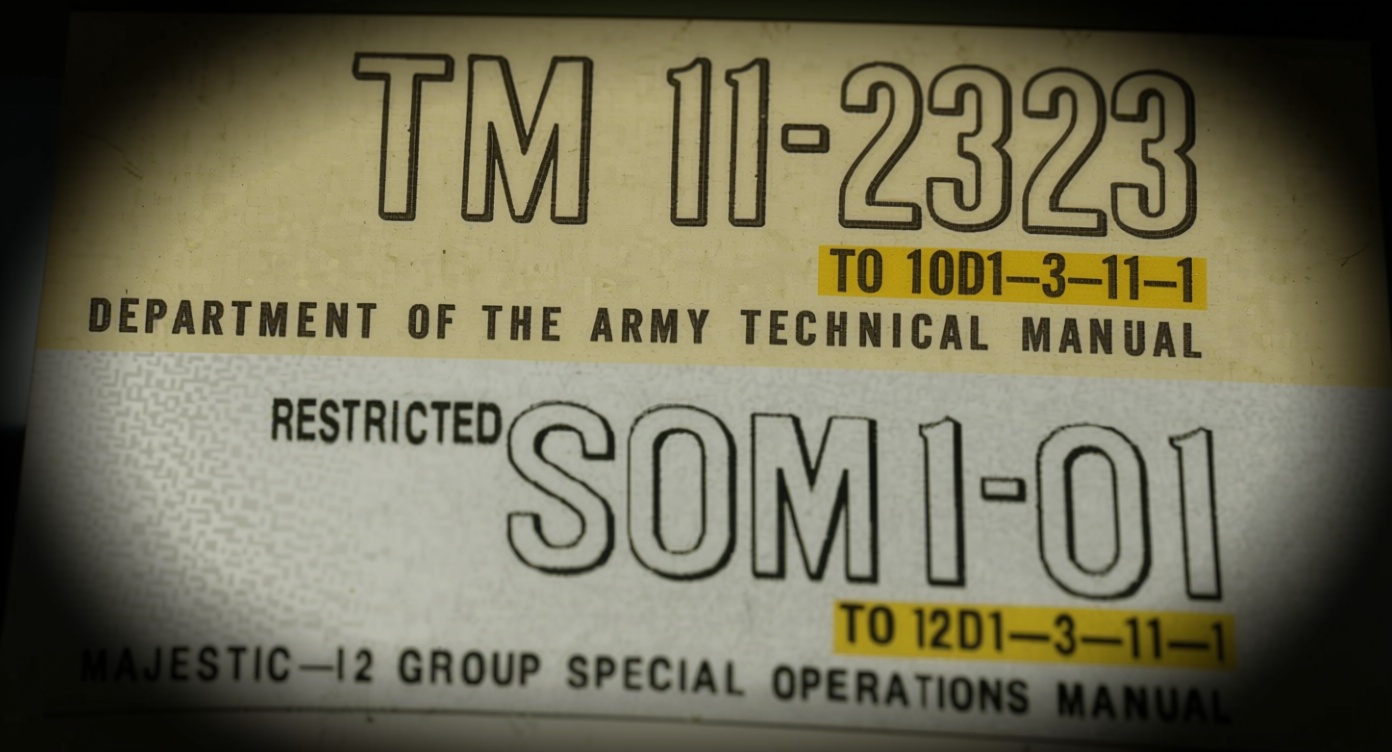
The new analysis centers on Technical Manual 11-2323, an Army publication concerning the operation, maintenance and packing of overhead projectors. Although unrelated to UFOs or intelligence operations, the manual reportedly shares a number of distinctive administrative and visual features with SOM1-01.
According to the analysis, elements appearing to have been transferred from TM 11-2323 include the issue date, technical-order numbering, printing identifiers, packaging illustrations and references. A side-by-side comparison presented in the source highlights similarities between the manuals’ covers and administrative markings. The author also examines how Army technical-manual identifiers and requisition information were used, arguing that understanding those conventions is important when assessing whether SOM1-01 reflects authentic military production.
What the Evidence Shows—and Does Not Show
Taken together, the similarities are presented as evidence that TM 11-2323 may have served as a template for SOM1-01. If that interpretation is correct, the document was likely assembled by an unknown fabricator who adapted the appearance and bureaucratic details of a genuine Army manual to give the alleged Majestic-12 material greater credibility.
That conclusion remains an assessment about the document’s construction, not proof of who created it or why. The comparison does not independently resolve the broader Majestic-12 question, demonstrate that extraterrestrial materials were recovered by the U.S. government, or authenticate the anonymous film package received by Berliner. Instead, it adds a potentially significant provenance argument to a case that has always depended heavily on indirect evidence, disputed documents and anonymous sources.