Overview
On the evening of October 30, 1938, Orson Welles and the Mercury Theatre on the Air presented a fictional radio adaptation of H. G. Wells’s The War of the Worlds. The program imagined an invasion of Earth by creatures from Mars, but its unusually realistic presentation led some listeners to mistake the drama for an unfolding emergency. The broadcast later became one of the most discussed moments in radio history, remembered both as a landmark in audio storytelling and as an example of how easily dramatic presentation can blur the line between fiction and news.
The Mercury Theatre on the Air was an independent repertory company founded in New York City in 1937 by Welles and producer John Houseman. The program aired over CBS stations at approximately 8 p.m. Eastern Time, with Welles broadcasting from the network’s facility at 485 Madison Avenue in New York. Although the broadcast included an opening announcement identifying it as a dramatization, the structure of the program made that clarification easy to miss for people who tuned in after the story had begun.
A Fictional Invasion Presented as Breaking News
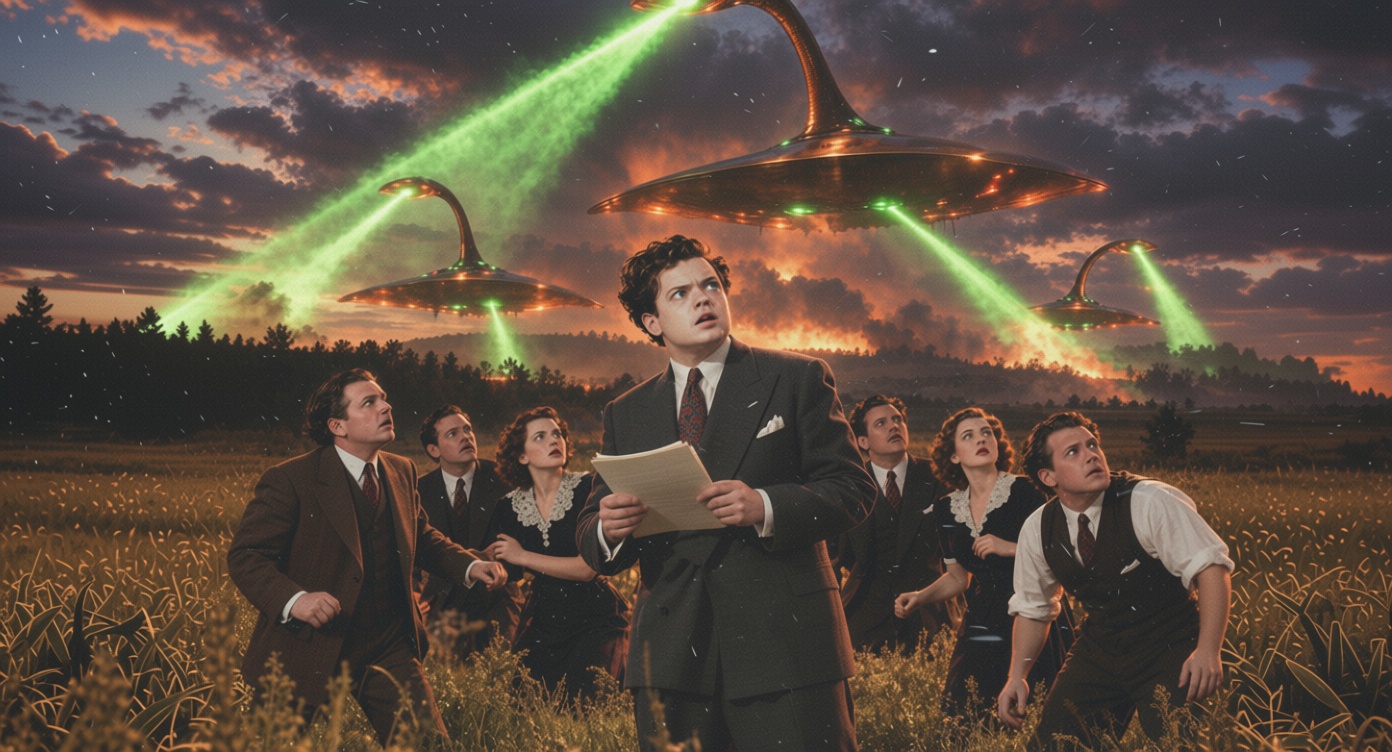
Rather than unfolding as a conventional radio play, the adaptation interrupted a fictional musical program with simulated news bulletins. The early reports described unusual explosions on Mars before shifting to an alleged landing near Grover’s Mill, New Jersey. Actors portraying reporters, eyewitnesses, government officials and military personnel delivered increasingly urgent updates as the story developed.
In the fictional account, a large metallic cylinder descended into a rural area, attracting a crowd of onlookers. The object then opened, revealing hostile creatures from Mars. Subsequent reports described towering machines—later identified as Martian tripods—moving across the countryside and attacking civilians with powerful weapons. The broadcast invoked familiar news conventions, including emergency announcements, eyewitness testimony, military reports, interruptions of regular programming and descriptions of fires, evacuations and widespread destruction.
Why Some Listeners Believed the Reports
The broadcast reached an audience at a time when radio was among the most important sources of immediate news. Listeners were accustomed to receiving reports of major events through the medium, and the United States was experiencing significant international tension in the years before World War II. Those circumstances gave the fictional bulletins an added sense of plausibility.
A listener who tuned in after the introduction could have heard what sounded like an emergency report rather than a clearly labeled drama. The gradual escalation—from reports of unexplained activity to accounts of military resistance and mass panic—also helped create the impression of a developing crisis. The program’s realism was a deliberate storytelling technique, but it carried consequences when separated from its fictional context.
Panic, Public Reaction and Later Reassessment
Newspaper accounts published after the broadcast reported confusion and fear in some communities. Listeners reportedly called police stations, newspapers and radio stations, while others contacted relatives, left their homes or gathered in churches. These reactions helped establish the broadcast’s enduring reputation as a national panic.
Later research, however, has challenged the most dramatic versions of that story. The entire country did not believe that Martians had invaded, and many listeners understood that the program was fictional. The audience was also smaller than some contemporary and later accounts suggested. Nevertheless, the calls and reports of confusion demonstrated how the realistic use of broadcast conventions could affect at least a portion of the audience.
Lasting Significance
The War of the Worlds broadcast remains significant not because it fooled everyone, but because it revealed the influence and authority radio possessed in 1938. Welles and the Mercury Theatre showed that sound, pacing and familiar news formats could create an unusually convincing fictional world. The episode continues to be studied as a case of media interpretation, public trust and the responsibilities involved in presenting simulated news—less a literal nationwide catastrophe than a powerful demonstration of radio’s ability to make imagined events feel immediate and real.