Overview
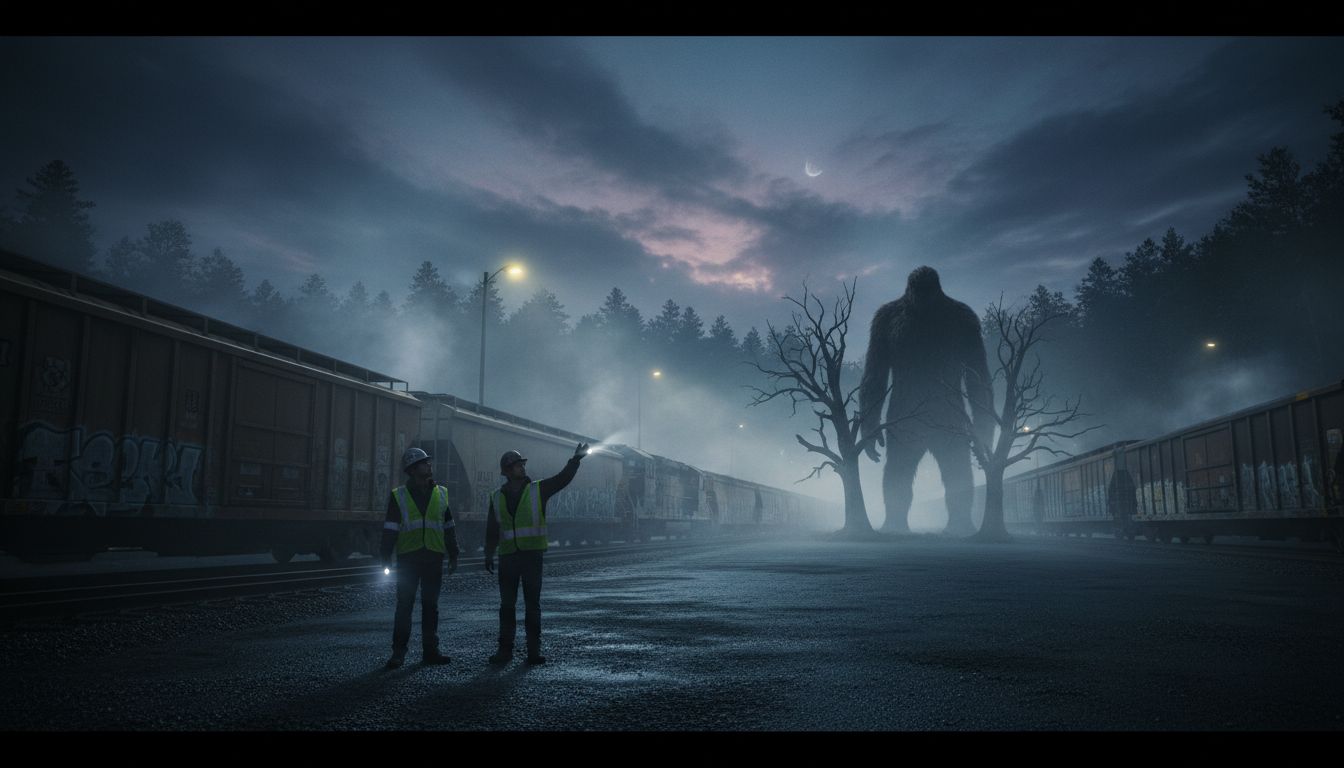
Overnight employees at the Tabler Station power plant in West Virginia reported an encounter that they describe as a classic Bigfoot sighting. On the night of April 10, two crew members working a 10 p.m.‑to‑6 a.m. shift said they observed an 8‑foot, pitch‑black figure standing roughly 400 feet from their work area. The report, first detailed in a Coast to Coast AM article by Tim Binnall on April 14, adds to a recent uptick in large‑haired humanoid sightings across North America, including a cluster of similar reports from southwestern Ontario.
Incident Details
According to the workers, who asked to remain unnamed for safety reasons, the figure was motionless for several minutes before disappearing into the surrounding woods. “It was huge—taller than any person I’ve ever seen, completely black, and it didn’t make any sound,” one employee recalled during a debrief with plant supervisors. The sighting occurred about 400 feet from the illuminated perimeter of the facility, a distance that, the workers said, allowed them a clear view despite the low light conditions. Security cameras covering the area captured no visual evidence, a fact that investigators are now reviewing for possible infrared anomalies.
Plant management reported the incident to local law enforcement, who classified it as a “non‑threatening wildlife observation” pending further investigation. The West Virginia Division of Natural Resources (WVDNR) has dispatched a field team to assess the terrain and interview additional staff, but officials declined to comment on the likelihood of a Sasquatch‑type creature being involved.
Regional Context
The West Virginia report mirrors a series of sightings documented earlier this year in southwestern Ontario, where multiple witnesses described 7‑ to 8‑foot, hairy figures moving through forested areas near the Niagara Escarpment. Researchers from the North American Bigfoot Research Association (NABRA) note that this region has not seen a concentration of such reports since the 1970s, a period often referred to as the “golden era” of Sasquatch investigations. “The clustering of sightings in two geographically distant but ecologically similar zones is intriguing,” said Dr. Elaine Martinez, a wildlife biologist who has consulted on the Ontario cases. “Both areas feature dense, mixed‑hardwood forests and limited human traffic at night, which could create conditions conducive to misidentification or, alternatively, to the presence of an unknown large mammal.”
Skeptical Perspective
Skeptics caution against jumping to conclusions. Dr. Richard Haines, a professor of zoology at West Virginia University, points out that “large, dark silhouettes can be produced by a variety of sources—misidentified bears, moose, or even optical effects caused by low‑light conditions and the human eye’s tendency to fill in gaps.” He adds that the lack of photographic or video evidence makes it difficult to substantiate the claim. The Mutual UFO Network (MUFON), which also tracks cryptid reports, has classified the West Virginia incident as “unverified” and recommends a systematic field survey before assigning any taxonomic label.
Next Steps
Authorities plan to conduct a comprehensive site survey at Tabler Station over the next two weeks, employing motion‑activated infrared cameras and environmental DNA (eDNA) sampling to detect any unknown fauna. Meanwhile, the West Virginia Department of Tourism has expressed interest in the story, noting that “responsible reporting of such phenomena can boost local interest without compromising scientific integrity.” As the investigation proceeds, both proponents and skeptics agree that rigorous data collection will be essential to determine whether the sighting represents a genuine unknown species, a case of mistaken identity, or a hoax.
The Tabler Station incident underscores the enduring fascination—and controversy—surrounding cryptid reports in the United States and Canada. Whether the figure observed was a misidentified bear, an undiscovered primate, or a fabricated story, the episode highlights the need for methodical, evidence‑based inquiry in a field often clouded by folklore and speculation.


