Overview
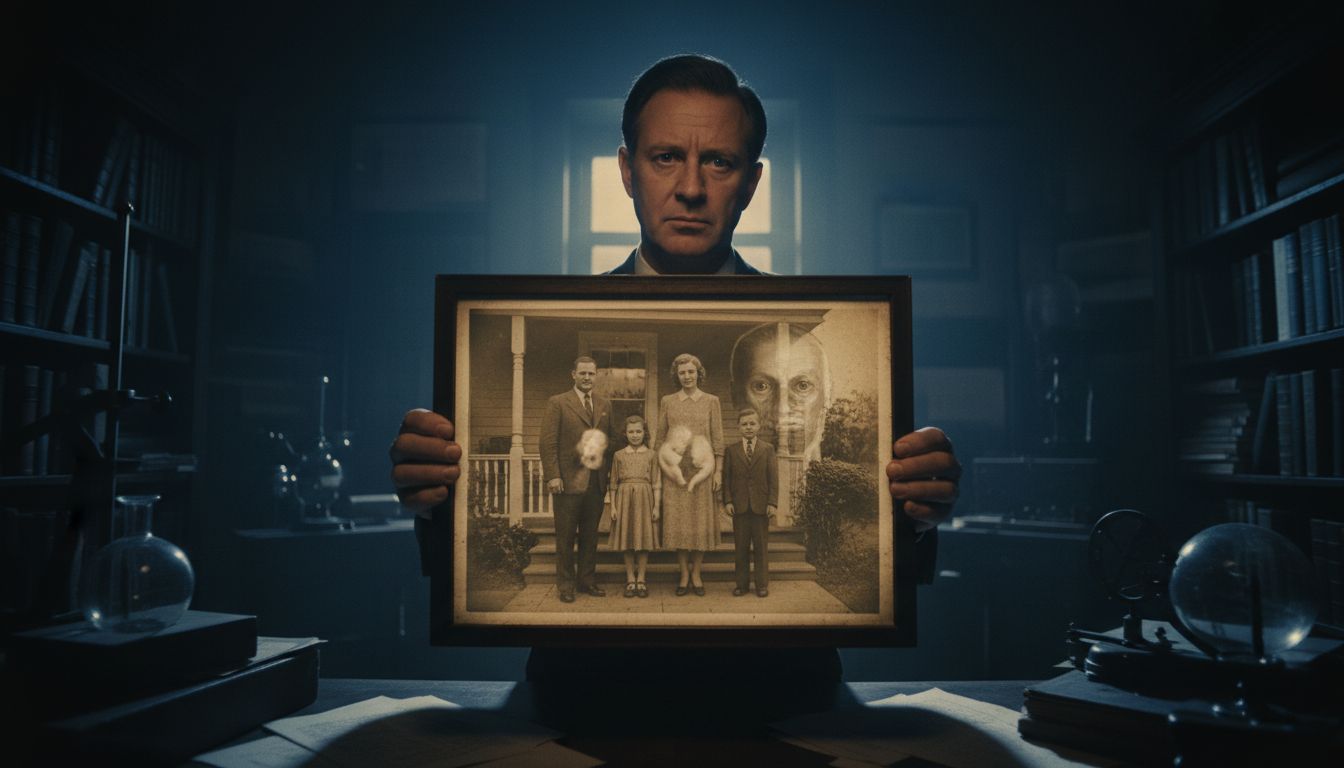
A photograph from a 1940 family album has become the focus of intense discussion among UFO and paranormal researchers after investigative journalist and filmmaker Paul Davids highlighted its unusual composition on the Coast to Coast AM platform. Davids describes the image as appearing to contain multiple overlapping exposures: a faint silhouette of an unidentified blond woman, a ghostly representation of what he interprets as unborn children, and a later‑life, age‑progressed portrait of the family’s matriarch. The claim has ignited debate over whether the picture is a genuine anomaly, a product of early photographic manipulation, or an elaborate hoax.
The Photo and Davids’ Claims
The original negative, reportedly taken by an amateur photographer in a Midwestern United States home, shows a typical family portrait: a mother, father, and two children seated on a couch. Davids points out that, upon close inspection, the background contains subtle, semi‑transparent figures that do not belong to the original scene. One figure—a woman with light hair and a 1930s‑style dress—appears positioned behind the family, while another faint shape seems to outline a pair of fetal silhouettes near the mother’s abdomen.
Davids argues that the “fetal” images could represent unborn children that never came to be, and that the blond woman might be a psychic or “thought‑projected” entity. He also notes that a later addition to the album shows the same mother, now elderly, seemingly age‑progressed in a way that aligns with the earlier ghostly figure. “When I first saw the overlay, it felt like the photograph was trying to tell a story beyond the ordinary,” Davids said in a recent interview. He has not released the high‑resolution scan, citing concerns about digital manipulation.
Historical Context: Thought‑Photography Experiments
Davids references early 20th‑century experiments in “thought‑photography,” most notably the 1913 Nensha case in Japan. In that incident, a group of researchers claimed to capture images of subjects purely through mental focus, producing faint, double‑exposed silhouettes on photographic plates. While the Nensha photographs were later dismissed by mainstream scientists as deliberate double exposures or misdeveloped plates, they have persisted in paranormal literature as early examples of alleged mind‑controlled imaging.
The 1940 photograph fits within this lineage, prompting scholars to ask whether advances in double‑exposure techniques—common in the 1930s and 1940s for artistic effect—could unintentionally produce the observed anomalies. “Photographers of that era frequently experimented with multiple exposures to create ethereal images,” explains Dr. Elaine Marsh, professor of photographic history at the University of Chicago. “Without proper documentation, it’s easy for a later viewer to interpret those artistic choices as something supernatural.”
Expert Opinions and Skeptical Analysis
Skeptics caution against jumping to paranormal conclusions. James Whitaker, a forensic imaging specialist with the National Archives, notes that “any film negative can retain latent images if the developer does not fully clear the emulsion between exposures.” He adds that the presence of a blond figure could simply be a second portrait accidentally superimposed during the printing process.
Conversely, Dr. Miriam Patel, a parapsychologist at the Rhine Institute, argues that the photograph’s consistent alignment of the fetal silhouettes with the mother’s abdomen—despite the grain of the film—suggests intentionality beyond accidental double exposure. “If the overlay were random, we would expect misregistration,” Patel says. “The fact that the shapes appear centered and proportionate raises the possibility of an unknown imaging phenomenon.”
Public Reaction and Ongoing Investigation
Since Davids’ segment aired, the image has been shared across UFO forums, photography enthusiast groups, and mainstream social media. Some users have attempted to enhance the scan using open‑source software, reporting varying degrees of clarity in the ghostly figures. Others remain unconvinced, pointing out that digital enhancement can create artifacts that were not present in the original negative.
Davids has announced plans to collaborate with a conservation lab to produce a non‑invasive chemical analysis of the original print, aiming to determine the number of exposures and any chemical anomalies. The outcome could either substantiate the claim of a multi‑layered exposure or confirm a single, conventional photograph later altered.
Conclusion
The 1940 family photograph highlighted by Paul Davids sits at the intersection of historical photographic practice and contemporary paranormal inquiry. While the image’s layered appearance is undeniably intriguing, experts agree that definitive conclusions require rigorous scientific testing. Whether the photo ultimately proves to be an early example of thought‑photography, a clever double exposure, or a modern hoax, its emergence underscores the enduring human fascination with visual evidence of the unseen. As the investigation proceeds, the case will likely continue to serve as a touchstone for discussions about the limits of photographic technology and the boundaries of belief.


