Overview
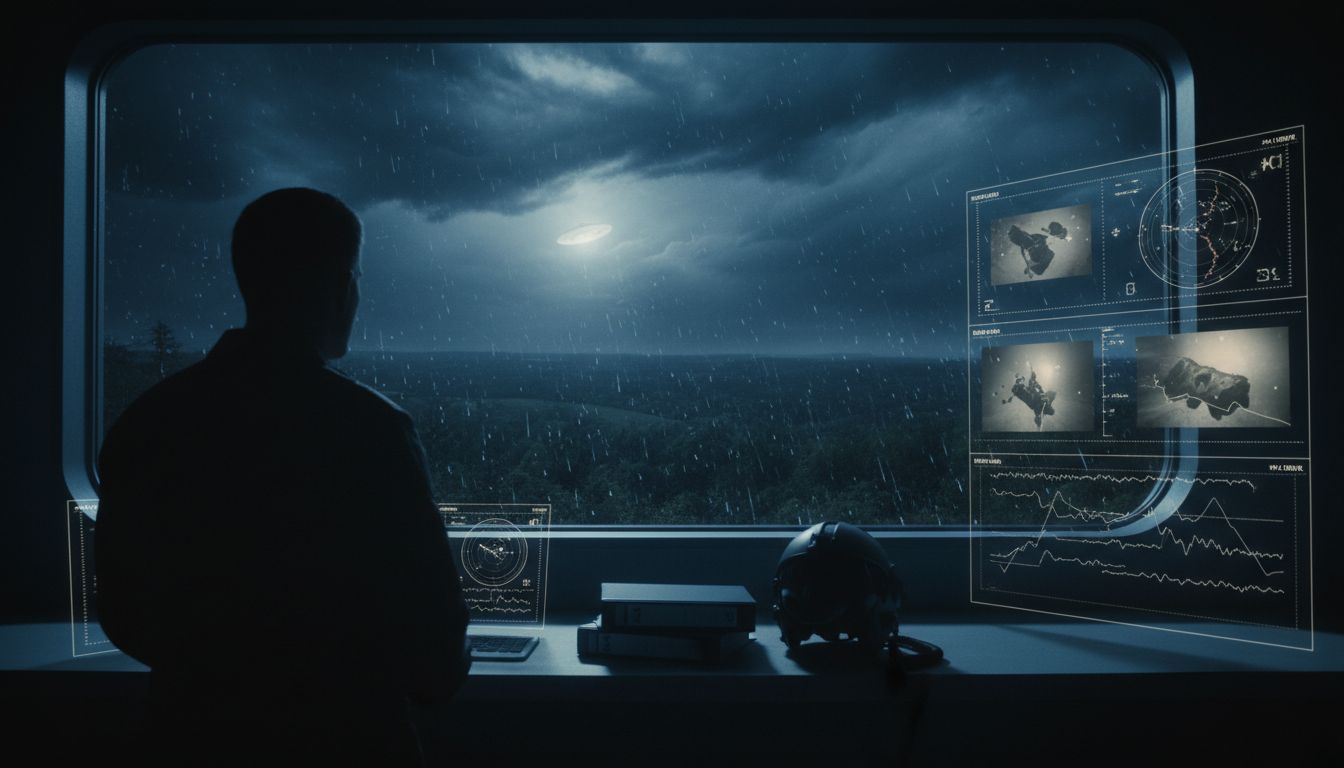
The Pentagon’s latest batch of declassified documents on unidentified anomalous phenomena (UAP) has reignited public interest in a long‑standing pattern of sightings across Connecticut. While the newly released files provide fresh technical data—radar tracks, pilot testimonies, and high‑resolution imagery—they do not resolve the many unanswered questions surrounding the state’s most recent reports. The National UFO Reporting Center (NUFORC), which has catalogued more than 2,100 incidents nationwide since its 1974 inception, logged three Connecticut sightings in 2026, adding to a half‑century of unexplained observations in the region.
Pentagon Release
The documents made public on Friday stem from a multi‑year effort mandated by the 2022 congressional directive to increase transparency on UAP encounters. Among the highlights are:
- Buzz Aldrin’s 1969 Apollo account of a “fairly bright light” that appeared to follow the spacecraft for several minutes.
- An Aegean Sea incident captured by naval radar, describing an object that executed “multiple 90‑degree turns” at high speed.
- A Kazakhstan observation of a “glaringly bright object” performing corkscrew maneuvers over the sky.
These entries mirror the format of earlier releases, pairing raw sensor data with narrative statements from eyewitnesses. The Pentagon’s 2024 UAP assessment, referenced in the release, concluded that none of the examined cases provided verifiable evidence of extraterrestrial technology, but it emphasized the need for continued scientific scrutiny.
Connecticut Sightings in Detail
NUFORC’s database lists three notable 2026 incidents in Connecticut:
Seymour (February 2026) – A “fast‑moving orb” was observed crossing the night sky. The witness reported, “Thought it was a satellite but then a second one quickly approached it. They matched speed and crossed over each other.” Radar logs from the nearby Bradley International Airport show a transient blip consistent with the described motion, though the return was too brief for definitive classification.
Westport (December 2025) – A driver on the highway described an “intense red dot” that hovered momentarily before vanishing. The sighting coincided with a brief geomagnetic disturbance recorded by the local magnetometer network, a factor analysts are still evaluating.
Hamden (June 2025) – Multiple objects were reported moving in coordinated formations, at times forming a “crescent moon pattern” with flashing colors. Several amateur astronomers captured low‑resolution video that, when analyzed, revealed erratic trajectory changes not typical of known aircraft or weather balloons.
These reports, while anecdotal, align with the broader pattern of UAP activity noted in the Pentagon’s files—particularly the emphasis on rapid directional changes and luminous characteristics.
Expert Analysis
UAP researcher Dr. Emily Carter, senior analyst at the Center for Aerospace Studies, cautions against drawing premature conclusions. “The Pentagon’s declassified material adds valuable context—especially the radar signatures and pilot observations—but it also underscores the complexity of distinguishing genuine unknowns from sensor artifacts or atmospheric phenomena,” she said.
Similarly, Lt. Cmdr. James Ortega, a former Air Force intelligence officer now consulting for the Congressional UAP Task Force, notes that the Connecticut incidents “fit within the statistical envelope of low‑altitude, short‑duration events that have been reported nationwide.” He adds that the lack of corroborating data (e.g., multiple sensor modalities) limits the ability to assess threat levels or origins.
Looking Ahead
The Pentagon’s ongoing declassification effort, driven by the 2022 mandate, is expected to yield additional files over the coming months. Federal agencies are coordinating with state and local authorities to improve reporting mechanisms, encouraging witnesses to submit timely, sensor‑backed evidence. NUFORC has updated its online portal to accept high‑definition video and raw radar logs, aiming to bridge the gap between civilian reports and military data.
For Connecticut residents, the recent releases may prompt renewed scrutiny of nightly skies, but officials stress that systematic investigation, rather than speculation, remains the cornerstone of understanding UAP phenomena. As the data pool expands, researchers hope to move beyond anecdote toward a scientifically grounded assessment of these enduring mysteries.


